

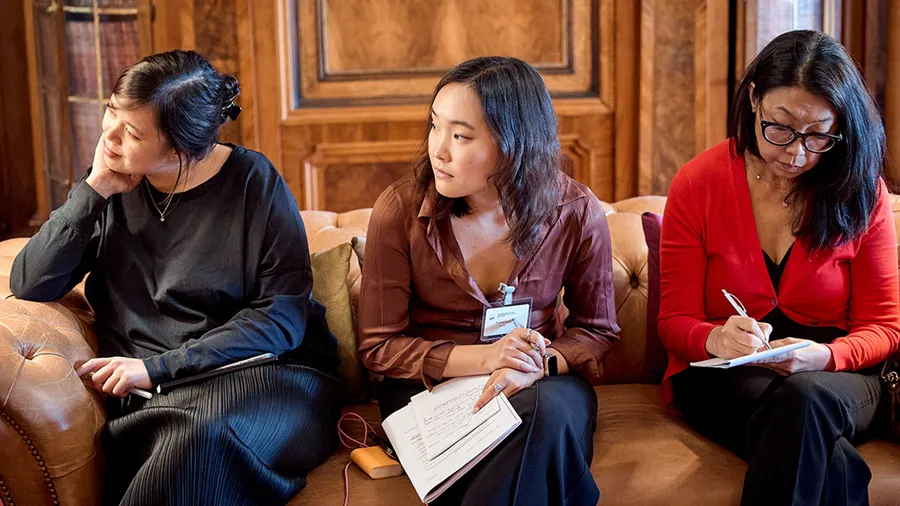
Salzburg Global Fellow Temuulen Enkhbat shares her learnings about Asian American identity through community, culture, and education
This article was written by Salzburg Global Fellow Temuulen Enkhbat, who attended the Salzburg Global American Studies program on “Crossing the Pacific: The Asian American Experience in U.S. Society and Discourse” in September 2024. Temuulen's attendence was made possible thanks to the generous support of William J. Reckmeyer and Joan Reckmeyer through the Reckmeyer Family Fellowship.
Asian Americans are often regarded as one of the highest-income earning and most well-educated racial groups in the U.S. While it is true that many Asians migrate to the U.S. for better education and employment opportunities, the experiences of some minority racial groups are overshadowed by stereotypes about Asian Americans in U.S. society. Through the Salzburg Global American Studies program on “Crossing the Pacific: The Asian American Experience in U.S. Society and Discourse”, I explored what it means to be truly Asian American from an outsider's perspective.
In 2021, I was among the few exchange students from Asia at Ball State University in Muncie, Indiana. Through my major in Urban Planning and Development, I met Professor Nihal Perera, who had an immense impact on how I approach community building in urban development. As someone who was born in Sri Lanka and moved to the U.S. 35 years ago, he fostered a deep appreciation for diverse cultures in the U.S.
One of my most significant exposures to Asian American communities in the U.S. was during a field visit with him and his master’s students to Myanmar communities in Fort Wayne, Indiana. The visit included a refugee camp used as housing for Myanmar nationals, a summer school for the Mon community, and several Buddhist temples on the outskirts of the city.
The biggest challenge for minority ethnic groups living in Western countries is to fit in without losing cultural roots. During my conversation with the head teacher of the summer language school, he emphasized the importance of the older generation educating the younger generations to preserve the language and culture. Many younger Mons do not speak their language now, but Mon leaders are determined to preserve it through teaching at this Buddhist monastery school.
How or why someone migrated has a tremendous effect on their life experiences in the U.S. Young people seeking higher education or employment opportunities elsewhere often move to the U.S. by choice, meaning they still have the freedom to return to their country of origin. However, there is a large number of migrants from countries affected by famine, war, or genocide, like in Myanmar; these people are forced to flee from their homes for survival.
This difference is one of the many reasons why the Asian American community is immensely diverse and should not be generalized, according to Dr. Gary Mukai, Director of the Stanford Program on International and Cross-Cultural Studies (SPICE). Dr. Mukai, a third-generation Japanese-American, has dedicated his life to educating younger generations on cross-cultural issues and has often drawn upon his experience as an Asian American.
“When we think about the Asian American community broadly, one notable thing is the challenge of preserving the culture of their ancestral homelands. It does require a constant effort to keep their culture, including language and religion, vibrant and to transmit it from generation to generation,” he said while reminiscing about his childhood as an Asian American.
Growing up in a Buddhist household, he struggled with going to a Buddhist temple on Sundays because it made him feel different than most of his Christian friends. When he entered college, he started taking courses in Asian-American studies and began to appreciate his roots and heritage. This led him to live in Japan shortly after graduation and teach English there while learning about his heritage.
Similar to Dr. Gary Mukai, Angela Yao, a second-generation Chinese-American, grew up rejecting much of her Asian identity because her neighborhood was predominantly Caucasian. The situation changed once she started college and began living with many Asian Americans who had already embraced their identity and were proud of it. Suddenly, she was surrounded by a diverse group of people who were comfortable discussing their culture and heritage. That’s when she felt more left out than ever.
It is difficult to generalize the Asian American experience since every country of origin has a different relationship with American society. “Community aspect is crucial because a lot of the loss of culture comes from the isolation of having to be one of few people representing something different, which can be overwhelming for young people settling somewhere for the first time,” said Angela Yao.
Despite geopolitical issues and cultural and language barriers, education and having a sense of community hold immense power in creating a truly equitable society. To foster an environment where everyone feels welcomed and accepted, the education system must offer a curriculum that is culturally relevant from the earliest stages of education. This requires a deliberate focus on the diversity within Asian American communities, acknowledging their unique issues, challenges, and triumphs.
Additionally, having a sense of belonging to a community that represents minority voices and experiences is crucial for embracing one's cultural roots. I believe we can empower future generations to appreciate and celebrate differences, ultimately building a more inclusive and harmonious world. In this way, education and community not only bridge divides but also lay the foundation for a society that thrives on diversity and mutual respect.
Temuulen Enkhbat is an urban practitioner working as a program lead at GerHub, a social innovation nonprofit based in Ulaanbaatar, Mongolia. She works to find innovative, grassroots solutions to urbanization challenges through placemaking, community engagement, and youth participation, focused on informal settlements. As an active member of the community, she works as a vice-curator of Global Shapers Ulaanbaatar Hub, leading several initiatives to increase green space accessibility in Ulaanbaatar and improve youth employability. Temuulen has represented the North Asia region in the World Economic Forum's Annual Meeting. She is also a member of the Youth Advisory Board of 1t.org and was selected for the LeadNext Program from the Asia Foundation in 2023.
Our digital publication includes more coverage from the Salzburg Global American Studies program on “Crossing the Pacific: The Asian American Experience in U.S. Society and Discourse”.
