

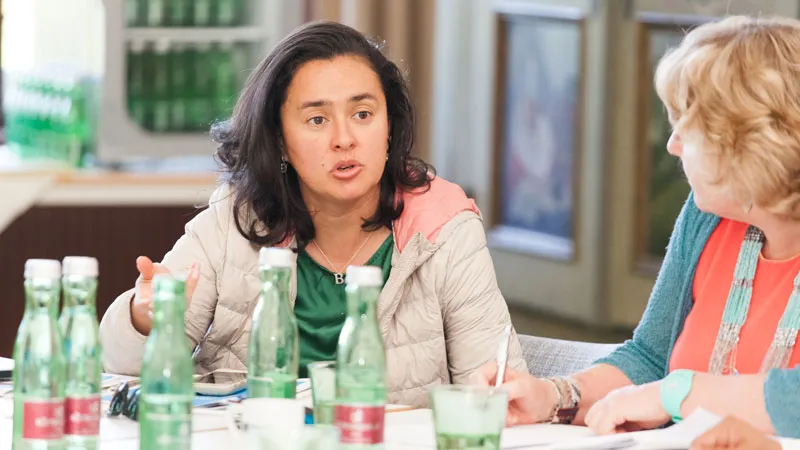
Director for government and strategic areas in Colombia discusses balancing the challenges facing the public sector after decades of conflict
In June 2016, the Colombian government and the Revolutionary Armed Forces of Colombia (FARC), the country’s largest rebel group, signed a ceasefire and disarmament agreement, a forerunner to a peace deal that was later signed in September. This formally brought to an end more than 50 years of armed conflict. One month later, voters were asked whether the peace deal should be approved. In a surprising turn of events, this deal was rejected by the people, some of whom believed the conditions to be too favorable toward FARC. The agreement was revised and signed again in November. In June this year, FARC formally ended their existence as an armed group.
This is one of the myriad challenges the Colombian government has had to face, but the implementation of this agreement is “only one issue,” according to Paula Acosta, director for government and strategic areas in the Office of the Presidency of the Republic of Colombia. Acosta is responsible for monitoring the strategic goals of the president and the cross-cutting coordination of his regional strategic initiatives. While she described the implementation as a “tremendous challenge,” she also recognized there were other areas which required attention.
Acosta made this observation while attending the sixth Public Sector Strategy Round Table – In the Spotlight: How Can the Public Sector Excel Under Changing Dynamics? Speaking to Salzburg Global Seminar during the session, she said, “I believe once you’re in government, you get to focus on the day-to-day. I see this [session] as a great opportunity to actually be able to look a little bit ahead. That’s also part of what public servants are supposed to do. It’s not only attending the fire that’s in front of them.”
The implementation of the peace agreement with FARC has already begun. Acosta said, “The main priority today in Colombia is to actually implement the agreement and to continue with all of the other policies. Although [the peace agreement] is probably the most important issue, it is only one issue. Then you have to keep on governing all of the other sectors and all of the other programs.”
Acosta said this was a “very hard balance” as it presented a question of how you distribute resources. Gaining credibility to the implementation of the agreement is as important as being able to sign the agreement itself. While the implementation began more than seven months ago, Acosta said it was too soon to draw any lessons from the process.
The main focus remains on keeping the government running. Acosta said, “Peace is such a big issue in Colombia. We have this over 50-year conflict, so everyone wants to work in peace, but it’s not the only thing.” Acosta said Colombia’s main cities had faced the “truths of the conflict” for many, many years but the government had to maintain its focus on running all of the other departments. She said, “Finding that balance, it is I think the main challenge that I have to help to coordinate because it is a network for many different parts within the government.”
The discussions at Salzburg Global provided participants the opportunity to hear of similar, and different problems faced by the public sector in other countries.
Acosta said, “There are a number of different countries here but most of the representatives come from very developed countries that pose a set of questions that we usually do not formulate ourselves.”
Remaining part of the network was “the most important thing,” according to Acosta, and to fully understand the consequences and the deep causes of the challenges being faced by the public sector, more time would be needed than just one – albeit very fruitful – weekend in Salzburg.
Paula Acosta attended the sixth meeting of the Public Sector Strategy Round Table – “In the Spotlight: How Can the Public Sector Excel Under Changing Dynamics?”. This meeting was convened by Salzburg Global Seminar in partnership with the Abu Dhabi Crown Prince Court and apolitical, and with the support of Chatham House. More information on the session can be found here.
