
-
Topics
TopicsOur programs create spaces where open-minded leaders can gather for breakthrough conversations on pressing global issues – each aligned to one of the following pillars:Get Involved
-
Events
EventsExplore the variety of events Salzburg Global hosts within Austria and in the rest of the world. Learn more about our programs and what else happens at Schloss Leopoldskron.Upcoming EventsSep 06 - Sep 11, 2026EducationA Tale of 2000 Days: New Partnerships in Early ChildhoodEducation for Tomorrow's WorldOct 05 - Oct 07, 2026Finance & GovernanceA Multipolar & AI-Driven World: Are New Approaches Needed To Preserve Profit and Public Trust?Salzburg Global Corporate Governance Forum
- Insights
-
Fellowship
FellowshipSince 1947, more than 40,000 people from over 170 countries have participated in Salzburg Global's sessions. Collectively, these alumni are known as Salzburg Global Fellows.
-
About Us
About UsSalzburg Global is an independent, non-profit organization committed to creating spaces that overcome barriers and open up a world of better possibilities.Our Approach
-
Support Us
Support UsYour generosity helps us gather open-minded leaders for breakthrough conversations, while creating space for dialogue that overcomes barriers and opens up a world of better possibilities.
- Donate

Finance & Governance
Report
Our Key Insights: The Future of Money: Balancing Competition and Resilience in the Evolving Tech Landscape
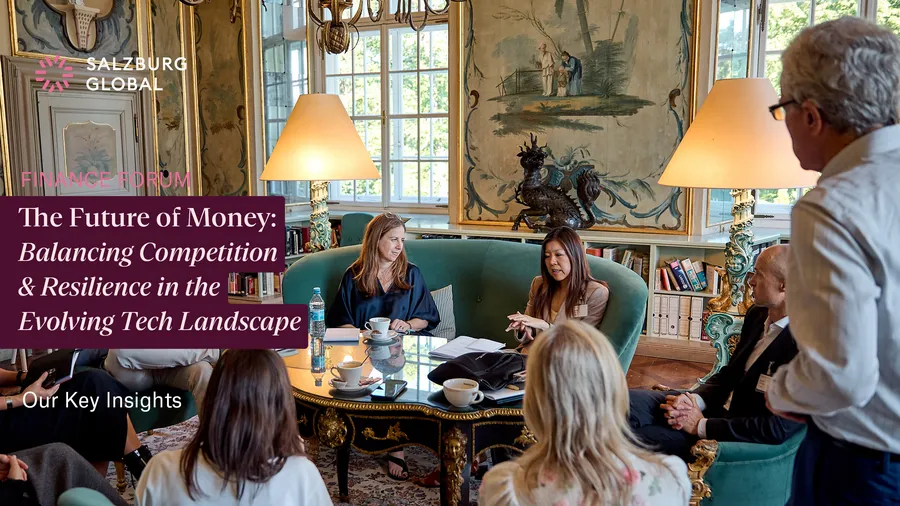
The 16th annual session of the Salzburg Global Finance Forum on "The Future of Money: Competition & Resilience Across New Financial Frameworks" convened from June 15 to 17, 2026, at Schloss Leopoldskron in Salzburg, Austria. Fellows tackled a critical question: How can financial regulators and market participants manage geopolitical shifts and balance competition and resilience across a rapidly transforming technological landscape? From stablecoins, CBDCs, and tokenized deposits to AI and evolving payment systems, discussions centered on how financial frameworks must adapt while preserving trust, stability, and inclusion.
The gathering of roughly 60 senior-level public and private sector leaders - including CEOs, heads of regulatory bodies, central bankers, and institutional investors - highlighted a noteworthy takeaway: Whereas the previous year’s forum assessed the global financial architecture as “shaken, but not deterred,” the 2026 landscape reveals clearer, structural shifts toward increasing geoeconomic fragmentation and the pursuit of strategic autonomy. Regional blocs are actively seeking to insulate themselves from external shocks, and a rising tide of economic nationalism is eroding the rules-based multilateral system.
Yet, while competition and systemic resilience have historically been viewed as contradictory forces - with competitive innovation threatening stability - some Fellows highlighted how technology driven economic growth can serve as a primary engine of long-term national resilience. Breakthrough advancements in tokenization, 24/7 digital networks, and agentic artificial intelligence (AI) are rapidly becoming the core infrastructure of markets. As different jurisdictions chart distinct paths between public settlement architectures and private digital currencies, global regulatory cooperation faces strain. To avert balkanization, participants stressed the need to preserve cross-border interoperability and narrow regulatory focus onto critical cross-border touchpoints. Meanwhile, despite intentional de-risking efforts and the development of structural alternatives, the global primacy of the US Dollar persists in the immediate horizon.
Seven Key Insights
While conversations took place under the Chatham House Rule, the following seven key insights emerged from Fellows' candid discussions.
- Competition and Resilience: Re-Evaluating an Historical Dichotomy Through Technological Innovation
- Redefining the Regulatory Perimeter: The Growth of Non-Bank Financial Institutions (NBFIs)
- Specialized Charters, Evolving Business Models, and Regulating New Products
- Navigating the Frontier of Automated Finance and the Governance of Agentic AI
- Monitoring the Rise of Stablecoins, Tokenized Deposits, and CBDCs and Managing Sovereign Risks in the Global South
- Tokenization of Markets and Real-World Assets: Redefining Infrastructure and Regulatory Clarity
- The Enduring Primacy Yet Increasing Challenges of US Dollar Hegemony
Read our Seven Key Insights
We invite you to download and share our seven key insights.
