
-
Topics
TopicsOur programs create spaces where open-minded leaders can gather for breakthrough conversations on pressing global issues – each aligned to one of the following pillars:Get Involved
-
Events
EventsExplore the variety of events Salzburg Global hosts within Austria and in the rest of the world. Learn more about our programs and what else happens at Schloss Leopoldskron.Upcoming EventsOct 19 - Oct 22, 2026Peace & JusticeThe Collective Action Problem: How Should Democratic Societies Respond to Increasing State Violence without Exacerbating Polarization and Political Violence?Violent Threats to Democratic SystemsOct 21 - Oct 25, 2026Peace & JusticeDemocracy Across the Frontlines: How Can Democracy Movements Collaborate To Build Resilience Across Borders?Democracy Resilience Forum
- Insights
-
Fellowship
FellowshipSince 1947, more than 40,000 people from over 170 countries have participated in Salzburg Global's sessions. Collectively, these alumni are known as Salzburg Global Fellows.
-
About Us
About UsSalzburg Global is an independent, non-profit organization committed to creating spaces that overcome barriers and open up a world of better possibilities.Our Approach
-
Support Us
Support UsYour generosity helps us gather open-minded leaders for breakthrough conversations, while creating space for dialogue that overcomes barriers and opens up a world of better possibilities.
- Donate

- Published date
- Written by
Share
Finance & Governance
Report
Our Key Insights: From Crisis to Catalyst: Strengthening Philanthropic Infrastructure in Europe and Beyond
Published date
Written by
Share
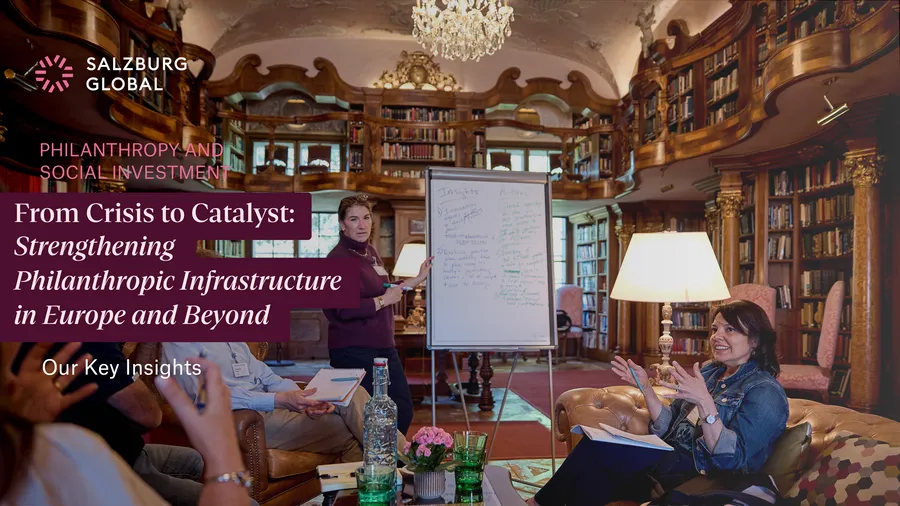
Leading donors, intermediaries, and representatives from the philanthropic sectors in Europe and the United States gathered at Salzburg Global from April 28 to May 1, 2026, to better understand the state of fiscal sponsorship and philanthropic infrastructure in Europe, its current capacity, and opportunities to innovate across the sector. Through a session on "Expanding Philanthropic Infrastructure in Turbulent Times: The Need for More European Intermediaries”, these 40 Fellows identified opportunities for growth and examined ways to sustainably expand the sector.
This initial gathering began the conversation by focusing on a handful of jurisdictions in Europe, while subsequent analysis will widen the aperture to assess the European landscape more broadly. Although the convening was informed by the experiences of European and U.S. intermediaries, the primary goal was to provide support for actors that work on projects operating beyond the transatlantic context.
Turbulent times present both challenges and opportunities for the philanthropic sector. Across the discussions, Fellows spoke transparently about the pressures they face, including shrinking civic space, political volatility, evolving regulatory frameworks, international hiring challenges, changing payment systems, and the implications of emerging technologies such as artificial intelligence. Yet these same challenges create opportunities for intermediaries to collaborate, innovate, and build more resilient infrastructure that can expand their impact.
Fellows examined the European landscape, with a particular focus on fiscal hosting, to understand the limitations and capacity needs of infrastructure already in place, and what is needed to evolve and innovate a more robust ecosystem of intermediaries. The exchange among experienced representatives and emerging influencers in the fields of European and U.S. philanthropy and fiscal hosting underscored the immediate need to learn from each other’s approaches, identify opportunities for increased collaboration, and name areas for innovation across the field.
Read Our Key Insights
Five Key Insights
While conversations took place under the Chatham House Rule, the following five key insights emerged from Fellows' candid discussions.
- The shifting and fraught terrain of philanthropy may be driven by short-term challenges, but holds meaningful long-term opportunities to increase resilience.
- Europe has strong and long-standing infrastructure that can expand to meet stakeholder desires and needs, but that expansion must be deliberate and proactive.
- The stakes on the ground are high, and the sector must rise to match them.
- From money-movers to ecosystem catalysts, intermediaries must reimagine their purpose.
- Donors must recognize the value and strengthen the impact of fiscal hosts and philanthropic intermediaries by investing in them.
