

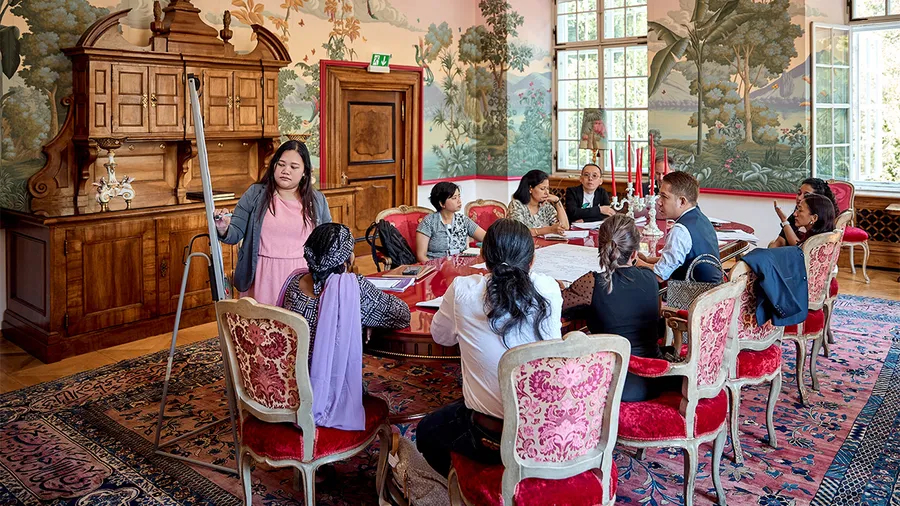
Salzburg Global Fellows from Nepal examine the ongoing struggle for transitional justice and peacebuilding over 17 years after the country's civil war
The Asia Peace Innovators Forum, established in a partnership between Salzburg Global Seminar and the Nippon Foundation, aims to shape long-term peace, stability, and regional cooperation in Asia. In June, Fellows from southeast Asia were invited to Salzburg to exchange ideas and address common interests and challenges; they participated in special "peace mapping sessions" focused on peacebuilding in different countries, including Nepal.
The Nepal peace mapping session offered Nepalese peace innovators space to explain their situation, exchange ideas, and share peacebuilding techniques with experts from other countries.
“Peacebuilding is a process. It’s not something that happens in one week or one year and then you’ve done it,” explained a Fellow during the group discussion.
For the peace innovators from Nepal, that has been the case. Nepal was engulfed in a brutal civil war between 1996-2006, with the Nepalese royal government fighting against the Maoist (Communist) party. The aftermath of the war left thousands dead, hundreds of thousands displaced, and a population traumatized by the crimes against humanity it endured. The war ended in 2006 when a Comprehensive Peace Accord was signed between the warring parties.
“It’s been 17+ years after the peace agreement was signed. But there are elements of justice and peace that are not being met by both the state actors and the non-state actors,” commented a Fellow.
Fellows mapped out short- and long-term objectives as well as key issues for Nepal. They concluded that one of the main goals should be to persuade the government to pass a new stronger Transitional Justice Bill, which has been caught in a years-long drafting and amending process, to guarantee justice and reparations for civil war victims.
In the past 17 years, however, the government has changed countless times. The leadership is tumultuous, which has led to an unbalanced political system.
Even though the Supreme Court of Nepal has ruled that the current law and agreements fail to uphold Nepal’s domestic and international obligations, the government has stalled the progress on a new Transnational Justice Bill. Many politicians want to provide justice for the sake of keeping their jobs, but not enough want to make a real difference, especially since victims sometimes name political or societal leaders as perpetrators.
Discussing how civil society can get involved in helping turn the bill into law, Fellows suggested using the media connections they have as activists to allow victims to share their stories with a wider audience; this would aim to persuade the government and Nepalese citizens about the importance of passing the bill.
Fellows also explored potential contingency plans in case of three scenarios: if the law is passed as a watered-down version of the original bill, if the bill is not passed at all, or if the law is passed but not fully implemented.
The Nepal peace mapping session provided a platform for collaboration and expertise to be shared among Fellows, who will utilize these learnings to take steps toward shaping a more peaceful and just future for their country.
The Fellows who contributed to this discussion are either Nepalese or work in the country. They participated in the 2023 Asia Peace Innovators Forum from June 14-18, 2023 at Salzburg Global Seminar.
