

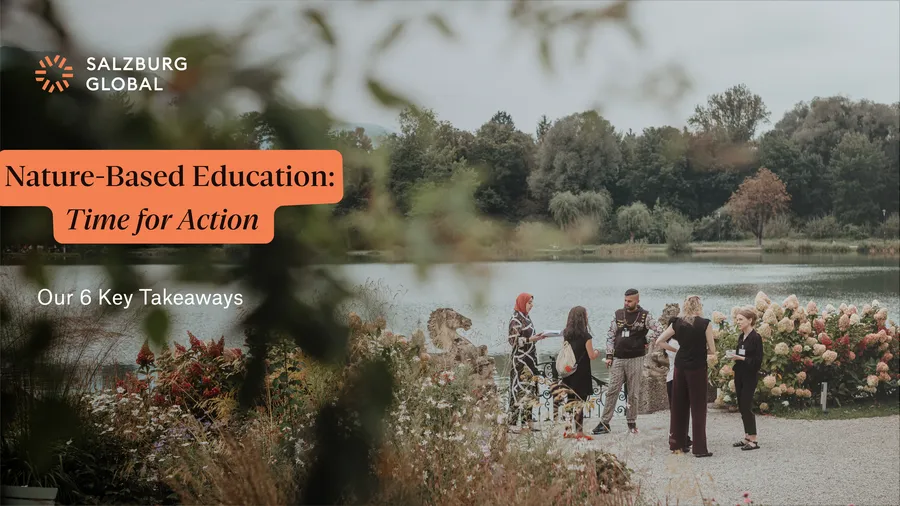
6 takeaways from a Salzburg Global session on harnessing Nature-Based Education’s transformative response to the biodiversity and climate crises
The climate crisis is one of humanity’s greatest challenges. While 196 countries have pledged to halt biodiversity loss by 2030 through the UN’s Global Biodiversity Framework, education’s role in that goal remains largely overlooked.
Salzburg Global’s session on “Nature-Based Education: Time for Action” set out to bridge this gap. It convened 47 educators, innovators, academics, conservationists, funders, Indigenous leaders, and youth leaders from around the world, united by a shared goal: To explore how Nature-Based Education can be embedded into global systems, building a resilient and just future in response to the climate and biodiversity crises.
1. Identifying Nature-Based Education: Defining, Measuring, and Scaling Impact
Several Fellows highlighted diverging definitions, content, and institutional contexts of Nature-Based Education. According to IUCN, “Nature-based Education is a pedagogical approach that embeds nature at the core of learning experiences, incorporating environmental education and experiential learning, among other teaching strategies.” Nature-Based Education “aims to serve as an educational ecosystem encompassing various initiatives that bring nature to the core of learning,” shared one Fellow, including but not limited to outdoor education and Indigenous knowledge. Another Fellow called for a shift from the dominant Western “Anthropocene view to an eco-centric reality,” recognizing humans as nature rather than separate from it. Several Fellows identified the need for mapping definitions, tracking best practices, and measuring impacts globally.
What’s Needed:
- Map international definitions, best practices, and examples of Nature-Based Education across diverging knowledge systems
- Identify and overcome systemic barriers to Nature-Based Education
- Develop a universal definition of "Nature-Based Education" that incorporates diverse knowledge systems, especially marginalized, Indigenous, and local knowledge
- Communicate the benefits of Nature-Based Education (physical health, social emotional skills, reduced anxiety, reduced crime rate) to effectively initiate and implement programs
- Measure the global and local impacts of Nature-Based Education
2. Centering Indigenous Knowledge in Nature-Based Education
Western and colonial education systems often exclude Indigenous knowledge. One Fellow shared how current education systems “sideline Indigenous knowledge,” while another said, “our elders have knowledge, we need it, our children need it.“ Nature-Based Education must center Indigenous knowledge and cultivate a shift from individualism to collective care - “caring for ourselves, our communities, and recognizing that we are nature,” as another Indigenous Fellow shared.
What’s Needed:
- Embed Indigenous knowledge and cultural diversity into Nature-Based Education to pass ancestral wisdom to future generations
- Include Indigenous languages in regionally adapted resources to preserve both ecological and linguistic heritage
- Co-design curriculum with Indigenous communities, elders, and educators
- Prioritize place-based learning to teach about native ecosystems and Indigenous plant species
- Interweave Indigenous knowledge into curricula through interdisciplinary approaches that reflect relationality, collective care, and humankind’s oneness with nature
3. Supporting Teachers in Bringing Nature Into the Classroom and the Classroom Into Nature
Educational professionals and teachers are key stakeholders in translating Nature-Based Education from resources to the classroom. A key part of this is greening school grounds, which should be embraced globally so that every school and student has access to green spaces to play, learn, and build a connection with nature. Fellows agreed that Nature-Based Education should not be treated as a separate subject, but rather woven into all areas of the curriculum as an integral part of education. “We will be most successful in achieving our goals of embedding nature at the core of learning if we support teachers,” emphasized one Fellow. To do so, teacher training, identifying teachers’ needs, and providing accessible resources are vital.
What’s Needed:
- Provide accessible teacher training and resources centered around Nature-Based Education that equip educators with skills to navigate uncertainty, foster climate action, and spark systemic change across school communities
- Design curriculum through co-creation with teachers to identify their needs and demands
- Partner with teachers to green schoolyards, ensuring Nature-Based Education extends beyond the classroom to transform outdoor spaces
- Treat Nature-Based Education as foundational, on par with literacy and numeracy, in preparing students for a climate-resilient future
- Implement project-based learning for students to gain local ecological knowledge, skills, and hands-on experiences in Nature-Based Education
4. Nature-Based Learning: Beyond Classrooms, Across Lifetimes
“Education” alongside Nature-Based Education remains largely restricted to formal education settings like primary and secondary schools. Fellows repeatedly emphasized the need to embrace a “lifelong learning” approach, where Nature-Based Education continues in communities, adulthood, workplaces, and retirement. As one Fellow shared, "learning occurs throughout life and Nature-Based Education enhances all learning.”
What’s Needed:
- Cultivate a lifelong learning approach to Nature-Based Education, recognizing that people continue to learn throughout adulthood and within their communities
- Extend Nature-Based Education programs beyond formal schooling and embed them in everyday life, nature clubs, workplaces, and post-employment settings
- Fund non-formal and informal Nature-Based Education programs
- Provide inclusive and affordable non-formal and informal education resources that engage all ages, backgrounds, and communities in collective nature-based learning
5. Resilience in Schools: Grounding Nature-Based Education in Local Realities
Educational realities differ widely across countries and regions, making it essential to reject a “one-size-fits-all” approach to Nature-Based Education. Many school communities face systemic deprivation, resource scarcity, and vulnerability to climate disasters, requiring context-specific and resilient solutions. “We are building exam-based systems and children cannot learn because of heat,” one Fellow stressed, exposing how conventional education neglects climate resilience and adaptation. Numerous Fellows emphasized that Nature-Based Education complements resilience-building efforts in schools facing environmental hazards and disaster risks. Greening school grounds, which ensures students have access to green spaces, was additionally identified as an urgent priority in building resilience in schools.
What’s Needed:
- Invest in resilient school infrastructure and raise awareness that schools serve as critical shelters for children during extreme weather events and climate disasters
- Embed resilience into the foundation of education systems as a core component alongside literacy and learning
- Implement localized safety plans tailored to environmental risks, such as constructing cyclone-resistant buildings in high-risk areas
- Mandate teacher training on school safety and resilience strategies
- Establish continuous monitoring and updates of school safety protocols to reflect evolving climate hazards and community vulnerabilities
6. Reclaiming the Future: Intergenerational Justice Through Nature-Based Education
Young people, the generation most affected by climate change, are routinely excluded from education design, funding, and decision making. At the same time, they face the contradictory reality of being tokenized while bearing the heavy expectation that “future generations will solve climate change.” One Fellow urged education systems to “equip young people in identifying their own resilience while being realistic about climate change.” Several Fellows agreed that Nature-Based Education must position youth as co-creators, advancing intergenerational justice through meaningful design, representation, and funding opportunities.
What’s Needed:
- Embed co-creation and inclusive design processes that reflect the diverse needs, demands, and lived experiences of youth. When youth are involved in education or institutional design, they should be fairly paid and sustainably supported.
- Align Nature-Based Education with green skills to prepare young people for the changing workforce
- Integrate competency-based teaching approaches that foster critical thinking, local ecological literacy, and practical problem-solving
- Provide robust mental health support to help youth resiliently and effectively address eco-anxiety and climate grief
- Trust young people with increased responsibility and decision-making roles within institutions, while ensuring youth have meaningful access to resources, funding, and training
“Time for Action”: The Title Says It All
“Time for Action” underpinned not only the session’s title but also the outcomes of the Fellows' conversations. By combining their diverse expertise and skills, Fellows conceived long-term international and local projects aligned with the session’s core themes. A draft of the resulting Salzburg Statement was presented at New York Climate Action Week and the International Union for Conservation of Nature, driving forward a lasting legacy of policy and systemic change.
"Nature-Based Education: Time for Action" is part of the Nature-Based Education program in the Salzburg Global Center for Education Transformation.
