

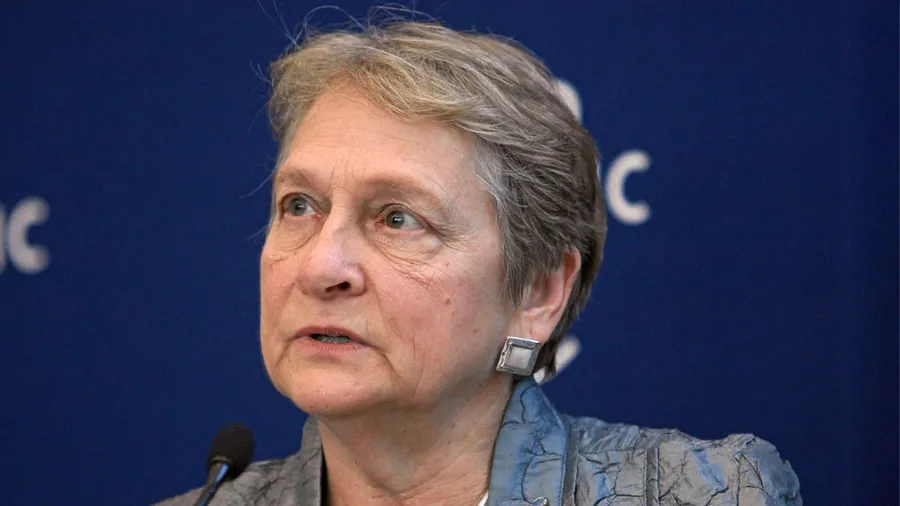
Laura Liswood reflects on her experience, preparing for future challenges, and her time at Women World Leaders
This October, Laura Liswood returns to Salzburg, Austria, to support Salzburg Global’s Health and Economic Well-being: Gender Equity in Post-Pandemic Rebuilding.
Along with the 60 participants coming from across the globe, and across different sectors, we are pleased to welcome and introduce our latest Program Ambassador, Laura Liswood.
Laura is the Co-founder of Women World Leaders, along with Vigdís Finnbogadóttir, former president of Iceland, and Mary Robinson, Ireland’s former president. Women World Leaders is a network of 83 current female presidents and former prime ministers established in 1996 and it is the only organization of its kind globally. Laura Liswood earlier served as a Managing Director, Global Leadership and Diversity for Goldman Sachs from 2001 to 2016. She has the insightful information of how organizations in both, private and public sectors can improve gender equality, and what difficulties arise when trying to make a difference inside an organization at the global level. Liswood holds an M.B.A. from Harvard Business School and a B.A. from California State University, San Diego. She also holds a J.D. degree from the Davis School of Law of the University of California and is a long-time participant of the World Economic Forum.
Laura now joins Salzburg Global’s Health and Economic Well-being: Gender Equity in Post-Pandemic Rebuilding, co-curating the program with Shuma Panse, Mary Helen Pombo and Charlotte Müer. As Program Ambassador, she will support strategic global recruitment for the session, amplify the impact of the program and bring her insight and expertise.
Mary Helen Pombo, Program Director for Salzburg Global's health programs worked closely with Laura on the program's development and says:
"We are delighted to be welcoming Laura Liswood once again at Salzburg Global. Her expertise in leadership, diversity, equity and inclusion and women in politics and vast experience across civil society and the public and private sector undoubtedly make her an asset to the program. As Program Ambassador, Laura plays a key role in curating our program and amplifying the impact of the session, while acting as a resource to other Fellows."
We spoke with Laura to get to know her better. This interview has been edited for clarity and conciseness.
Charlotte Müer, health Program Manager, Salzburg Global Seminar: How do you envision supporting our Fellows as a Program Ambassador?
LL: “I hope to be a resource particularly on women's leadership and Diversity, Equity and Inclusion (DEI) subject matter.
“In addition, during the informal breaks and unscheduled times, there will be opportunities to learn more about Fellows, their goals, and interests. To the extent that I would plan to provide guidance or connections.”
Shuma Panse, Session Chair and Senior Program Officer, The Robert Wood Johnson Foundation: What do you think is the added benefit of this cross-country and cross-sector session on gender equity in post-pandemic rebuilding?
LL: “Diversity of thought always enhances innovation and creativity.
“Cross-country and cross-sector perspectives will help everyone find best practices post-pandemic. Knowledge gaps can also be observed, and action taken about the absence of needed information to shape actions.”
Mary Helen Pombo, health Program Director, Salzburg Global Seminar: What major challenges will we face in the next five to 10 years to advance an equitable and inclusive economy?
LL: “First of all, challenges to advancement include lack of government leadership and support for ensuring equitable and inclusive economies, including policy, legislation and guidance. Backlash from those who feel that diversity, equity, and inclusion are taking away what is rightfully theirs are not understanding the advantage and privilege they have had in their societies.
“Secondly, economic hardships, climate change, and poverty remain intractable with seemingly slow progress. The possibility that conservative societies will go backward in the advancement of women, taking away education, reproductive health, and other steps that have helped progress.”
Mary Helen Pombo: What can Fellows in this program do to prepare for these challenges?
LL: “Continuing their work and energy on the key areas of interest to the Fellows is very important. Also, learning from the experiences of others and finding ways to collaborate to multiply their impact.
“Also, continuing to voice publicly the issues that are constraining progress. Leveraging their work with other like-minded organizations and people. Calling for continued research and data analysis by governments and other organizations to provide the information needed to create policy change.”
Momoko Tamamura, Global Impact Fellow: What is your greatest motivation to continue your work in diversity and leadership?
LL: “I continue to work in the DEI leadership arena because I have personally seen the importance of equitable opportunities, the need to level the playing field, and to make sure all feel included and valued.”
“It is also because I like presenting ideas in ways that both dominant groups and non-dominant groups can relate to and provide a different perspective and vocabulary so that all see the need for equity and social justice.”
