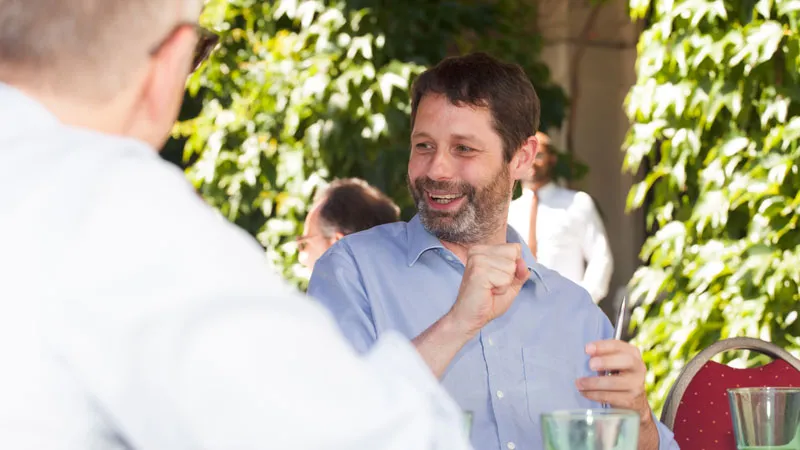
Deputy director of the UK’s Institute for Government considers how people can help governments work more effectively
As deputy director of the Institute for Government in London, Julian McCrae has one main question to answer: How do you help politicians and civil servants in the UK get better at doing their jobs? It’s not the only conundrum he’s looking to solve, but it encompasses the path the Institute is following.
In a bid to get answers to this question, and more, McCrae attended the sixth Public Sector Strategy Round Table – In the Spotlight: How Can the Public Sector Excel Under Changing Dynamics? – in June.
Speaking to Salzburg Global Seminar during this session, McCrae said, “This is a brilliant opportunity to meet people from all around the world who are thinking about how do you improve? How do you make government work more effectively for its citizens? What it’s really about – not just people thinking about it, but people who are actually doing it.”
McCrae was one of 28 participants to take part in the two-day program, held by Salzburg Global Seminar for the first time this year. Together, the cohort represented 15 countries. McCrae said, “There’s nothing better than listening and talking to people who are facing the same challenges as you are in different environments; bringing that all together, aggregating it up, and getting a real sense of momentum into some of the key challenges all our societies face.”
Among the challenges discussed, McCrae suggested the changing nature of technology was both an opportunity and a threat. That being said, the issue of resources and how to use them is also pertinent. McCrae said, “How do we make [the use of resources] work in a way that our citizens feel this is fair [and] this is equitable?”
Before joining the independent non-profit organization, the Institute for Government, McCrae spent half a decade working for former UK Prime Minister Tony Blair, serving as deputy director in his strategy unit. Discussing his experience, McCrae said, “I think one of the things about working in a strategy unit at the heart of government, it’s in a way about great analysis. It’s about really, really good people who can look at a problem from new dimensions and give insight to that.”
The next step requires effective communication of the insight that has been acquired. McCrae said one had to think how to get the relevant information in the hands of the decision-makers. He said, “When we were working in the UK, and we had Tony Blair as the prime minister, he wanted strategic advice. He saw us as his people… He’d set us a problem and he didn’t want us drawn into the day-to-day crises of government.” Instead, Blair wanted McCrae and his colleagues to think about the long-term solutions. McCrae, however, conceded that each prime minister is different in their way of thinking.
McCrae joined the Institute for Government in 2009. He is currently responsible for leading the Institute’s work on professionalizing Whitehall, the performance of public services, fiscal policy, and spending consolidations. McCrae said, “We’re focused primarily on what we might describe as the machine of government. We’re not a policy think-tank. We don’t tell governments [they] should be this, or that, or the other. We’re certainly not political. We have to stay out of the party politics. What we’re about saying is, ‘If you want to achieve these things, how can you set up government [and] how can you run a government in a better way to make it more likely that these things you really want to do will be achieved?’”
The two-day program at Salzburg Global Seminar brought forward several ideas and examples of good practice taking place around the world. McCrae said he hoped to leave with a set of concrete ideas he could point to and show others. Most of all, he was interested in the personal connections.
McCrae said, “Virtually, no one has a wonderful experience with change. It’s difficult. It’s messy. You have to persevere at it. So, actually, being able to pick up the conversations about how you deal with the difficulties [and] how you overcome it – that comes from knowing people.
“That’s what I think Salzburg Global Seminar is really about – bringing those ideas together, bringing those people together, to create that shared network going forward.”
Julian McCrae attended the sixth meeting of the Public Sector Strategy Round Table – “In the Spotlight: How Can the Public Sector Excel Under Changing Dynamics?”. This meeting was convened by Salzburg Global Seminar in partnership with the Abu Dhabi Crown Prince Court and apolitical, and with the support of Chatham House. More information on the session can be found here.