-
Topics
TopicsOur programs create spaces where open-minded leaders can gather for breakthrough conversations on pressing global issues – each aligned to one of the following pillars:Get Involved
-
Events
EventsExplore the variety of events Salzburg Global hosts within Austria and in the rest of the world. Learn more about our programs and what else happens at Schloss Leopoldskron.
- Insights
-
Fellowship
FellowshipSince 1947, more than 40,000 people from over 170 countries have participated in Salzburg Global's sessions. Collectively, these alumni are known as Salzburg Global Fellows.
-
About Us
About UsSalzburg Global is an independent, non-profit organization committed to creating spaces that overcome barriers and open up a world of better possibilities.Our Approach
-
Support Us
Support UsYour generosity helps us gather open-minded leaders for breakthrough conversations, while creating space for dialogue that overcomes barriers and opens up a world of better possibilities.
- Donate

- Published date
- Written by
Share
Peace & Justice
Opinion
Is India Aging Well?
Published date
Written by
Share
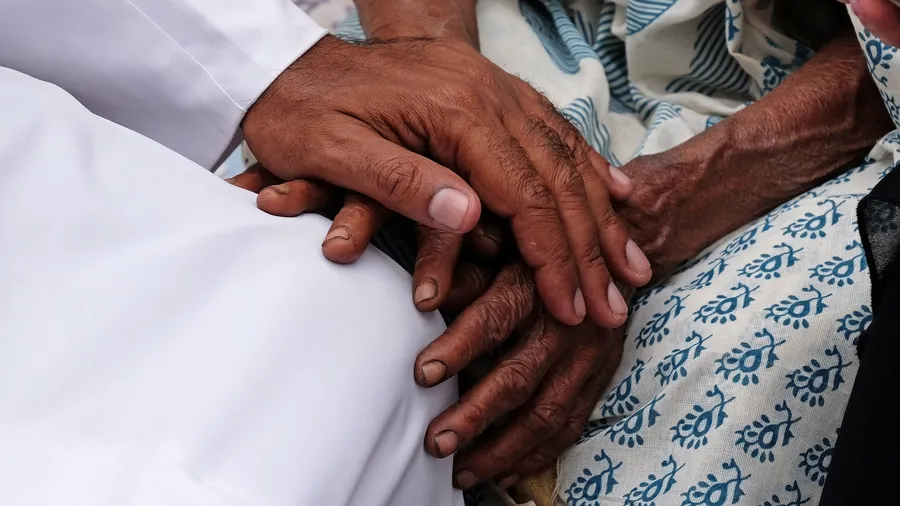
Photo Credit: Shutterstock.com/1813112569
Key takeaways
- India stands at a demographic juncture, with 138 million people over 60 years old aging fast without systems built to support them.
- Many older Indians live with a disability, driving unpaid caregiving, reduced workforce participation, and rising out-of-pocket health spending.
- With foresight and timely intervention, India can build systems of care, inclusion, and support for its population.
This article was written by Salzburg Global Fellow Romita Ghosh, who is a member of the third cohort of the Japan-India Transformative Technology Network.
The views expressed here belong to this Fellow individually and should not be taken to represent those of any organizations to which they are affiliated.
India stands at a critical demographic juncture. As the world applauds our youthful population and tech-driven economic momentum, a quieter but seismic shift is unfolding. Over 138 million Indians are currently aged 60 and above, and by 2050, this number will nearly double, reaching 20% of our total population. This demographic shift is closely intertwined with a growing burden of age-related disability. Nearly one in five older Indians lives with a disability, including mobility issues, sensory loss, or cognitive decline. 13% of older Indians have some type of disability that affects at least one activity of daily living. These limitations not only impact personal independence but also have far-reaching economic consequences.
Aging with disability often leads to reduced workforce participation, increased out-of-pocket health spending, and reliance on unpaid caregiving, mostly by working-age family members, particularly women. The World Bank estimates that unpaid care work, mainly for people with disabilities and older persons, would equate to 9% of global GDP if compensated. In India, where geriatric care systems are underdeveloped and pensions are inadequate, this translates into a silent but substantial drain on economic potential. If left unaddressed, aging in India could evolve into a quiet crisis, one that demands attention as an urgent social priority.
The Demographic Transition: More Than Just Numbers
The Longitudinal Ageing Study in India and the Government of India’s 2025 report on "Ageing in India: Challenges and Opportunities" paint a stark picture:
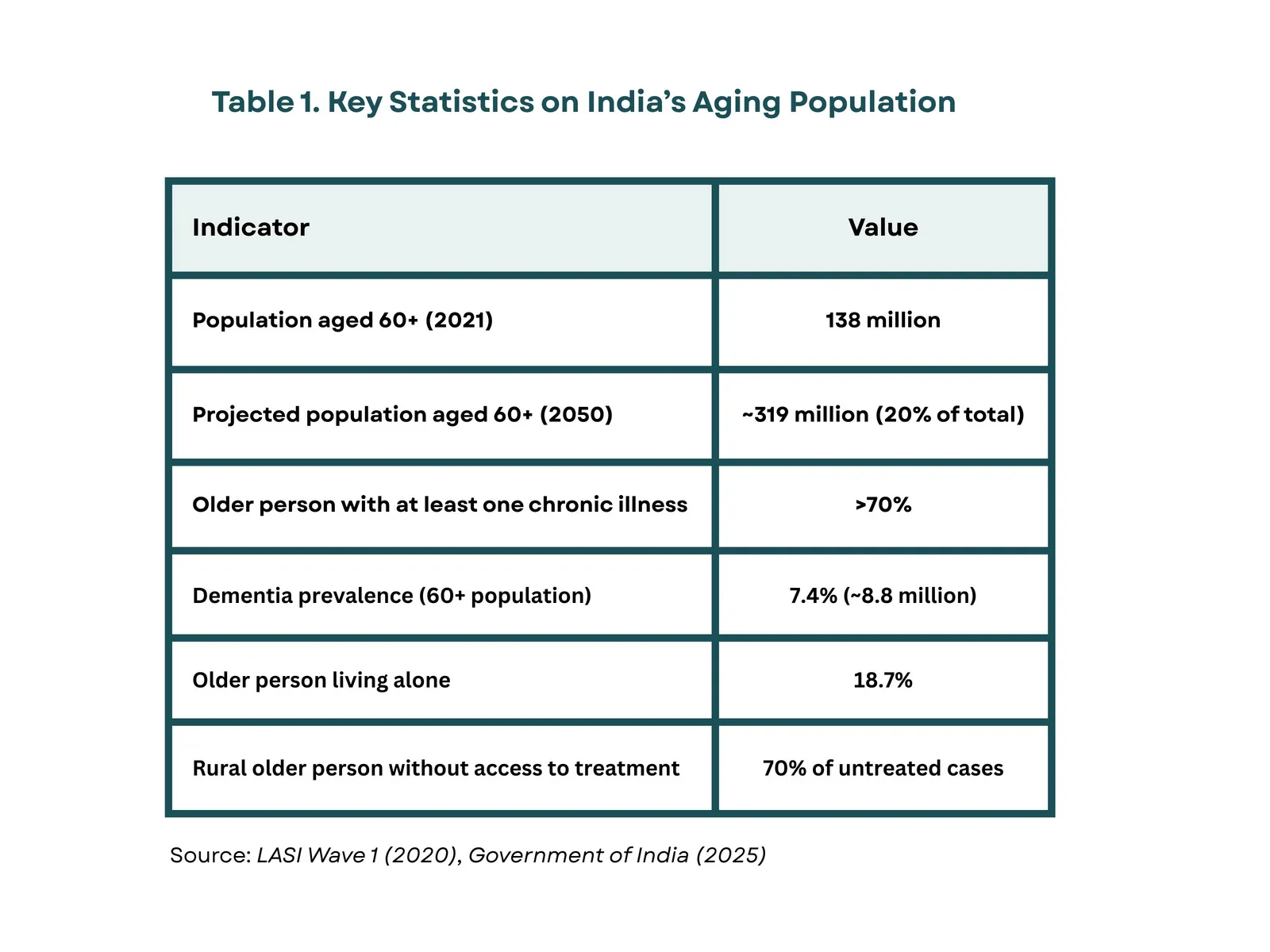
From Longevity to Liability
While life expectancy has improved, healthy aging has not kept pace. Over 40% of Indian elders face functional limitations, particularly related to musculoskeletal and visual impairments. Mental health, often a silent killer among seniors, remains grossly under-addressed: Nearly 30% of older Indians have depressive symptoms, and the prevalence of cognitive impairment and dementia is rising rapidly.
The elderly are also disproportionately burdened by high out-of-pocket health expenditures. In households composed only of elderly members, over 13% of spending goes to healthcare, compared to 5% in younger households. Without insurance coverage, which only 31% of Indian seniors have, many delay or forgo treatment.
Programs like the National Programme for Healthcare of the Elderly (NPHCE) and Indira Gandhi National Old Age Pension Scheme (IGNOAPS) remain severely underfunded and poorly implemented. Geriatric services are nearly absent at the primary health level, and there is a glaring shortage of trained professionals in geriatric care, mental health, and rehabilitation.
Caregiving and Economic Drain
India’s policy and social assumptions are still rooted in the notion of joint family caregiving. Yet LASI reveals a growing demographic of elderly women living alone, often widowed, financially dependent, and socially isolated. Intergenerational co-residence has declined, and migration has left many older adults without day-to-day support.
Caregiving, mostly unpaid and performed by women, is the invisible backbone of aging societies. But it comes at a cost. Nearly 75% of older adults require assistance with daily activities. Family members, especially middle-aged women, often drop out of the labor force or reduce work hours to care for aging parents and in-laws.
In households composed only of older adults, health spending is about 20% of total consumption versus about 12 to 13% in other households, highlighting the financial strain of aging without support. Meanwhile, only about 18% of Indians aged 60 and older have any health insurance, and high out-of-pocket costs discourage timely care. Time-use evidence also shows unpaid caregiving depresses women’s labor-force participation. Unrecognized and unsupported caregiving reduces both caregiver well-being and household economic stability.
What Works Elsewhere
We don’t need to reinvent the wheel. Other countries have implemented effective models:
- Japan: Community-based integrated care systems that combine health, long-term care, social support, and housing at the neighborhood level.
- Sweden and Norway: Publicly funded home care and home modification services that allow seniors to age in place with dignity.
- Singapore: CPF-based eldercare savings, intergenerational housing incentives, and digital inclusion campaigns tailored to older adults.
- Thailand: Volunteer-driven elder outreach in rural communities, with health checks and social support.
- Mexico: Conditional cash transfers and subsidized medication for older adults without pensions.
What India Must Do Now
India should adopt the following policy priorities to improve its demographic resilience:
- Revise and Enforce Policy: Update the 2011 National Policy for Senior Citizens to include measurable outcomes, budget allocation, and decentralized implementation.
- Integrate Geriatrics into Primary Care: Include geriatrics in medical curriculum, train ASHA (Accredited Social Health Activist) and ANM (Auxiliary Nurse Midwife) workers, and expand mobile health units.
- Universalize Social Security: Make pensions universal and inflation-linked, with special focus on widows and informal sector retirees.
- Invest in Mental Health and Community Support: Set up memory clinics, mental health hotlines, and senior day-care centers.
- Digital and Financial Inclusion: Establish elder-friendly digital kiosks, fraud-awareness campaigns, and accessible complaint redressal for cyber fraud.
- Support Caregivers: Provide paid leave, training, and financial incentives for family caregivers; introduce community respite care models.
- Build an Ecosystem of Research: Institutionalize LASI-like surveys every 3 years and integrate aging into public health policy and university research.
Steps Forward
As an ancient verse reminds us: “The body is decaying, the head is gray, the mouth is toothless; even while holding a trembling staff, the bundle of desires does not leave.”
Aging has long been associated with dependency, illness, and decline, and viewed as something to fear. We inherited that view by watching generations before us grow old without support, often in silence and invisibility. But for our generation, aging may arrive faster, and hit harder, amplified by stress, sedentary lifestyles, social isolation, and loneliness.
With foresight and timely intervention, aging can be reimagined as a phase of dignity, purpose, and connectedness.
To ensure the dignity we all deserve in our later years, we must plan and build systems of care, inclusion, and support now. If we don’t, we risk facing old age without anyone left to care for us.