

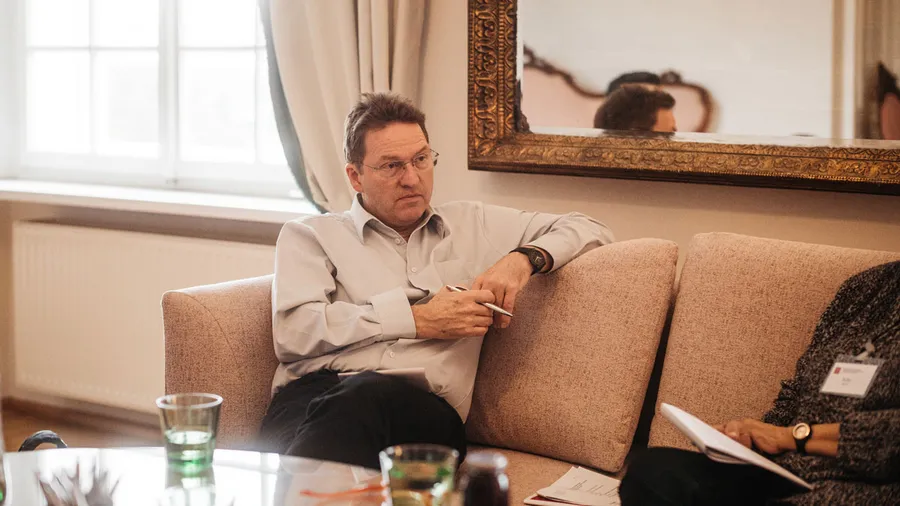
Salzburg Global Fellow Andreas Etges reflects on the United States’ image abroad in the past and future
This op-ed piece is part of a series written by Fellows of the Salzburg Global Seminar program “Democracy on the Front Lines: Polarization, Culture and Resilience in America and the World.”
Several months before Pearl Harbor, Henry Luce, the publisher and editor of Life and Time, worked hard to convince the American people that it was time they accepted a new international role for their country. His famous essay “The American Century,” published in Life on February 17, 1941, was a sharp rejection of isolationism and a passionate plea to finally act as “the most powerful and the most vital nation in the world.” It also turned out to be a rather prophetic description of the twentieth century as an “American Century” where the United States played a leading role politically, economically, militarily, and culturally.
There was a brief period in the 1990s when the U.S. was the single superpower. Some even spoke of a “hyperpower.” The think tank “Project for a New American Century,” founded in 1997, argued for a “Reaganite policy of military strength and moral clarity” to guarantee U.S. leadership in the 21st century. Several of its most prominent members and supporters – like Dick Cheney, Donald Rumsfeld, and Paul Wolfowitz – got influential positions in the George W. Bush administration and tried to implement some of these ideas after 9/11. They failed. The Great Recession after 2007 showed that not only the military and political power, but also America’s economic and financial capabilities were limited. The deep political and cultural divisions inside the U.S., which grew even more during the Trump years, have further weakened the attractiveness of “America.”
At the same time, China has grown ever stronger. And for a while, many believed that the most populous country in the world also offered an attractive model for alternative global development. Most recently, that attraction has waned. What does all of this mean regarding the influence and the image of the United States today?
The United States most likely will never again be the dominant power it was during the “American Century,” which was characterized by a bipolar and – briefly – unipolar world. The decline of U.S. hard power cannot be denied. Barack Obama and Joe Biden, therefore, rightly emphasized multilateral approaches instead of unilateral ones.
But there is no other country in the world coming even close to the impressive soft power the U.S. still wields. That is a major asset.
There is strong anti-Americanism in many parts of the world. Much of the often rather negative views of the U.S. have to do with its presidents and foreign policy. But the United States is also seen exceptionally critically, not necessarily because people dislike it, but quite the opposite. It is often rather the disappointment about the continued failure to live up to its attractive ideas and ideals that cause negative reactions against the U.S.
During the leadership of Edward Murrow, U.S. public diplomacy (then by the U.S. Information Agency – USIA) was tasked with telling “America’s story to the world, warts and all.” The warts existed in the early 1960s, and they do exist now. But the fact that the United States has not fully lived up to its promises, that it has not fully dealt with the dark sides of its history, that the democratic system is also under threat here, should not be hidden or denied. They are part of America’s still fascinating story, and they should be told, “warts and all.”
U.S. governments never supported American Studies and public diplomacy for purely altruistic reasons. But the U.S. should once again invest much more in American Studies, in exchanges via Fulbright and other programs, and in cultural programs. In order not to be seen as propaganda or just serving the national interest, something like the USIA should be recreated. Or maybe rather something along the lines of Germany’s Goethe Institutes or similar cultural institutes.
Cultural exchange and learning should never be a one-way street! A poster promoting the Peace Corps created in 1968 shows the Statue of Liberty, with her right arm pointing to the side and the following text in bold and capital letters: MAKE AMERICA A BETTER PLACE. LEAVE THE COUNTRY. If you read the smaller print below the photo, what could be mistaken as a nativist demand turns out to be something quite different: “Of all the ways America can grow, one way is by learning from others. (…) There are those who think you can't change the world in the Peace Corps. On the other hand, maybe it's not just what you do in the Peace Corps that counts. But what you do when you get back.”
That should be the spirit.
Andreas Etges is senior lecturer in American history at the American Studies Institute of the University of Munich (LMU). From 1999-2012 he taught US history at the John F. Kennedy Institute for North American Studies at Freie Universität Berlin. Andreas regularly gives talks to non-academic audiences on US history and current affairs and offers teacher trainings on these issues.
