

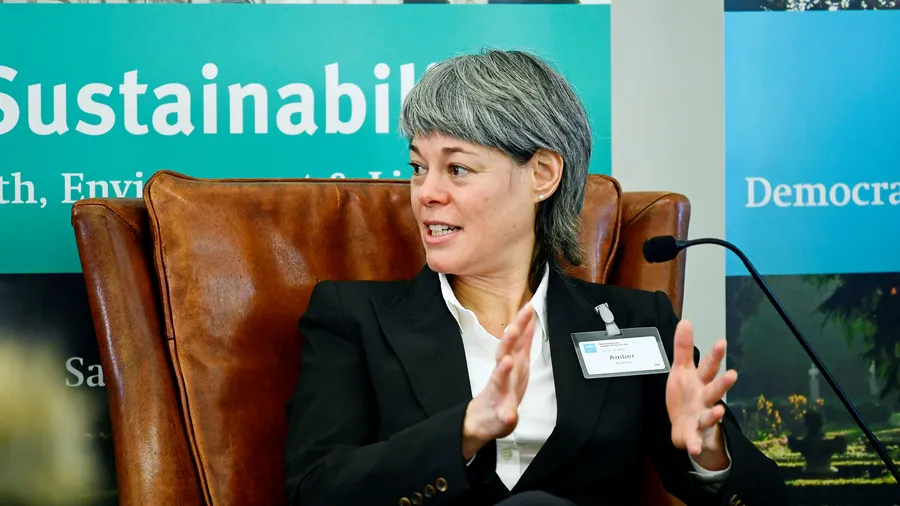
Participants answer the "Hot Topic" of day two, examining how to best ensure the needs of patients and their families
“The key to delivering good palliative care is to start the process at the right time. It should not start at the later stage when the end is near. The doctor who initially delivers the treatment needs to convince the patient that there is another team who are going to take care of the patient until the end. Otherwise, the patient will refuse to even take palliative care. After that, palliative care has to be holistic, comprising of medical care, psychosocial support and also, financial and livelihood support when you are dealing with low-income countries with a lot of people living in poverty.”
Jagannath Jayanthi
Executive Committee Member, Pain Relief and Palliative Care Society, India
“I think patients and families need to be engaged in three ways, and they are all about conversation. First of all, we need to have more conversation at the beginning between the treatment team, the medical team and the patient and family. After someone has died, we need to have real conversations with the family about how it went. Beyond that, we need to have patients and families who are willing to work on the team together, to design and deliver the system better. In addition, we have to have the fridge magnet – the reliable place to call in an emergency.”
Anya Humphrey
Patient and Family Advisor, Canadian Fund for Health Care Improvement, Canada
“I think the most important thing is to listen. To listen carefully to the patient and to the family, and to read in between the lines – not just the words, but the body language and the meaning behind the words. In general, families want the best for the patients, but that is not necessarily true. They may not realize that what they think is the best for the patient may not be the same as what the patient wants. I think we need to distinguish between those things.”
Cynthia Goh
Senior Consultant, Division of Palliative Medicine at the National Cancer Centre, Singapore
“When the patient with a terminal case comes to our hospice, we start by assessing the five needs: social, psychological, medical, spiritual, and financial need. With every visit, we reassess the need of the patient so that we can provide the right support at the right time. Through this reassessment, we could meet the expectation of the patients and family members. Sometimes I find family members coming to volunteer for us after the death of the patient, or patients donating their belongings to our organization. I think these indicators prove that our work has met most of their expectations.”
Tandiyar Samir
General Manager, Josaab Foundation for Social Development, Egypt
“One of the things I teach first and foremost to medical students is to try to avoid focusing on their own goals, but to stay present, mindful, and curious so that they can listen to what patients and family members are saying, including their nonverbal communication. In addition, I teach students how to manage their own discomfort when patients go through emotional moments. We usually have a natural compulsion as humans to try to reassure or comfort them. However, I teach students ways to acknowledge the discomfort and sit with it, rather than trying to deflect or distract the situation.”
Amber Barnato
Tenured Associate Professor of Medicine, Clinical and Translational Science, and Health Policy and Management, University of Pittsburgh, USA
“Particularly in palliative care, we need to understand the cultural context behind this responsibility. We have seen in today’s discussion that the cultural context, which changes by country, has all to do with the way caregivers, families and patients interact. And in that interaction, it is not only the cultural aspects of the patients and families but also those of the caregivers that need to be acknowledged, in order to enable the three of them to work as a team around the quality of life of the patient.”
Juan Pablo Uribe
Director General, Fundación Santa Fe de Bogotá, Colombia
Want to join the conversation?
Tweet @SalzburgGlobal using the hashtag #SGShealth
Download the full newsletter from Day 1
The Salzburg Global Seminar session Rethinking Care Toward the End of Life, part of the long-running series Health and Health Care Innovation, is being held in partnership with the Dartmouth Institute for Health Policy & Clinical Practice and the Mayo Clinic. Follow online on Twitter with the hashtag #SGShealth.

