

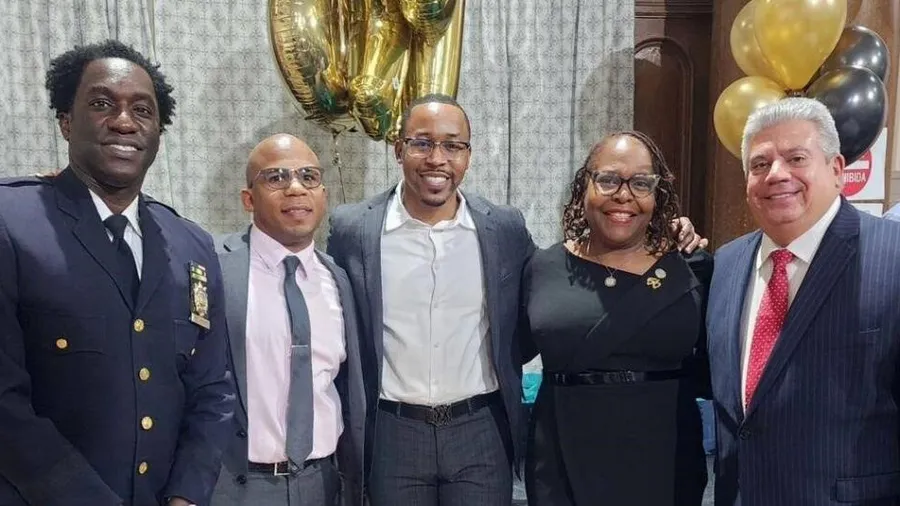
Salzburg Global Fellows draw lessons from Project Restore Bed Stuy on community-led strategies transforming justice and safety
This article was written by Salzburg Global Fellows Derby St.Fort and Peter Dixon, who have participated in the Global Innovations on Youth Violence, Safety and Justice initiative. The article was also contributed to by their colleagues Jarrell E. Daniels (Project Director, Center for Justice at Columbia University, Community Organizer) and Geraldine Downey (Robert Johnston Niven Professor of Humane Letters in Psychology, Director, Center for Justice, Columbia University).
Today’s public safety challenges require holistic, integrated responses to which traditional law enforcement approaches are poorly attuned. Monitoring, arrest, and incarceration have their place, but policing must evolve to play a more innovative and supportive role in an expanding public safety ecosystem focused less on punishment and more on meeting community needs.
This is not just wishful thinking. In some jurisdictions, law enforcement is evolving beyond the restrictive framework that has defined policing for too long. Brooklyn District Attorney Eric Gonzalez recently created an entire unit dedicated to restorative justice, which invests crucial resources into community-based programs that seek to bridge the gap between accountability and healing.
In 2022, DA Gonzalez put his support behind Project Restore, a community-based violence intervention co-designed by public officials and justice-impacted individuals at Columbia University’s Center for Justice. Through a coalition of community, university, and government partners—including law enforcement—Project Restore dramatically reduced gun deaths and shootings in its pilot phase in the Brooklyn neighborhood of Bedford-Stuyvesant (Bed-Stuy). It did so by supporting high-risk youth from rival street crews through case management, credible mentorship, restorative healing circles, life skills development, employment, and community engagement.
Ultimately, the project equipped these youth to transform their lives, reconcile their rivalries, and become champions of safety in their neighborhoods in a city where Black New Yorkers are 16 times more likely to die by gun homicide than their white counterparts.
Lessons From Project Restore Bed-Stuy
1. Clear roles and accountability can facilitate strategic police-community partnerships
Project Restore is fundamentally a community-led initiative where participation is voluntary and not compelled as in alternative-to-incarceration programs. In Bed-Stuy, law enforcement played a crucial role by drawing on their data to identify participants. Police also maintained a presence in the neighborhood and attended community events to bolster trust. Their involvement, however, was carefully defined to protect confidentiality, maintain participant trust, foster a safe space for transformation, and uphold the program's integrity. Program staff did not share individual participant information with law enforcement, unless explicitly requested by the participant or if it directly benefited their well-being under a strict no-determination policy. This principle ensured that program goals came first, keeping the program’s leadership, direction, and vision firmly rooted in the community.
2. Assessing and addressing participant needs requires moving beyond the paradigm of criminality and punishment
Instead of labelling participants’ street crews according to a traditional law enforcement lens as "criminal gangs," Project Restore framed them more holistically as "social networks" through which youth address their varied needs for identity, belonging, security, and more. Using a needs-based approach, the project identified the core driving factors that lead to street involvement and instead of punishing participants for their role in street crews, sought to address their needs holistically through multifaceted programming.
3. Transformational change comes from harnessing the power of social networks, not dismantling them
In Bed-Stuy, the youth who participated in the program largely ended up street-involved not out of self-interest, but because their social networks were already in conflict with each other due to long-standing rivalries. A traditional law enforcement approach would aim to dismantle these networks through arrest and incarceration. Project Restore, on the other hand, sought to transform them by fostering communication and building relationships across lines of polarization. This addressed the immediate dynamics that were fueling violence and had the knock-on effect of creating more sustainable capacity for conflict resolution within the neighborhood.
4. Breaking the poverty-violence cycle requires investing resources in communities and community-based solutions
While traditional law enforcement approaches receive vast resources for policing and incarceration, community-based solutions remain severely underfunded, even though they are essential to breaking the poverty-violence cycle. Project Restore challenged this imbalance and redefined public safety resources by investing in youth to address economic insecurity, disconnection, trauma and other key drivers of violence. Real public safety comes from community investment, not punishment. Without increasing resources to community-driven solutions, we are simply perpetuating the cycle of violence, trapping communities in a system that prioritizes incarceration over opportunity. In a context of political polarization, this is no small task. Where law enforcement generally sees their budgets go up when crime rises, innovative efforts like Project Restore can lose their support with one misstep.
Finding a Balanced Approach to Public Safety
The real challenge lies in finding a balanced approach—one that incorporates traditional law enforcement methods where necessary while also embracing community-centered partnerships focused on rehabilitation and prevention. This requires a double shift. On the one hand, it entails moving from a law enforcement model focused exclusively on punishment to one that embraces more innovative and rehabilitative approaches. On the other hand, it requires moving from a public safety framework that sees law enforcement as its main tool toward one that embraces an expanded and more integrated ecosystem where police play their part in the service of building safe and thriving communities.
Since 2021, Fellows participating in the Global Innovations on Youth Violence, Safety and Justice initiative have contributed to the Global Innovations on Youth Violence, Safety and Justice Report. Each section highlights the key challenges and opportunities identified by the initiative’s international participants, with illustrative case studies, recommendations for consideration and action, and suggestions of where the research agenda should focus in future. This report is continuously updated to reflect new findings, case studies, and resources.
Explore the full digital report here.
Learn more about the Global Innovations on Youth Violence, Safety and Justice initiative.
Salzburg Global is grateful to the MacArthur Foundation and the Harry Frank Guggenheim Foundation for their generous support and partnership that made this program possible.
