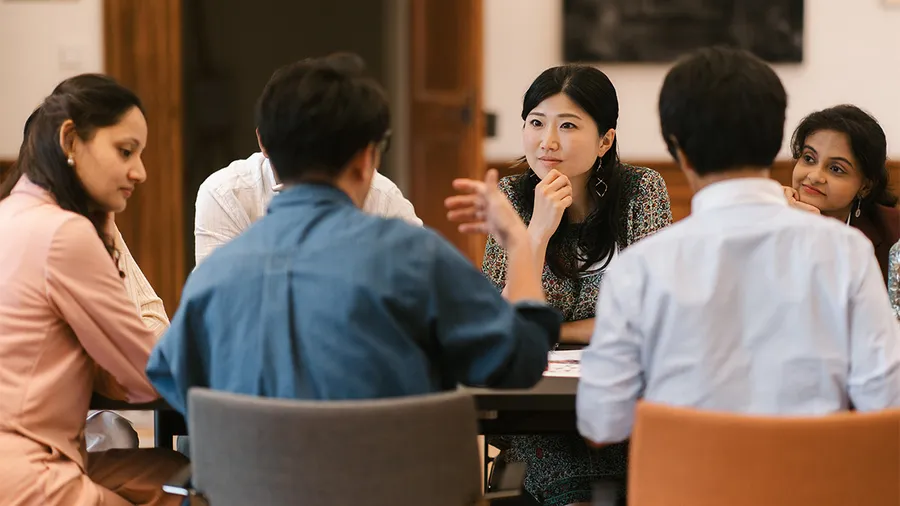
Salzburg Global Fellows from India and Japan identify common challenges in accessibility, healthcare, and livable cities
As part of the Japan-India Transformative Technology Network, Fellows develop projects that address pressing social challenges with technological solutions. As a first step in this process, they have identified common challenges between India and Japan, focusing on how to expand social inclusion, improve health and healthcare, and enrich life in urban and rural communities. The ideas contained in this article were generated by working groups of the third cohort of the Japan-India Transformative Technology Network.
Accessibility, Mobility, and Inclusion
Challenges related to accessibility, mobility, and inclusion impact marginalized groups such as the elderly, persons with disabilities, and non-English speakers. Conversations at Salzburg Global have revealed that India and Japan need to address accessibility in both physical and digital realms, especially in the development of AI and language models. Current AI models predominantly cater to English speakers, which excludes many Asian languages. Future AI should integrate voice or neurotransmitter technologies to support diverse languages. Direct translation tools between languages (e.g., Japanese to Indian languages) are also essential to avoid relying on English as an intermediary.
Inclusion efforts must focus on developing solutions with marginalized groups in mind, ensuring these can be scaled for broader use. Companies should prioritize the needs of minority groups when developing new technologies to ensure true inclusivity.
Mobility issues are pronounced among the aging population in rural Japan and India, with inadequate transportation options and economic divides exacerbating these challenges. Technologies like autonomous vehicles and digital solutions, such as ordering medicine through WhatsApp, can help bridge mobility gaps.
In discussions at Salzburg Global, Fellows agreed both India and Japan must build frameworks that address the diverse needs of their populations, such as by developing a platform to collect marginalized voices and establishing guidelines for accessibility and inclusion. A participatory design approach can ensure accessibility issues are identified and that solutions meet the needs of minority user groups.
Health and Healthcare Systems
A critical issue in health and healthcare across India and Japan is the marginalization of vulnerable populations. Learning from one another and exploring this issue in more depth, Fellows recognized the potential of technology to bridge these gaps. While Japan has established healthcare guidance programs, India struggles with access to basic healthcare services, exacerbating poverty and limiting labor market inclusion.
Fellows have highlighted that both countries face a common problem in ensuring the well-being and mental health of their populations. The need for a proactive rather than reactive healthcare policy is evident, especially considering the ripple effects of climate change on health. Effective disease eradication strategies must focus on household-level interventions and strengthening from the bottom up.
Mental health is a significant challenge, with social perceptions and political behavior influencing policy and public awareness in both countries. The representation of persons with disabilities, especially in mental health, needs urgent addressing to reduce stigma and promote inclusion.
Autism and developmental disorders, as well as hearing and attention deficit disorders, require immediate attention. The COVID-19 era has highlighted the importance of investing in healthcare, with technology and AI advancements providing new opportunities for intervention and support. However, sustainable public service costs and affordable universal healthcare remain elusive goals in both countries.
Synergies between India and Japan can be found in addressing disabilities. A culturally adapted mixed model incorporating both medical and social aspects of disability can provide a comprehensive solution. For example, redefining sign language not as a disability but as another language can shift social perceptions. Developing tech-based projects to generate mind maps for understanding disabilities from a grassroots level can further enhance inclusivity. Overall, Fellows felt the focus should be on creating sustainable, inclusive, and tech-enabled healthcare solutions that address the diverse needs of these populations.
Livable Cities and Communities
Safety is a foundational concern present in developing livable cities and communities because without a sense of security, people are reluctant to stay in a city. In Japan, safety is ensured through system protocols such as stringent building regulations and land use policies and is communicated authoritatively. However, there are concerns about safety against climate change impacts, such as rising sea levels and natural disasters. India, while having well-established communicative measures for emergencies, often falls short in providing adequate compensation and insurance against damage from natural disasters, such as floods.
Mobility and transportation also present significant challenges. Overpopulated cities in both countries struggle with infrastructure issues, making accessibility a key concern. India's infrastructure, including broken pavements and lack of elevators, severely restricts mobility, especially for persons with disabilities. In Japan, bureaucratic obstacles make it difficult for people to move between cities and rural areas, affecting overall mobility. Fellows agreed that both countries need to improve multi-modal connectivity and make public transport more inclusive and efficient.
Additional challenges include fragmented governance in India, which causes accountability issues among multiple municipalities, and the lack of continuous, disaggregated data on different social groups, hindering effective policy implementation. Building consensus among various stakeholders and balancing community needs with individual demands are also critical issues.
Enhancing cross-cultural collaboration between India and Japan could address these challenges by combining Japan's structured approach with India's adaptability and openness to innovation. By fostering synergies and leveraging technological advancements, changemakers in both countries can work towards creating more inclusive and accessible societies.
The Japan-India Transformative Technology Network connects and empowers outstanding changemakers in two countries on the forefront of technological progress in Asia – India and Japan. The program offers a platform for those working towards social good to maximize the benefits of various forms of new technologies.
Through participating in the Network, Fellows form small project teams to design potential solutions to shared challenges in their professional work. Read more about the projects that are being developed by cohort 1, cohort 2, and cohort 3.