-
Topics
TopicsOur programs create spaces where open-minded leaders can gather for breakthrough conversations on pressing global issues – each aligned to one of the following pillars:
-
Events
EventsExplore the variety of events Salzburg Global hosts within Austria and in the rest of the world. Learn more about our programs and what else happens at Schloss Leopoldskron.
- Insights
-
Fellowship
FellowshipSince 1947, more than 40,000 people from over 170 countries have participated in Salzburg Global's sessions. Collectively, these alumni are known as Salzburg Global Fellows.
-
About Us
About UsSalzburg Global is an independent, non-profit organization committed to creating spaces that overcome barriers and open up a world of better possibilities.Our Approach
-
Support Us
Support UsYour generosity helps us gather open-minded leaders for breakthrough conversations, while creating space for dialogue that overcomes barriers and opens up a world of better possibilities.
- Donate

- Published date
- Written by
Share
Peace & Justice
Opinion
Engaging the Business Sector on Youth Safety and Justice
Published date
Written by
Share
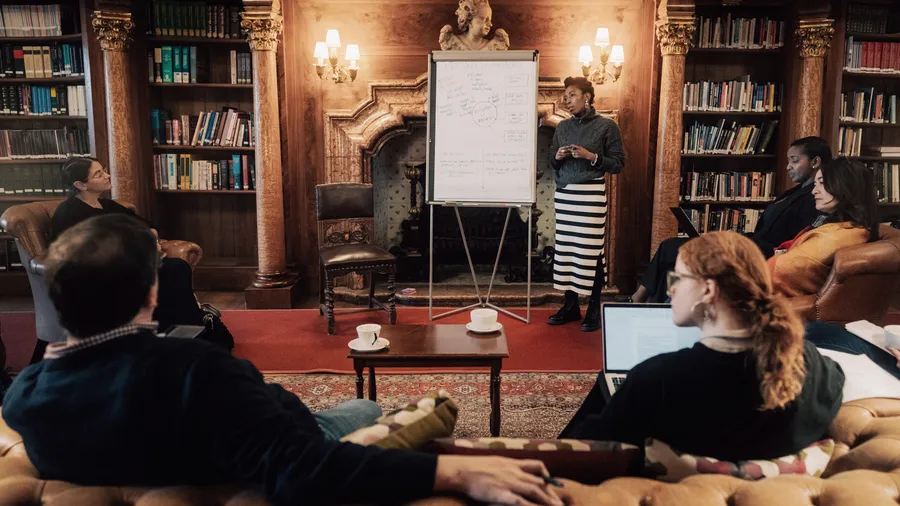
Fellows at the Global Innovations on Youth Violence, Safety, and Justice Program in December 2025. Photo Credit: Richard Schabetsberger
How can advocates for youth safety and justice win over some of society's most powerful players - businesses and corporations?
Drawing on her experience as Partner and Executive Director of Global Pro Bono at the law firm of Baker McKenzie, Angela Vigil offered a pragmatic look at what it takes to bring private-sector lawyers and corporate actors into the fight for social justice. As a lawyer and social justice advocate, Angela bridges the lived realities of under-resourced clients with the worlds of corporate lawyers. Her work channels the funding capacity of the private sector while staying rooted in the values of public-interest advocacy.
Angela observed that for many law firms today, pro bono work is viewed as integral to professional identity, as individual lawyers are expected to contribute to the public good. But when the conversation shifts from the expectations of individual professionals to those of corporate entities, it becomes more complicated. While "responsible business" is a growing priority, there are many differing motivations, constraints, and incentives behind these corporate efforts.
Understanding the Corporate Worldview
Angela joined Fellows at Salzburg Global's Global Innovations on Youth Violence, Safety, and Justice Program on “Advancing Youth Safety and Justice: Transformative Policies, Community Solutions, and Accountable Practices.” To help them navigate this terrain, Angela introduced a framework that begins with understanding the corporate worldview. Businesses are revenue-driven and accountable to a complex mix of shareholders, boards, governments, employees, and communities. These institutional realities shape how they interpret concepts such as impact, partnership, and social responsibility - often in quite different ways from community organizations or youth justice advocates. Still, she emphasized, there is a growing belief within the private sector that companies are stronger when they are socially responsible and when employees are proud of the institution they work for.
Angela described several “entrance points” for collaboration, each with its own constraints and opportunities. Corporate foundations tend to have clear, long-term missions tied to brand identity, and while they move slowly, their commitments can be deep. In contrast, employee volunteerism is driven by enthusiasm and networks, but these efforts may lack dedicated funding or strategy. Using multiple incentives to drive support – time or treasure – can be a successful strategy to gain friends, followers, funds, and advocates for social justice. “We don’t care why you do it, just do it,” she said, reflecting a pragmatic approach to mobilizing private-sector engagement.
"Money follows people," Angela advised, explaining that companies tend to invest where their employees are involved and their people have shown interest. Even within these constraints, the potential is enormous. She pointed out that “industries follow industries,” meaning a successful partnership with one company can generate momentum across a whole sector.
Storytelling as an Advocacy Tool
So how do you do it? Storytelling is an essential part of this work. Companies want to understand why a project is meaningful and how their involvement makes a positive difference. Strong narratives help both executives and employees feel connected to this impact.
To successfully engage businesses, Angela stressed, initiatives must be framed in ways that speak to corporate goals and stakeholder interests. While values matter, she cautioned that companies will always weigh social missions against financial risk and other unknown stressors that have to take priority at one time or another. Understanding that will help avoid disappointment because a rejected request for support may simply reflect bad timing.
Challenges remain, especially in the discrete arena of youth justice: Businesses are often risk-averse, pressed for time, and may not fully grasp the lived context of youth justice. Yet the private sector also brings its strengths: the courage of one company can inspire others, and healthy competition can drive collective action. International norms and internal targets can further reinforce long-term commitments. And passionate and committed individual leaders can move mountains. The key is to find them and share the stories that speak to them. “Be bold and tell the story,” she advised. This can open doors that you would not expect.
Angela’s reflections helped Fellows understand that meaningful engagement with the private sector requires storytelling, strategy, and an understanding of what motivates businesses. When approached thoughtfully, companies can become powerful partners in advancing youth safety and justice, potentially helping shift entire industries toward more principled action.