

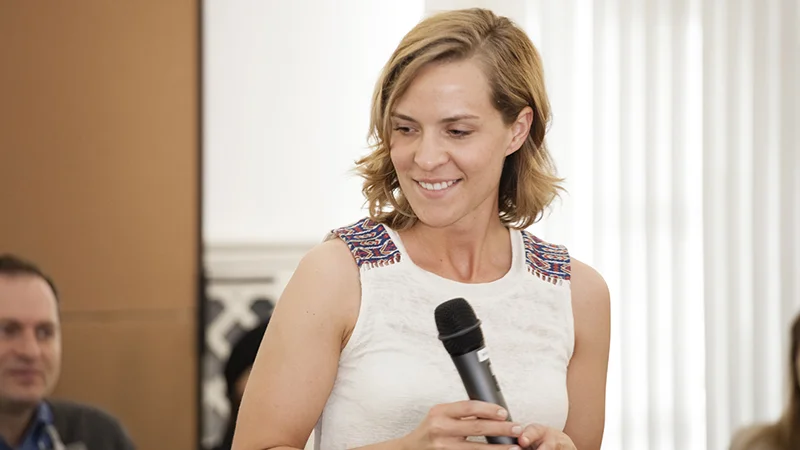
Emma Leblanc, Rhodes Scholar at Oxford, discussed her experience photographing and recording narratives during the outbreak of the Syrian revolution
While the situation in Syria remains grim, Emma Leblanc, a Rhodes Scholar at Oxford who photographed Syria during the outbreak of the revolution, pointed out that any strand of hope comes from witnessing the courage of others risking their lives. “If theres any hope, I think it means a lot to grow up in an environment where you see people being as brave as they're being. People who know the risks, and they do, they know the risks of what they're doing.”
Leblanc discussed her experience photographing and documenting the lives of Syrian citizens at the session Youth, Economics and Violence: Implications for Future Conflict . She talked about her first experience visiting a nursing home in Syria, where she later went on to photograph and record their stories.
“It was really this sort of catch all for everyone who doesn't have a place in society. The elderly, the disabled who maybe are stigmatized in their communities and have nowhere else to go, women leaving abusive husbands, drug addicts — there is very little care there.”
Still, said Leblanc, it was interesting to get the insight people who live on the fringes of society. “This was a space where everyone was sort of considered kind of crazy, marginal — they were able to say things that no one else could say.”
While she also photographed the war in Iraq, she felt a divisive difference in the photographs she produced there and in Syria. “I felt very dissatisfied with the work I did there — it felt like more the same war pornography that we see every day.”
She spoke of her detachment from photographs of Syria in Western media at the outbreak of the revolution. “I remember seeing one picture from a protest, and it was young men with scarves around their faces and fists up, and I thought, ‘I don’t recognize this as Syria. This isn't the place I know. This is generic Middle East unrest.’ And I felt very uncomfortable with that.” For that reason, Leblanc wanted to highlight aspects of the revolution and conflict that are often overlooked.
“I think I wanted to take pictures of people in war in which the agents were not just men with guns and the victims were not just women and children.” Some of the people Leblanc photographed included young ballerinas in the suburb she lived in.
While, as an academic, Leblanc complicated the notion of freedom and relative perspectives in the US and Middle East, she recognized the difficulty of growing up in different contexts. “I think as a young person, to see that, that’s got to be empowering. On the one hand, it’s devastating to see the response of the regime, the international response, but…also, what courage. I'm not sure I grew up seeing that courage firsthand.”
While being an academic may have Leblanc and her colleagues critiquing theory and strategy, she touched on the importance of hearing different perspectives and offering real solutions.
“This is great to be around people who are approaching this from all different ways, who are thinking about moving beyond the theory— they're thinking about what are we going to on the ground, how are we going to work with what’s there?”
A constructive outlook to create change, said Leblanc, is to focus on the positive. “Some of the ideas I thought were most exciting were ‘let’s stop talking only about what were fighting against, but let’s construct positive solutions,’ and I think that thats a really inspiring one. I think that it becomes very easy to fall into the critique, critique, critique, not just as academics, but in general, but there’s a real force to just creating a better system, and then everyone else has to catch up.”
Emma Leblanc was a Fellow at the session Youth, Economics & Violence: Implications for Future Conflict, which was held in partnership with the Harry Frank Guggenheim Foundation and the Carnegie Corporation of New York. For more information, please visit the session page: www.salzburgglobal.org/go/549
