

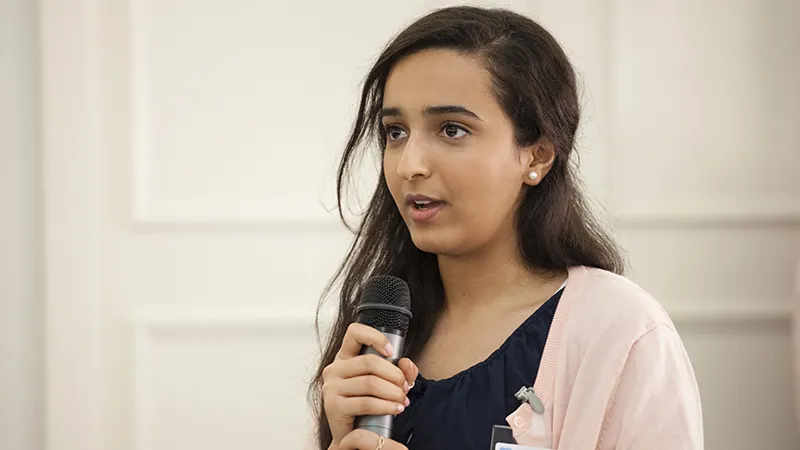
Aml El-Houderi, international advocacy program coordinator at Lawyers for Justice in Libya (LFJL), discussed the impact of marginalizing the Libyan youth
To tackle societal issues in Libya, from women’s political participation and youth involvement in civil society, there are cultural and legal foundations to consider. Aml El-Houderi, an international advocacy program coordinator at Lawyers for Justice in Libya (LFJL), talked to Salzburg Global Seminar about the youth’s marginalisation in Libya, and how this may lead to larger social shifts.
El-Houderi’s work with LFJL, an independent NGO promoting human rights in Libya from a legal framework, was originally founded by six Libyan lawyers who lived in the diaspora and used their international law expertise during the 2011 uprising. It now has a network of 60 Libyan lawyers across the country.
One of these key issues in Libyan society is the marginalization of the youth, a topic quite relevant for the session Youth, Economics & Violence: Implications for Future Conflict, held in partnership with the Harry Frank Guggenheim Foundation and the Carnegie Corporation of New York. The youth, said El-Houderi, are left out from decision-making roles in civil society, political participation, and under the law.
“In legal terms, youth are not protected in law. They are marginalized in the decision-making process, [in] their political participation they are marginalized [as well]. So they were called for in the revolution, their voice was heard, but then when it came to the next steps of rebuilding the country, they were completely marginalized and thought of as irritants.”
This kind of marginalization does not exist in a vacuum; the lack of decision-making power, said El-Houderi, can lead to issues inside of the home. Finding this new space to be assertive can lead to larger issues, such as domestic violence.
“This is nurtured by Libyan law,” said El-Houderi, “since there is a provision that a man can discipline his wife. The legal and cultural aspects are interrelated and they perpetuate the culture of discrimination of women.”
El-Houderi’s work with LFJL focuses on international advocacy, where she engages with the UN Human Rights Council sessions, the EU, the African Commission, and other Libyan NGOs to discuss resolutions for Libya as well as meet key stakeholders to discuss human rights violations.
She is also coordinator of the Coalition of Libyan Human Rights NGOs, which was created by LFJL. It includes six Libyan human rights organisations working around Libya’s Universal Periodic Review. Recently, LFJL put out a joint statement with Article 19 welcoming Libya’s acceptance of all recommendations related to free expression, association, and assembly.
El-Houderi also highlighted the significance of the session, and the impact of discussing different case studies from around the world. “It was just so great to have different stakeholders come together, youth, older people, experts from around the world in different fields.”
As a Libyan, El-Houderi found it especially important to share her perspective. “The first day you’re very intimidated, and then you realize that everyone is there to learn and that no one is intellectually arrogant…it’s also its a really nice feeling to be a Libyan here, especially since Libya is not on the international scenes or forums.”
To combat the issues that Libya is facing, whether internally or on an international level, El-Houderi stressed that focusing on positive behavior is key. LFJL’s work on a freedom of expression program called Express is an example of this, as it encouraged artistic expression of human rights.
“The general remark is that law and human rights are heavy topics to understand for everyone, so we have to bring those terms in such a creative and simple way,” she said. “I think creativity is key here.”
Aml El-Houderi was a Fellow at the session Youth, Economics & Violence: Implications for Future Conflict, which was held in partnership with the Harry Frank Guggenheim Foundation and the Carnegie Corporation of New York. For more information, please visit the session page: www.salzburgglobal.org/go/549
