

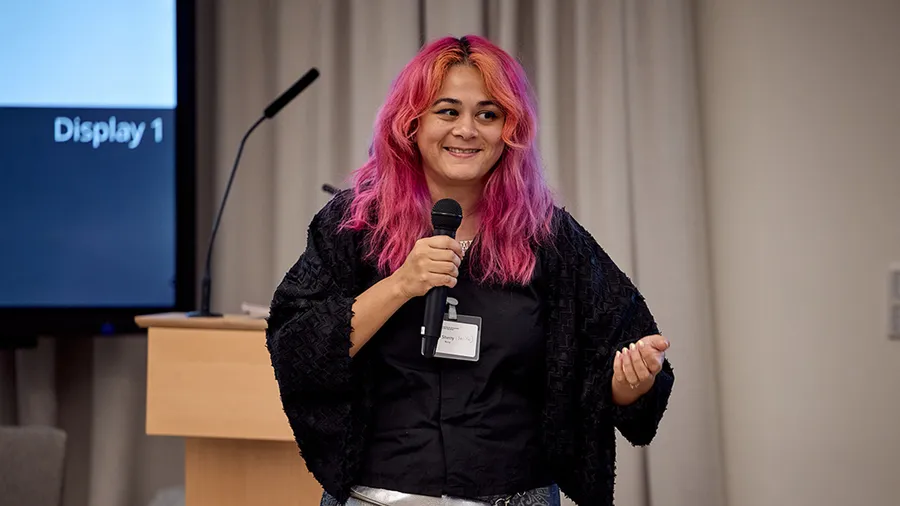
Artist Sherry Wong critically examines the societal impacts and ethical concerns of artificial intelligence in creative expression
The use of AI in artistic expression is a polarising concept. We asked Malik Afegbua, storyteller and creative technologist, for whom AI is an integral part of his art, and Sherry Wong, conceptual artist who tackles societal impacts and issues of belief and bias in AI, what their take is.
Read the diverging perspective of Malik Afegbua here.
Şerife (Sherry) Wong is a conceptual artist investigating power, narratives, and technology through her work at Icarus Salon. She has been recognized for her work on AI with fellowships and awards from the Rockefeller Foundation Bellagio Center, Berggruen Institute, Mozilla Foundation, and Creative Capital. As an affiliate of O'Neil Risk Consulting and Algorithmic Auditing and a research scientist at Kidd Lab, UC Berkeley, she tackles societal impacts and issues of belief and bias in AI. She serves on the boards of Gray Area and Tech Inquiry, leads AI governance at the Tech Diplomacy Network, and has served on award committees for Ars Electronica, Burning Man, and the Rockefeller Foundation.
Aurore Heugas, Communications Specialist, Salzburg Global: What concerns do you have about the potential risks, associated with AI and its increasing presence in the arts world?
Şerife (Sherry) Wong, artist: So my main concern with the proliferation of AI tools at the moment is how it concentrates power in the hands of a few. AI technologies take a lot of computer power and money, it doesn't actually belong to that many diverse group of people. It’s just primarily a few companies, and that concentrates power. And when you collect and incentivize data collection at that scale, with all the AI hype going on, what you're going to get is power over in this direction. That gives the ability to companies only in like the United States pretty much, to have power over others because data helps make things more legible. It's a way of surveilling people to collect their data as well. And when you have that knowledge and you have the computers that can see and compartmentalize and make decisions, you're basically leading to authoritarianism.
AH: Your work often relates to the issues of belief and bias in AI. How do you see those manifesting within artistic creation?
SW: There is nothing new about AI. It seems new, but the technology itself is rooted in the 1950s. The math part of it is really from the 1980s, the big data stuff we've been doing whenever we've had all these computer chips for the past 20 years. It's the money part that's sort of new. And that data that AI is dependent on, this big data, it's our data. So it's very reflective of who we have been as people. And that means that it is full of bias, it is full of our racism. Our good parts, our bad parts, poor decisions that other people have made. So when you use an AI tool, that stuff comes up… If you're using an image maker and you ask it for images of a doctor, it is more likely to give you an image of a white man. Now they have filters on it so it doesn't do it as often, but the underneath embedded stuff is just us. It's the internet, and the internet is not reflective of the world. It's just the internet. And it's primarily a certain viewpoint from people of privilege. It's whiter, it's more male… So it replicates itself and invisibly can affect all the output and work that comes out of it. What I think you're going to see, because of the use of ChatGPT and all these art tools, the more popular they get, the more content will be out there, and it'll just be, subtly, a lot more mediocre and racist and sexist and biased against disabled people and like hurtful and biased against the poor, and all sorts of those kinds of issues are going to be more dominant.
AH: What do you think about the potential for a lot of art to become homogenous. How do you see this impacting the diversity and richness of artistic creation?
SW: The way that people are using the tools are going to be in this homogeneous, neutralizing way because you're just replicating kitsch, and what is the average of all the arts, so there's a certain look to what it is. It takes creativity and an artist using these tools to make it cooler. I'm not as worried about it because artists are creative… They’re not going to be using the tools in that way. They try to break the tool. They try to make it expose itself. They play with it…
I am concerned about the use of these tools that takes away jobs from people. It’s not jobs like mine, because the kind of art I do is not … art that you can replace. I do conceptual, weird art. But for example, in Hollywood and the special effects industry… the people who are basically changing the color of a car from yellow to red, from scene to scene over and over again, those are outsourced jobs that are already less paid, already less valued and less respected. Those ones are going to be impacted. And we already know from the writers’ group that their jobs have been impacted too. People are looking for less freelance work. They're using these tools instead of hiring a writer. So the quality of work has gone down for the kinds of things that people never really wanted to pay much for in the first place.
AH: How do you see the dialog around the risks and weaknesses of AI in the arts evolving in the coming years? How do you see the relationship between artists and AI evolve?
SW: Right now there's a lot of narratives around the relationship of the arts to AI or the artist to AI. And the big thing to know about the narratives is that they're driven by fear. And that's what I see in the news all the time. The narratives are also ones of competition, like AI versus the human, artist versus artists. And one thing I keep hearing is like “AI is not coming for your job. Someone who uses AI is coming for your job, you better get with it”… And that's also just not true. It's a story. And we're telling all these stories because it markets the tools, and it's a choice.
People don't need to use AI to make art. They've never had to. I even saw this one post (that) was saying how AI has made it possible for anyone to make art now. What child hasn't made art?Anyone with a crayon has been able to always be a creator. So the shifting of the dialog that's necessary, the relationship that's missing or that needs to get worked on is a changing of a narrative…That there’s no competition, we don't need to be incentivized to use these tools, and people who do want to use them can use them in creative ways, but that they should be skeptical online…
Once you have a little bit of education, I think the narrative will eventually just shift because artists are smart and they're creative and they're very good at breaking the tools too. And when you break things, you expose exactly how they work and you expose all the problems in them and it will just fall apart. So I have a lot of hope that artists are going to be the ones who are leading in this space for other members of the public to learn about these tools and have their own stories that are generated by people and not being told by a big tech company.
To hear more from Malik and Sherry, watch the video below:
The Salzburg Global Fellows featured in this article convened alongside around 50 other artists, technologists, futurists, curators, and activists for Salzburg Global's annual Culture, Arts and Society program in May 2024. "Creating Futures: Art and AI for Tomorrow's Narratives" explored the emergent possibilities at the intersection of creative expression, technology, and artificial intelligence.
This article featured in our Shorthand story, which includes more coverage from the program "Creating Futures: Art and AI for Tomorrow's Narratives".
