

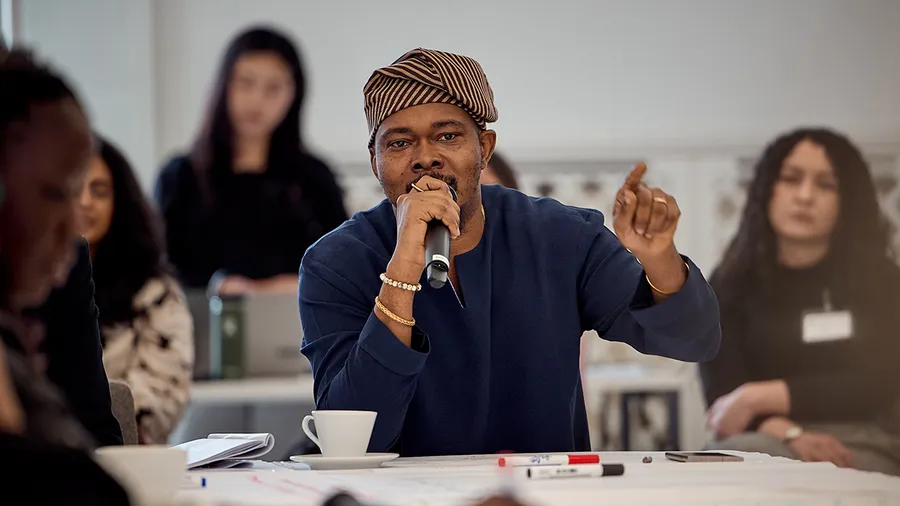
Nigerian artist Malik Afegbua shares his view on using artifical intelligence to reimagine tradition and challenge bias
The use of AI in artistic expression is a polarising concept. We asked Malik Afegbua, storyteller and creative technologist, for whom AI is an integral part of his art, and Sherry Wong, conceptual artist who tackles societal impacts and issues of belief and bias in AI, what their take is.
Read the diverging perspective of Sherry Wong here.
Malik Afegbua is a Nigerian artist and the CEO of Slickcity Media in Lagos, Nigeria. At Slickcity Media, he crafts documentaries, commercials, and immersive VR experiences, pushing boundaries and blending tradition with innovative tech like VR and AI art. In his viral project "The Elder Series", he used AI to reimagine seniors in vibrant fashion shows, sparking a global dialogue about inclusivity and challenging ageism. Malik is a champion for social change and founded C.E.L.S. to empower Nigerian youth through education and mentorship. He is a cultural guardian, collaborating with Meta to preserve African heritage through VR documentaries.
Aurore Heugas, Communications Specialist, Salzburg Global: How did you first become interested in incorporating AI in your art?
Malik Afegbua, CEO, Slickcity Media: It was mostly for research on how to use AI for my traditional storytelling. I'm a filmmaker as well, so I shoot TV commercials, films, etc.. So I used to use that for storyboarding, for visualization. But I also realized that it's powerful enough for you to create things that don't exist. So I started to experiment with that. And that's how I use it now.
AH: Can you share a little bit more about what kind of creative process goes into working with with AI?
MA: I look at AI as a tool, so it's mostly co-creation. I don't let it dictate the final result for me. So it's either I am mostly trying to be inspired by it or try to speed up my workflow or try to create more variations of things. But what I do is, I work with other softwares as well, like Photoshop, Illustrator and all of that, just to create the actual things I want to do. I'm very particular about the ethics of it. I make sure everything that I work with is my content, so that means that I could copyright it. That means that I could sell it or work for big brands, which I have been doing already.
AH: Your project, The Elder series, is very innovative and challenges ageism. What inspired you to start it?
MA: It was, first of all, from a personal space. You know, I love my mom so much. She wasn't feeling well, she was on life support. That was something that I was not used to, so I wanted to create her memories with AI, her demographic community, not in a suppressed state, but in a more elegant (one). I felt like I could use AI to do that. But it was a shocker for me because I realized that the AI was biased, so I literally had to train it to make it understand what we really look like. Not the biased image from the internet
AH: Can you talk more about AI bias and what you've noticed?
MA: The bias in AI is based off of what it's trained on. And if you look at inception of photography in Africa, it's mostly based on the colonial masters, showing the progress of Africa… And if you check out the pictures back then, most of the pictures were taken (with) Africa as a subject, or to show how powerful they were in comparison to how suppressed Africans were. The problem about that is, that is what stock imagery and AI is being trained on, alongside every other false narratives from the media… So that problem meant that AI, you know, understands how to filter was right or was wrong. So that meant that I had to do something about it…I had to showcase that, using the data that I had, and train it and make variations of those to come out with something different.
AH: What kind of potential do you see for AI to revolutionize arts?
MA: I look at AI as a blank canvas. First of all, I don't think it's intelligent. I think it's an assistance, because at the end of the day, you have to be experienced enough to create something unique from it, or else you'll be creating something very generic, so that means there's a blank canvas. If you're a creator or not, you have to be a part of it, to train it, to have the right types of data sets. So that could be used for the right types of solutions, or for the right types of stories, or for just envisioning and reimagining the future or the past, what it should be, you know? So that is something that I feel is profound because of the fact that you could alter it for the right reasons and create mind blowing things from that.
To hear more from Malik and Sherry, watch the video below:
The Salzburg Global Fellows featured in this article convened alongside around 50 other artists, technologists, futurists, curators, and activists for Salzburg Global's annual Culture, Arts and Society program in May 2024. "Creating Futures: Art and AI for Tomorrow's Narratives" explored the emergent possibilities at the intersection of creative expression, technology, and artificial intelligence.
This article featured in our Shorthand story, which includes more coverage from the program "Creating Futures: Art and AI for Tomorrow's Narratives".
