-
Topics
TopicsOur programs create spaces where open-minded leaders can gather for breakthrough conversations on pressing global issues – each aligned to one of the following pillars:Get Involved
-
Events
EventsExplore the variety of events Salzburg Global hosts within Austria and in the rest of the world. Learn more about our programs and what else happens at Schloss Leopoldskron.
- Insights
-
Fellowship
FellowshipSince 1947, more than 40,000 people from over 170 countries have participated in Salzburg Global's sessions. Collectively, these alumni are known as Salzburg Global Fellows.
-
About Us
About UsSalzburg Global is an independent, non-profit organization committed to creating spaces that overcome barriers and open up a world of better possibilities.Our Approach
-
Support Us
Support UsYour generosity helps us gather open-minded leaders for breakthrough conversations, while creating space for dialogue that overcomes barriers and opens up a world of better possibilities.
- Donate

- Published date
- Written by
Share
Peace & Justice
Opinion
Building Land-Rooted Federalism: Why Land in Post-Coup Myanmar Matters Now
Published date
Written by
Share
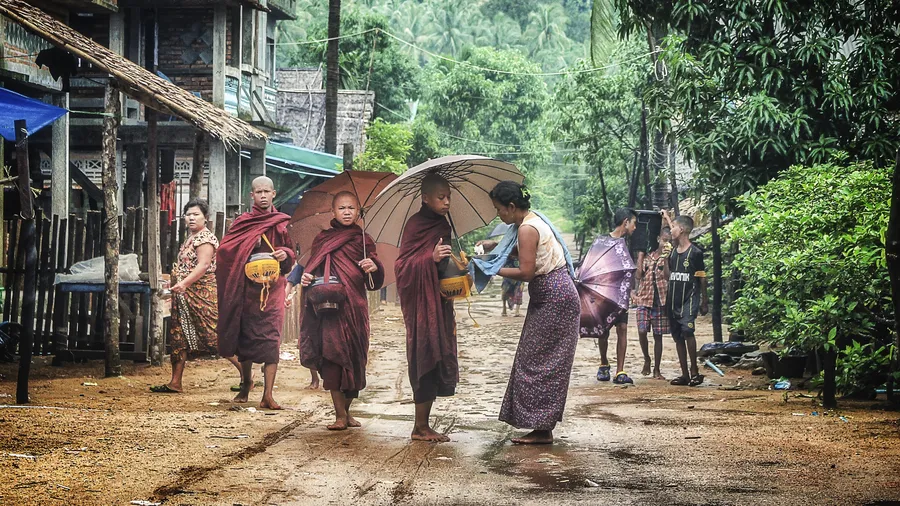
"The Donation": Launglon, Tanintharyi Region, Myanmar, 2019. Photo Credit: José Arraiza
Land has always been at the heart of conflict in Myanmar, but it can also be a platform for building peace and federal democratic governance.
Unfortunately, while some progress was achieved in promoting housing, land, and property (HLP) rights in Myanmar during the failed transition between 2011 and 2021, international actors have largely lost interest in the sector since the 2021 military coup. This has happened in the context of a global retreat of development and humanitarian aid, also termed the “humanitarian reset."
It is essential to support the protection of HLP rights in areas controlled by the junta, Ethnic Resistance Organizations (EROs), and People’s Defense Forces (PDFs); to enhance community land management; and to develop and implement land policies by EROs (which control large parts of the country and have done so for many years) and interim federal unit governments (that have begun to emerge since the coup). Such support would empower vulnerable communities, help protect their rights, and build their resilience, paving the way “from below” for a future federal democracy in which customary land rights are respected and victims are restituted.
The End of Donor Support for Land Reform in Myanmar
Military rule in Myanmar from 1962 to 2011 was marked by widespread human rights violations in which land was centrally implicated. Land was routinely confiscated, forcibly displaced communities were denied access to land, and vast territories were placed off-limits to legitimate users. Even where people formally retained use rights, their land was often tightly controlled under a flawed legal system.
During the democratic opening from 2011 to 2021, there was significant international support for land reform in Myanmar. Civil society played a critical role in developing the 2016 National Land Use Policy and ERO land policies, as well as in providing legal aid to communities, empowering them, and advocating for better land laws. International donors supported this work.
While most help ended after the coup, and civil society activity in the land sector dropped considerably for the first few months, that activity has rebounded and is again vibrant “under the radar.” The international community has remained disengaged, however, and some donors have explicitly stated that they will not support work on land anymore. Many think it is impossible to make progress. Some Western donors left Myanmar to prioritize Ukraine and other areas.
Why Work on Land Matters Now
There are various reasons to support work on land now.
First, CSOs who engaged in sensitive work in the land sector before the coup are vulnerable to repression. Without funding, they are unable to invest in digital security, safe relocations, and legal aid needed to protect themselves.
Second, land and natural resources are deeply implicated in conflicts among groups resisting the junta. Putting in place processes to begin to address control of land, territory, and resources would go a long way towards building unity among them.
Third, attention to land is essential in any development, peace, or humanitarian intervention. This was made clear in the recovery effort following the March 2025 earthquake, when aid providers discovered how important it was to verify property documentation or legitimate uses before engaging in reconstruction. Such due diligence efforts (including recovering personal documentation) are critical for ensuring fairness and “doing no harm.”
Fourth, ongoing changes in the land sector may have negative impacts on rural populations and their resilience. Land grabs have increased since the coup, especially in Junta areas, resulting in loss of livelihoods for the people and damage to ecosystems, and often cannot easily be undone. There is a need for interim protection. This means adaptive legal aid, support to mediation and Collaborative Dispute Resolution, and strengthening local customary systems against land grabs, as well as strengthening climate resilience. Since the coup, legal aid has helped communities in many cases defend land rights in both junta- and ERO/PDF-controlled areas, reportedly stopping harmful land takings thanks to collective pressure.
Fifth, action now can help the country prepare for a transition to a federal system where land governance will happen at the federal and lower levels, while inaction risks a crisis in land governance when transition happens. Already, some EROs and interim state governments have developed their land systems; some, such as the Karen National Union, did this long before the coup. Help is needed to ensure that systems developed protect human rights and reflect best practices. Some systems that have been developed are significantly better than their predecessors, such as recognizing customary rights and restitution for displaced people. However, there are causes for concern, for example, in the treatment of Rohingya lands by the Arakan National Army/United League of Arakan in Rakhine. There will be enormous incentives for new federal units to exploit natural resources to fund their operations and for powerful emerging groups to seek control over land. Ethnic land governance systems should be the basis for a new legal framework which completely overhauls the existing one and protects customary tenure and the right to restitution for victims. There is, in fact, the potential for new systems of land governance in Myanmar to be a global model of good governance, if support is provided.
No Federal Future Without Land
The scenario playing out in Myanmar is disheartening. The civil war has displaced 3.6 million people. There is no clear path to democracy: the December 2025 to January 2026 sham elections held by the junta have been neither free nor fair.
However, meaningful progress in Myanmar’s land sector is possible, as CSOs are already demonstrating. Work on land can empower communities, foster dialogue, prevent dispossession, support vulnerable communities, and lay the groundwork for a future federal democracy that recognizes customary land rights.
Neglecting efforts in post-coup Myanmar to promote land rights would be a serious mistake. Let us not allow the CSOs doing this vital work to be abandoned.