

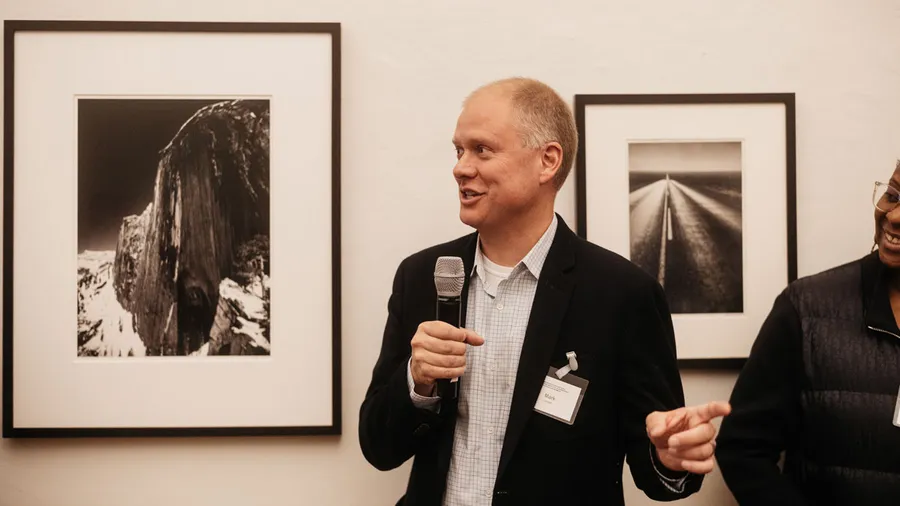
Salzburg Global Fellow Mark Jensen reflects on the role American Studies can play in addressing contemporary problems
This op-ed piece is part of a series written by Fellows of the Salzburg Global Seminar program “Democracy on the Front Lines: Polarization, Culture and Resilience in America and the World.”
Many of us find the world alarming today. We fear the neo-imperialism of China and Russia. We worry about the nuclear weapons in North Korea and Iran. We have a nervous eye on the forces of Al Qaeda and ISIS reconstituting in the lawless regions of Somalia, Syria, and elsewhere. More generally, we are concerned about the global impacts of modern industrialism on our soil, rivers, oceans, food, water, and climate. Focusing on the U.S., we are troubled by anti-democratic nationalism on the right and cultural zealotry on the left. At the same time, the tribalism evident in these movements is fed by increasing wealth inequality, regional polarization, as well as the persistent incompetence and spectacular failures of basic institutions such as schools, churches, unions, and police.
Just as alarming, in many ways, is alarmism itself. Our popular news sources present the concerns above in dystopian rhetoric and with the aesthetic of urgency. At the same time, these sources constantly identify winners and losers across the social, political, and economic landscape, feeding a general narrative that we are trapped in a zero-sum game in which most of us—certainly anyone who consumes their content—are on the losing end. Social and political leaders amplify all of this, believing that our fears will drive us to vote for them.
Clearly, however, alarmism is vicious. It encourages the “ethics of emergency,” in which our telos narrows to survival, and anything goes in order to achieve it. In other words, we are encouraged to focus increasingly on the short term, a focus that disincentivizes education, marriage and family-building, city planning, and long-term commitments to sustainable energy production and environmental stewardship. At the same time, the ethics of emergency encourages antipathy: when I “prep” my house for my survival or stock my closet with a “go” bag, I am telling myself that when the threat materializes, I alone matter.
American Studies can help us both disarm the alarm and confront our contemporary problems. It is, therefore, worth our time to reinvest in serious engagement in American Studies. Let me note three dimensions of the American experience that are especially relevant to our problems today, both the problems that we actually face and the alarmism that distorts our understanding of them.
Justice as Fairness. American philosopher John Rawls argued that distributive justice is best conceived of as fairness, where a fair distribution of important goods recognizes both the equality of citizens before the law and that social and economic liberty, even when it produces unequal material gain, can be good for all. In constructive dialogue with others (including especially Americans Robert Nozick, Carol Gilligan, Thomas Sowell, Carole Pateman, and Charles Mills), this conversation provides an important scholarly counterweight to traditionalist, utilitarian, and socialist alternatives. Unfortunately, this conversation seems to have vanished today. Reviving our attention to the sophisticated and nuanced discussion of justice among American scholars in the late 20th century could provide important theoretical and practical help to contemporary movements concerning human rights, human dignity, and social justice.
Ingenuity. Americans have long tackled problems through the dogged and optimistic application of science and industry. To be sure: American ingenuity has, at times, enabled colonialism and the darker side of capitalism. But American ingenuity has also produced profound global benefits in agriculture, medicine, energy production, transportation, and communication. While many of the problems appear to call on us to cease activities of one sort or another, it may be that progress toward solutions can also be made through the careful and creative application of science and technology.
Civil Society. As described by Toqueville and studied in depth by Robert Putnam, Nancy Rosenblum, and others, Americans have long been committed to achieving shared goods through the organizations of civil society: churches, clubs, sports teams, philanthropic organizations, affinity groups, and labor unions. Social scientists have observed that many legacy organizations of civil society have seen decline in recent decades. At the same time, the growth of social media has transformed the form, content, and communities in which we identify and participate on a regular basis. The models of civil society that we find in American history were unique in supporting the formation of positive communities among those with significant differences across race, ethnicity, gender, and other forms of cultural difference. At the same time, these communities demonstrate the ability to make decisions through deliberation, inclusion, and compromise. Perhaps these historical models can inspire innovations in contemporary cultures that will encourage a revival of these virtues.
Mark Jensen is a professor of philosophy at the United States Air Force Academy. Mark's interests include civil society, aesthetics, deliberative democracy, political liberty and social justice. He has published papers on military decision-making, the philosophy of architecture, ethics, and political philosophy.
