

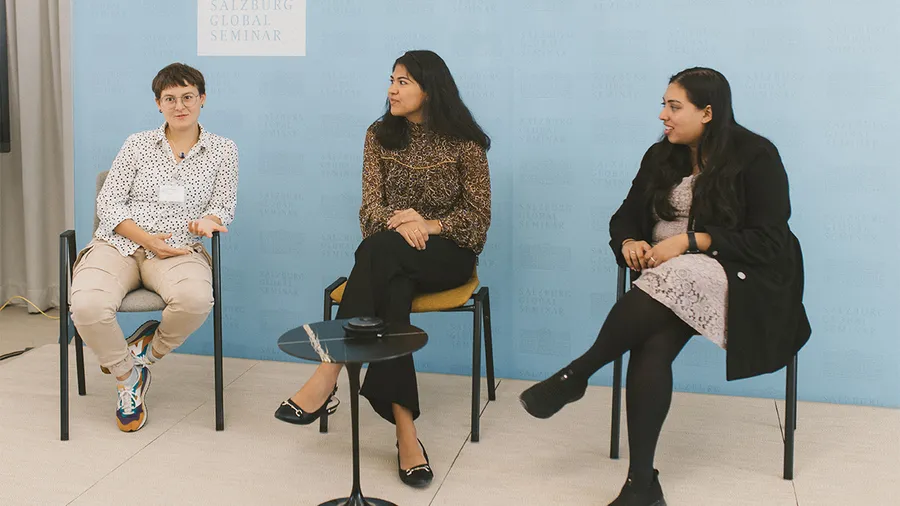
This op-ed piece is part of a series written by Fellows of the Salzburg Global Seminar program “Public Policy New Voices Europe”
This op-ed was written by Evelina Barbanti, Gabriela Pajuelo Chávez, and Noshin A. Chowdhury.
“Young people, when informed and empowered, when they realize that what they do truly makes a difference, can indeed change the world” - Jane Goodall
According to the OECD, youth participation in policymaking processes is an action-oriented process involving young people in institutions, initiatives, and decisions, affording them control over resources that affect their lives.
For our Public Policy Challenge, in the context of the Public Policy New Voices Europe Fellowship, we identified solutions to systemic critical issues we foresee for the future of public policy. Our focus was on how young people are inadequately engaged in policymaking because they do not have the tools available to become policy advocates.
A caveat to our conversation is the definition of youth. For our analysis, we defined youth as a flexible and broad spectrum. There are three age segments that we broadly identified: Kids (0-9), Teenagers (10-19), and Young People (20-30), but for our recommendations, we decided to use the UN definition of youth, which is the segment between 15-24 years old. However, we believe that all segments need to be engaged in different ways, and early intervention specifically sets up the baseline to empower youth to become policy advocates.
We believe that the 4 main pillars of youth engagement in public policy are:
- Civil Awareness
- Providing the Tools
- Implementation
- Impact
Having proper implementation of these pillars allows young people to participate in the policymaking process and will:
- Lead to more appropriate and effective policy outcomes that reflect the needs and aspirations of young people.
- Enhance the democratic legitimacy and accountability of policy processes by ensuring that young people have a voice and a stake in the decisions that affect them.
- Foster the civic engagement and empowerment of young people, as well as their skills and competencies for active citizenship.
- Contribute to social inclusion and cohesion by promoting intergenerational dialogue and mutual understanding.
Some of the specific recommendations we explored were:
- Developing a mixed funding model with government investment in core infrastructure and innovative programs for youth engagement in policy and change-making, leveraging both community and NGO expertise and infrastructure.
- Establishing or strengthening institutional mechanisms for youth participation, such as youth councils, forums, advisory boards, or networks, that are representative, consultative, and collaborative.
- Using digital media and technologies to facilitate online and offline communication, consultation, and collaboration among young people and between young people and policymakers.
- Providing feedback and recognition to young people on how their inputs have been used or valued in policymaking processes, as well as opportunities for evaluation and learning.
We opted to focus on digital tools as an immediate solution in getting young people involved in policymaking, looking at case studies in this field.
Case Study: Digital Tools as a Solution
Gabriela Pajuelo, a Salzburg Global Fellow of Public Policy New Voices Europe, organized the first official edition of the Hult Prize social entrepreneurship competition in Spain, with over 100 students participating to innovate around the UN's Sustainable Development Goals.
In 2020, right after the peak of COVID-19 in Spain, a lot of physical restrictions were set in place but young people were still up to the challenge, and through the use of digital tools, the competition was carried out online and its promotion was done via social media platforms. This now seems like the go-to approach to get youth to engage in any sort of activity, especially as technology and more digital tools become available to us. We have progressively drifted further from the traditional way to engage (e.g. paper flyers, in-person meetings, etc.) and this will arguably continue to be the trend (e.g. metaverse, streaming).
This case study about digital conversations helped us to reflect on the concept of meeting youth where they are and connecting with them in their own spaces, which ultimately proved to be a more successful and effective way to connect with them.
Recommendations
Although these suggestions are not comprehensive, we want to share some final suggestions that everyone can apply to engage young people in policy:
- Engaging with local politicians online
- Connecting with digital youth communities (that focus on topics like climate policy or EU affairs)
- Using social media platforms to have conversations around policy subjects
