-
Topics
TopicsOur programs create spaces where open-minded leaders can gather for breakthrough conversations on pressing global issues – each aligned to one of the following pillars:Get Involved
-
Events
EventsExplore the variety of events Salzburg Global hosts within Austria and in the rest of the world. Learn more about our programs and what else happens at Schloss Leopoldskron.Upcoming EventsSep 06 - Sep 11, 2026EducationA Tale of 2000 Days: New Partnerships in Early ChildhoodEducation for Tomorrow's WorldOct 05 - Oct 07, 2026Finance & GovernanceA Multipolar & AI-Driven World: Are New Approaches Needed To Preserve Profit and Public Trust?Salzburg Global Corporate Governance Forum
- Insights
-
Fellowship
FellowshipSince 1947, more than 40,000 people from over 170 countries have participated in Salzburg Global's sessions. Collectively, these alumni are known as Salzburg Global Fellows.
-
About Us
About UsSalzburg Global is an independent, non-profit organization committed to creating spaces that overcome barriers and open up a world of better possibilities.Our Approach
-
Support Us
Support UsYour generosity helps us gather open-minded leaders for breakthrough conversations, while creating space for dialogue that overcomes barriers and opens up a world of better possibilities.
- Donate

- Published date
- Written by
Share
Culture
Testimonial
When Bureaucracy Gets Creative: Reflections From Berlin
Published date
Written by
Share
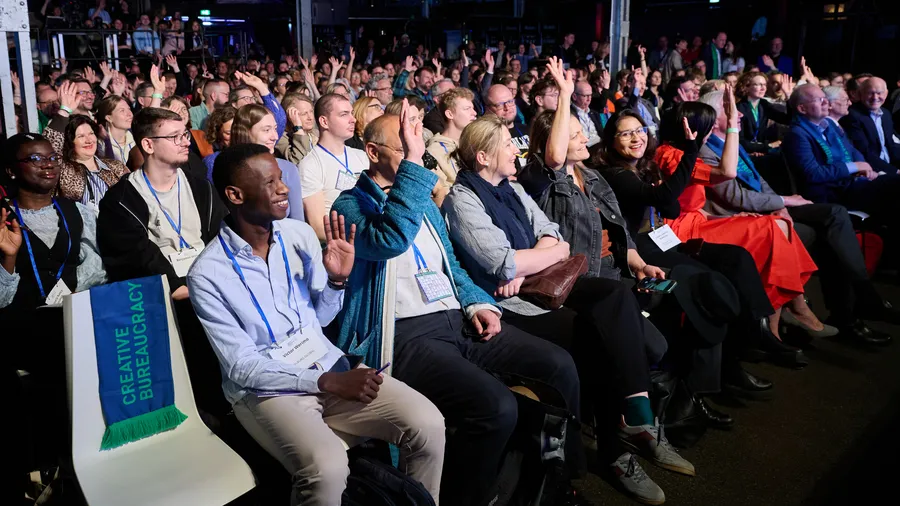
Victor Werimo (pictured at the front left) participating in the 2026 Creative Bureaucracy Festival. Photo Credit: Annette Riedl/Creative Bureaucracy Festival
This article was written by Salzburg Global Fellow Victor Werimo, who is a member of the fifth cohort of the Public Policy New Voices Europe program.
The views expressed here belong to this Fellow individually and should not be taken to represent those of any organizations to which they are affiliated.
The first time I heard the words “Creative Bureaucracy Festival,” I paused. It genuinely felt like an oxymoron. What exactly does it mean for bureaucracy to be creative? Every time I mentioned it to someone, “I'm heading to the Creative Bureaucracy Festival”, I'd get a raised eyebrow or a laugh. “That does not exist,” more than one person told me. “Those three words do not belong together.”
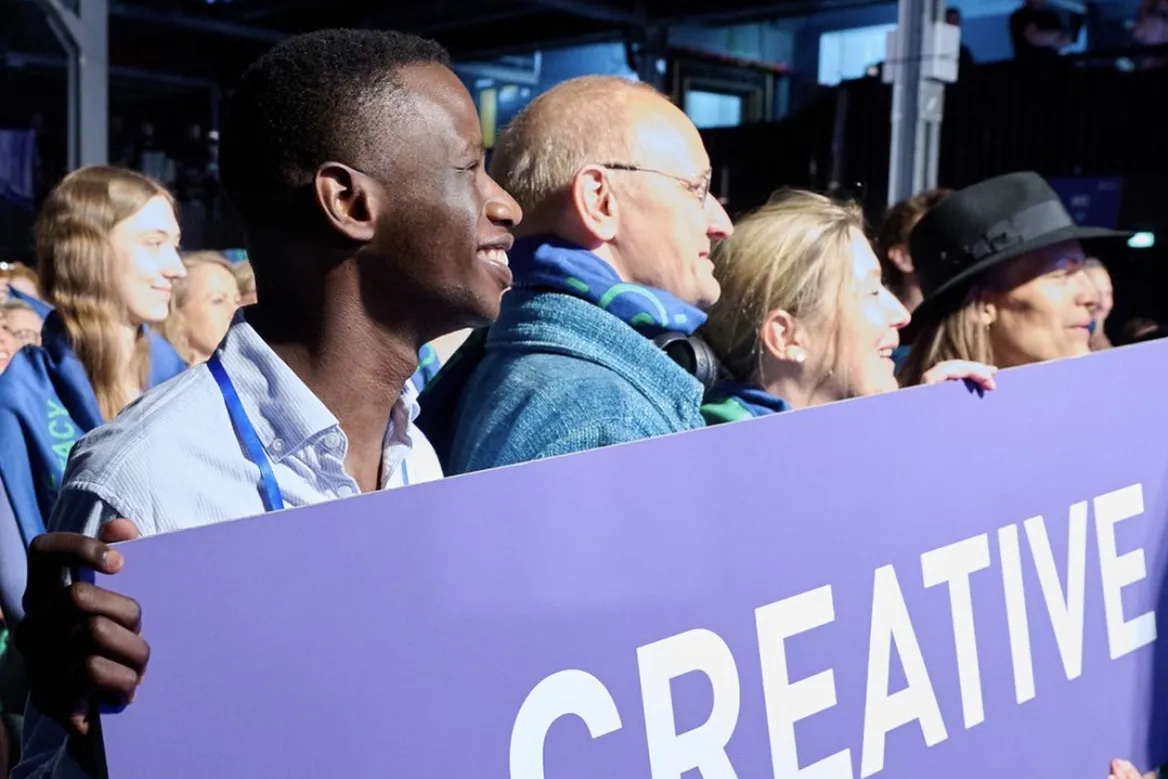
Yet, there I was in Berlin, among over 2,000 people, for one of the most thought-provoking days I have had in a long time.
Three Lingering Questions
The Festival was organized in a way that the full-day program took place across more than half a dozen stages with varying formats - from the Club, Factory, Garden, Circle, two parallel Forums, to the Academy. I leaned toward sessions with themes I suspected would challenge how I think. Looking back, it wasn’t any one stage or conversation that stayed with me. It was three questions that kept resurfacing, no matter which room I was sitting in.
1. What Connects Bureaucracy and Democracy?
The first was about democracy itself. This year's festival theme was "Creative Bureaucracy – Stronger Democracy," and the opening session described the high stakes of complex challenges facing modern democracies: scarce resources, repeated crises, and citizens growing more skeptical of what governments can actually deliver. George Papandreou, the former Prime Minister of Greece and now Rapporteur-General on Democracy for the Parliamentary Assembly of the Council of Europe, spoke with the candor of lived experience. He drew on Greece's 2010 financial crisis, and the innovation in public administration it eventually forced, to argue that other EU member states still have more to learn from that decade than they have absorbed. His answer kept circling back to the same three suggestions: collaboration, innovation, and design that starts with people. It was a grounding way to open the day.
2. What Is the Balance Between Technology and Citizens?
The second was how far automation can go before it stops being about citizens at all. Presenters from Estonia and Finland described the “agentic state”: a government that anticipates its citizens’ demands and requests. Estonia's Ott Velsberg, the country's Chief Data Officer, walked through what that takes in practice: building on the public data and digital infrastructure already in place; getting departments to responsibly share knowledge and data instead of guarding it; measuring outcomes over time instead of just promising them. It sounds ambitious. In Estonia, it appears to be working. But the line that stayed with me longest wasn't about the technology at all; it was the caveat that an agentic state worth wanting can't be reduced to chatbots. It has to be socio-technical, and it has to put the citizen, not the system, at the center. The question, still, is how you scale that kind of trust.
3. What Is the Government’s Role in Innovation?
The third was about the government's own role in innovation, and it came up most directly in a session called "From Control to Stewardship: Scaling Innovation for Health for All," built around the WHO's new guidance and toolkit for scaling innovation in public health systems, with Christian Bason, who is also a Salzburg Global Fellow, and Louise Agersnap. Public sector innovation is an emotionally loaded subject even in the best of circumstances, since taxpayer money is on the line, and the stakes multiply when the system in question is healthcare. The toolkit's central move was to reframe what government is for: not controlling or implementing, but acting as a steward to align policy, financing, and regulation so that good ideas survive contact with a real system, through repeated cycles of exploring, adopting, and learning. Other sessions ranged from mission-oriented innovation and open-source co-creation to AI chatbots and digital sovereignty, to data-driven strategy and AI-informed city planning. They shared the same undercurrent: Decisions are only as good as the information and trust behind them.
One of the most quietly resonant sessions came from the EU Policy Lab's PolyFutures meetup. It took a different format from everything else I'd seen: no panel, no slides, just a room full of people standing in a circle. The facilitators invited us to draw on our own lived experience and reflect on what shapes policymaking today. We imagined how participatory, creative, future-oriented approaches, design, foresight, and behavioral insight, used together rather than in isolation, might change policies. In my group, the conversation turned to trust: its foundations, and what it means to build policy at a moment when citizens are increasingly skeptical of institutions.
The thread running through our discussion was that you cannot have trust without accountability, and you cannot have accountability without openness. These are not separate conditions; they are interdependent. And the work of building them is not dramatic. It is incremental, unglamorous, and constant.
There was a lot to digest, and a quiet awareness in the room that the process is complex, and that there is very little time to do all of it.
The Question of Time in Policymaking
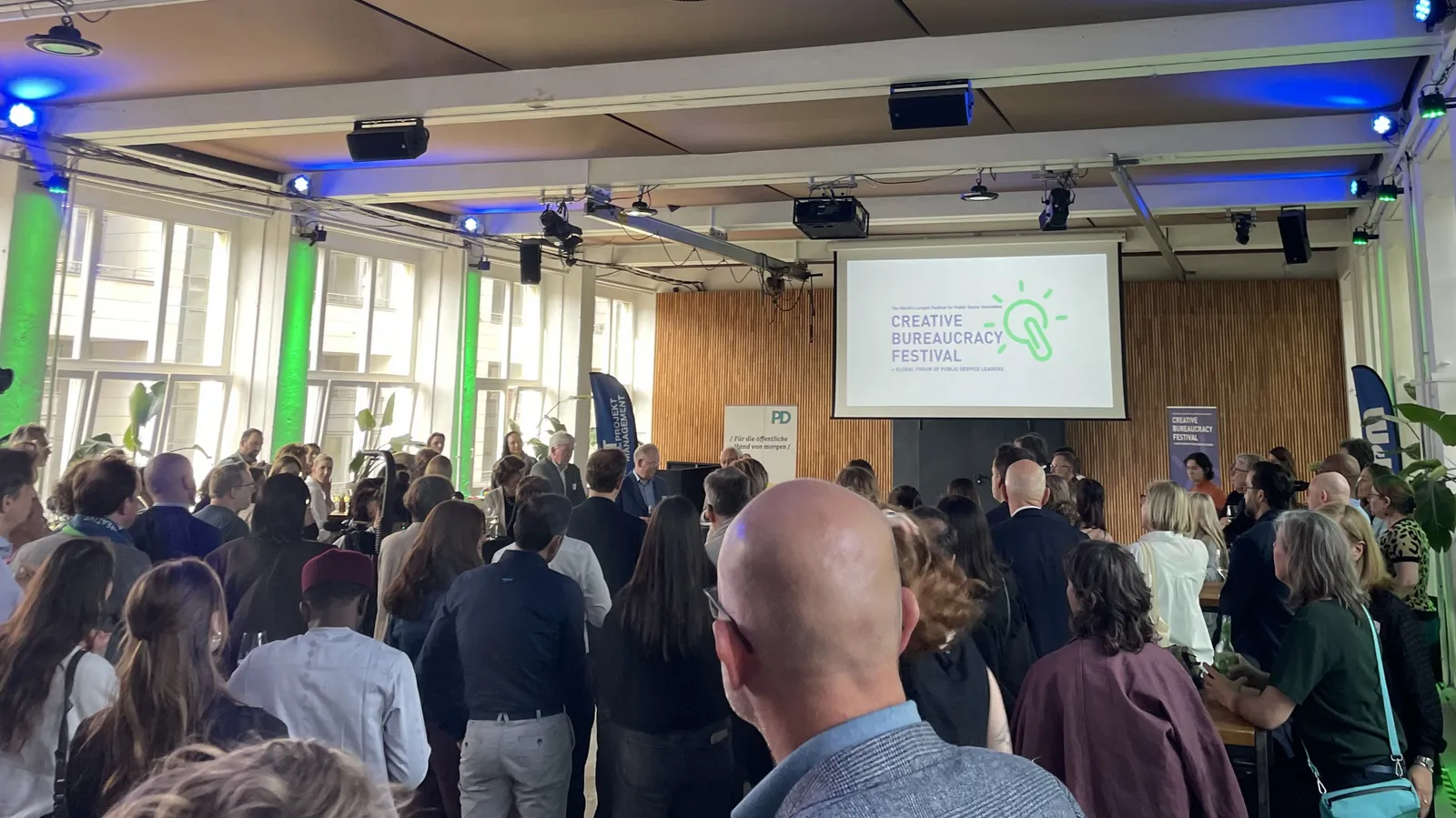
On June 12th, a smaller group of us gathered at the European House in Brandenburg Park for a deeper conversation on the tension between speed and legitimacy in policymaking. The scenario is familiar to many of us. A crisis arrives (such as COVID-19, the obvious example) and governments need to act fast. But fast action often risks bypassing the consultation processes that give policies their democratic legitimacy. Skip those processes and you risk resistance. Move too slowly and you risk harm. What do you do? Often, long-term thinking is sacrificed under pressure. The conversation turned toward a few practical responses: Anticipatory policymaking involves building living labs that run experiments before a crisis hits; Open data use, if citizens trust systems in place, allows decisions to move fast without moving blind; people who understand both the technical and human sides of a problem need increased capacity and funding; and political will is needed from champions willing to back policy that outlasts their own electoral cycle. In the discussions, it was interesting that nobody concluded the policy cycle itself is broken; instead, the question was how to make it faster, more legitimate, and more resilient, all at once.
My Take Home
Beyond the sessions, there was something valuable in simply being in the same space as people doing this work across health systems, climate policy, digital governance, public service design, and more. Some were from ministries, some were entrepreneurs, and some were researchers. All of them were, in one way or another, trying to close the gap between what governments promise and what they deliver, and how technology could reduce this gap.
Policymaking today can feel like surgery performed with imperfect instruments: little time, limited resources, and a patient list that includes people who are not even born yet. Almost every conversation in Berlin arrived at some version of the same prescription, even when the specific affliction changed:
Build capacity. Design for collaboration. Insist on accountability and transparency. Create spaces where citizens and stakeholders can help shape a future they want to live in. None of it is solved by a single clever tool. It requires testing, measuring, and adjusting rather than a one-time fix.
If I had to name one thing I am carrying back into my own work, it is this: The work of innovation in public life is not a solo endeavor. It requires many actors, from government, from civil society, from the private sector, and from communities themselves, sitting at the same table, often in uncomfortable proximity, working through things together.
The creative bureaucracy does not happen by itself. But it does happen.