

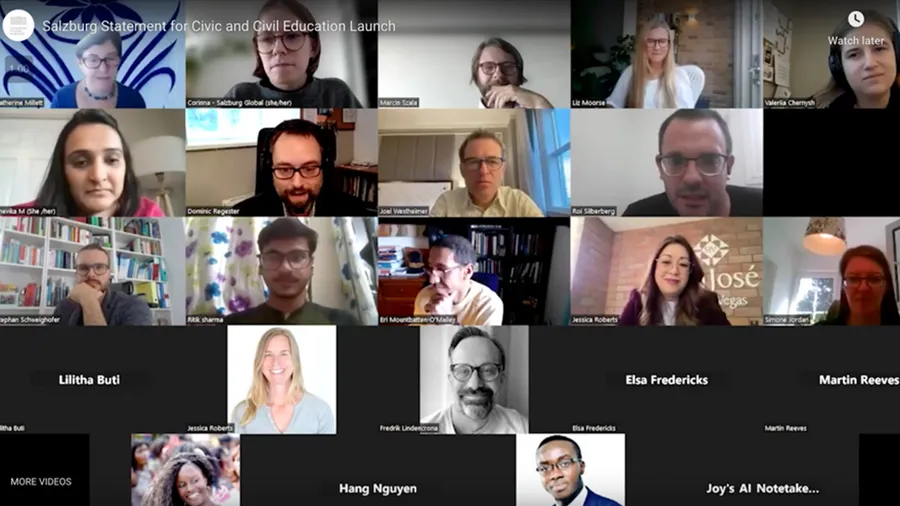
An online webinar attended by global participants launched the Salzburg Statement for Civic and Civil Education
Schools are microcosms of society, and important concepts such as voting, community organizing, and civic leadership should be integrated into schools worldwide. At a time when democracy is in crisis across the world, there is a need to understand, question, and challenge existing political, economic, and social systems. Through civic and civil education, we can foster more informed and engaged citizens who are equipped to challenge these systems and improve democracies globally.
The Salzburg Statement for Civic and Civil Education emphasizes the vital role of education in democratic societies and offers suggestions on fostering democracy, social movements, and challenging existing systems. It was created by Fellows of the Salzburg Global program on “Civic and Civil Education: Identity, Belonging and Education in the 21st Century”.
Through an online webinar on September 17, 2024, the Statement was launched by the Salzburg Global Center for Education Transformation. As participants introduced themselves, the names of people and places streamed in to form a global river. People joined from India, Sweden, the United Kingdom, Vietnam, Austria, Colombia, Kenya, Palestine, Portugal, Nigeria, Canada, Ethiopia, Kosovo, Argentina, and Germany! The virtual room we found ourselves in became a global melting pot, bringing people from around the world together.
Throughout the launch, we were guided by several Salzburg Global Fellows who wrote the Statement after participating in the program last year. Catherine Millet, strategic research expert and former director of the Educational Testing Service (ETS) Global Academy, reminded us that education is a lever for change. She emphasized that a diversity of experiences matter in navigating contexts of difference. One of the hallmarks of experiencing a Salzburg Global program is the global diversity of the participating Fellows, she noted.
It was clear from the diversity of the webinar participants that when people from different cultural and professional backgrounds come together, it is valuable for broadening perspectives, fuelling curiosity, and embracing different ways of being and knowing in the world.
Marcin Szala, co-founder of Liceum Artes Liberales high school in Poland, shared, “With civic education it is extremely important to go beyond just understanding on a knowledge level. What we want is to create an environment in which students are shaped into people who will take responsibility in their communities”.
Encouraging students to take local action can start in the early stages of schooling through a civic education framework called “Being, Doing, and Thinking” that was created by Fellows as part of the Statement. The framework offers a hands-on, action-oriented approach to implementing civic education in school communities.
The Salzburg Statement for Civic and Civil Education is a tool that can be used by anyone interested in introducing concepts of democracy or civic education to their classrooms or communities; this can include individuals, non-profit leaders, educators, among many others. The webinar closed with Shevika Mishra, founder of Kuviraa India, who explained further exactly who can put the Statement into action. She suggested that it can be helpful for people who are planning on introducing civic education as well as those who are working in the field and looking to expand what they are doing.
Corinna Nawatzky, program manager at the Salzburg Global Center for Education Transformation, hopes the Statement will be used all around the world in different contexts.The Statement is a foundation for advancing civic education in communities and building liberated education systems, she elaborated.
The webinar was a celebration of the learnings and outcomes from the 42 Salzburg Global Fellows from 20 countries who contributed to the Statement. It embodied their efforts to disseminate this knowledge with a wider audience and utilize the Statement as an advocacy tool in the education sector.
We encourage everyone to read and share the Salzburg Statement for Civic and Civil Education in your community and networks. If you have any feedback or want to share how you’re using the Statement, please contact the Salzburg Global Center Education Transformation. The Statement is available in English, Spanish, German, Portuguese, and Albanian. If you have the time and capacity to translate into your home language, please get in touch!
Read and download the statement here.
Resources from the statement launch
During the launch, participants shared links to the following related resources and topics:
- Book: "Designing Democratic Schools and Learning Environments" by Linda F. Nathan, Jonathan F. Mendonca, and Gustavo Rojas Ayala.
- Book: "What Kind of Citizen? Educating Our Children for the Common Good" by Joel Westheimer.
- Teaching tool: "The Harkness Method" - A participatory discussion method that can be implemented by students in the classroom that places students in the driver's seat of their learning.
- Teaching tool: "Parallel Elections Project" - A six-week resource guide from the United Kingdom (UK) General Election in 2024 which was used in schools to provide students with a practical experience of how democratic elections work in the UK.
Lilitha Buti is a youth community organizer from the YouthXYouth Weavership 2024. She is currently doing her "weavership" at the Salzburg Global Center for Education Transformation.
Watch the full webinar here:
