

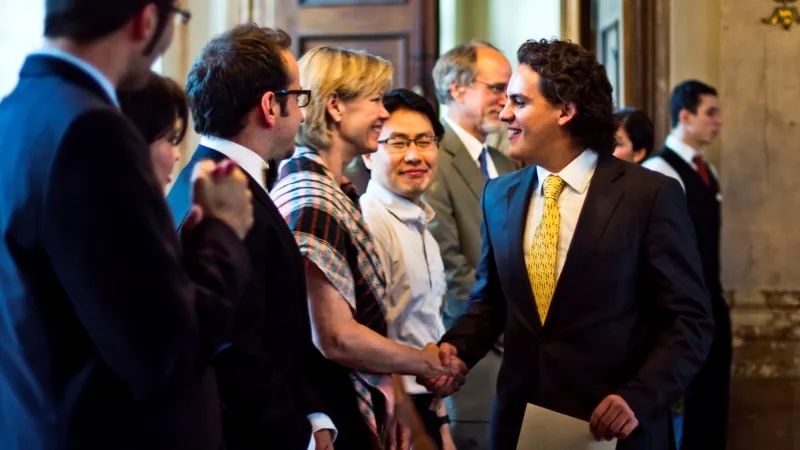
Over 60 students from 13 universities attended a three-week session on media literacy in Salzburg
Salzburg Global Seminar this weekend welcomes 68 students from 13 different universities on five continents to Schloss Leopoldskron for the annual Salzburg Academy on Media & Global Change.
The students, together with 13 faculty members, and a host of guest lecturers and practitioners will collectively make this the largest Academy to date.
Starting on Sunday, August 22, the three-week program, now in its sixth year, will cover Critical Thinking & Critical Skills and Freedom of Expression, aiming to teach media literacy skills—comprehension, analysis, and evaluation—highlighting the connections between media literacy and civil society, and informing the students about the importance of exercising their human right to freedom of expression.
The overarching theme for this year’s Academy is ‘Civic Voice and Protest’, reflecting the importance and prominence of such events as the Arab Spring, the global Occupy Movement and the student-led protests in Mexico, Canada, the UK and Chile. Students will explore the role of social media and mobile technologies in empowering civic voices, activism, and human rights, and look at the ways in which social media platforms can level the playing field between the powerful and the repressed.
Faculty from the students’ home universities, along with guest lecturers, will provide seminars around topics such as journalism protection, media framing, media literacy, multimedia storytelling, global citizenship and civic voices, amongst a host of other topics.
The curriculum has been developed over the past six years, culminating in the publication of News Literacy: Global Perspectives for the Newsroom and the Classroom by Paul Mihailidis, Academy Director and Assistant Professor, Department of Marketing and Communications at Emerson College in Boston, MA, USA.
Hailing from Argentina, Bahrain, China, Hong Kong, Kenya, Lebanon, Mexico, Peru, Slovakia, Switzerland, the United Kingdom, and the United States, the students have already begun their work, completing assignments on the concept of ‘Community’; students were instructed to read a number of chapters of Mihailidis’ book, write a short essay relating their reading of the book to the concept, and finally take a single photo that represented what ‘community’ means to them or how that concept is seen in their culture or in the country they come from.
Whilst at Schloss Leopoldskron, each week students will enter photography contests based on the topics discussed. Once such assignment last year covered the topic of “diversity”, with Slovakian student Martina Kincešová’s photo chosen as the winning entry. Through these assignments, students will examine how universal or disparate different concepts are across the globe, with the aiming of promoting cross-cultural understanding and considering how media can be used to share this understanding further.
With the London 2012 Summer Olympics also taking place during the Academy this year, students will also conduct an analysis of the media coverage of the Games, engaging in a global research project on the issue.
In addition to attending lectures and seminars during the session, students will also work in groups on media literacy projects and to create multimedia content. Previous years’ projects can be seen on the Academy’s YouTube channel. Students will also take study trips to the Alps and the Dachau Concentration Camp Memorial Site.
The Salzburg Academy began in 2007 as a partnership between the Salzburg Global Seminar and the International Center for Media and the Public Agenda at the University of Maryland, but quickly attracted partner universities from across the world that are home to leading journalism and communications schools*. To read more, please visit the website of the Salzburg Academy on Media and Global Change.
*American University of Beirut (Lebanon), American University in Sharjah (UAE), Bournemouth University (UK), Hofstra University (USA), Makerere University (Uganda), Polytechnic University of Namibia (Namibia), Pontificia Universidad Catolica (Argentina), Pontificia Universidad Catolica (Chile), Quaid-i-Azam Univeristy (Pakistan), Stellenbosch University (South Africa), Tsinghua University (China), Universidad Iberoamericana (Mexico), University of Maryland, College Park (USA), University of Miami (USA), University of Texas, Austin (USA), Zayed University (UAE), Syracuse University (USA) and University of St. Cyril and Methodius in Trnava (Slovakia).
Related content:
Salzburg Academy on Media and Global Change website:
http://www.salzburg.umd.edu/
Salzburg Academy on Media and Global Change 2012 student blog roll:
Rasha Abou Dargham - American University Of Beirut, Lebanon
María Paz Paniego - Universidad Católica Argentina, Argentina
Students Worldwide Interpret Core Concepts Differently:
http://www.salzburgglobal.org/current/blog.cfm?IDMedia=61850
…indispensable reading” and “…well timed and much needed”:
http://www.salzburgglobal.org/current/blog.cfm?IDMedia=64929
