

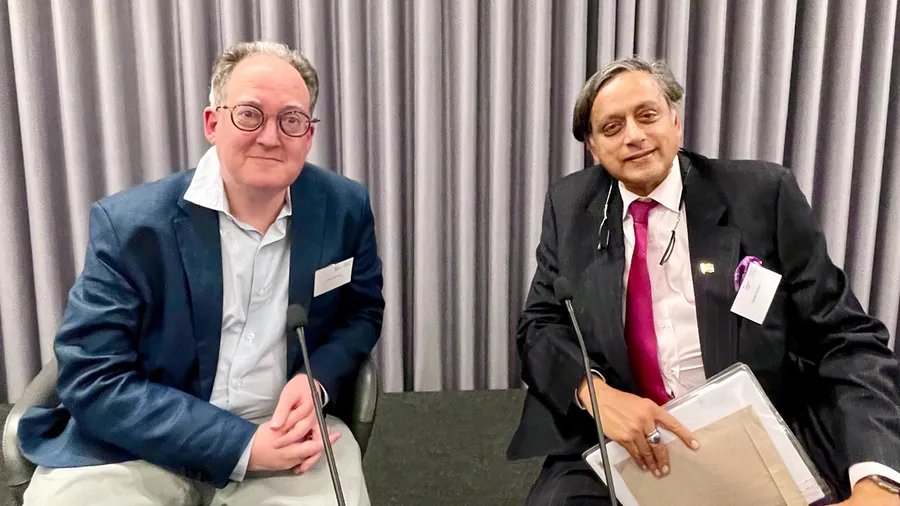
Shashi Tharoor, MP for Thiruvananthapuram, India, and former under-secretary-general at the United Nations, spoke with Gideon Rachman, chief foreign affairs columnist for the Financial Times
A new event dedicated to the memory of Salzburg Global Senior Fellow Edward Mortimer launched in London, UK, last month.
On June 12, the first-ever Mortimer Dialogue occurred with guests invited to consider the topic of "Reinterpreting the Responsibility to Protect," the UN's doctrine of humanitarian intervention.
Shashi Tharoor, MP for Thiruvananthapuram, India, and former Under-Secretary-General at the United Nations, sat with Gideon Rachman, chief foreign affairs columnist for the Financial Times, to explore the origins and importance of the Responsibility to Protect and its controversial implementation in countries such as Libya.
Nearly 100 people attended the Dialogue at the Aga Khan Centre, an event held under the auspices of 21st Century Trust in partnership with Salzburg Global Seminar – Austria.
Edward Mortimer, a Distinguished Fellow of All Souls College, Oxford, was also senior vice-president of Salzburg Global from 2006 to 2012 and chair of the 21st Century Trust from 2011 until his death in 2021.
Tina Micklethwait, a trustee for the 21st Century Trust, who initiated and sponsored the Mortimer Dialogue, told guests, "It's just wonderful to see so many of Edward's friends here, his family, and some new friends as well. Thank you so much for coming."
Before introducing Shashi and Gideon, John Lotherington, director of 21st Century Trust and a program consultant for Salzburg Global, described Edward as "the most astonishing friend and colleague and inspiration for around 30 years" that he had the enormous privilege of knowing and working with.
He added, "He wasn't just a brilliant writer. He wasn't just a brilliant speaker. He was a brilliant listener. He loved this sort of thing because he always wanted to encounter new ideas or take old ideas and interrogate them afresh.
"And one of the ideas he was so committed to - one of the doctrines he was so committed to - was the Responsibility to Protect. It meant so much to him intellectually, morally, and in terms of a view of the way the world should be."
Earlier in his career, Edward worked at the Financial Times between 1987 and 1998, where he served as chief foreign affairs columnist. From 1998 to 2006, he served as chief speechwriter and director of communications for UN secretary-general Kofi Annan. In 2005, he drafted the speech for Kofi announcing the Responsibility to Protect. Edward worked closely with Shashi, who headed the UN Department of Public Information.
During Shashi and Gideon's conversation, the audience was left to consider several questions. Is the Responsibility to Protect past its sell-by-date? Was it discredited by the intervention in Libya in 2011? As a result of current geopolitics and public opinion, is the principle even operable?
Or are there new sources of normative response coming from smaller and medium powers we can consider? While answering one of Gideon's questions, Shashi suggested there could be a gradation of responses, starting with sanctions, embargoes, or diplomatic isolation.
During the Dialogue, Shashi also suggested the principle was a product of a particular historical moment. In his last question, Gideon asked Shashi whether the principle was also the product of an unusually effective UN secretary-general or one who had a certain charisma.
Shashi said, "I believe so. I mean, [Kofi] certainly liked to think outside the box, push the envelope, [and] all these cliches.
"In fact, when [Kofi] decided to make a speech on intervention, the very first one that Edward wrote, we had some real questions about whether this was a wise thing for a brand-new secretary-general to attempt to do. But [Kofi] was clear in his mind that if at all there was anything to be said for the notion of the moral authority of the office […], then it meant raising some of the uncomfortable questions.
"We talked about Edward's draft at the time. [Kofi] was quite clear in his mind that this was worth saying and that he would say it. I was in the audience, and there was a sort of frisson through the hall as he spoke. There was this real sense of something, a sort of new door had been opened, or at least a window, that was letting [in] an awful lot of light and fresh air that we would somehow have to come to terms with."
Salzburg Global Seminar – Austria and the 21st Century Trust would like to express its warmest appreciation to those who made this event possible.
Watch the Mortimer Dialogue on YouTube
Listen to the Mortimer Dialogue on "The Rachman Review," a podcast by the Financial Times
