

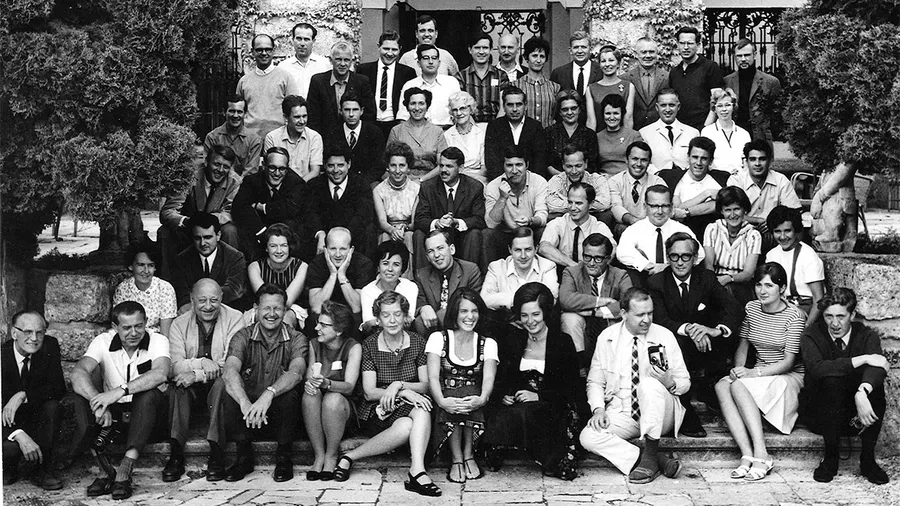
The relationship between the US Bicentennial, American studies, and Salzburg Global Seminar
Deborah Cohn is provost professor of Spanish and Portuguese at Indiana University Bloomington. She is the author of several books and has received fellowships from the National Endowment for the Humanities, the Rockefeller Archive Center, the American Philosophical Society, and the Harry Ransom Center, among other sources. Her areas of research include Cold War cultural diplomacy, especially the use of academic disciplines such as American studies and language study as a means of bolstering the US national interest.
This interview has been edited for length and clarity.
Paul Matangcas, Salzburg Global Seminar Communications Intern: What sparked your interest in the Salzburg Global American Studies program?
Deborah Cohn, Provost Professor, Indiana University Bloomington: I've known about this program for a number of years. I started working on American studies and foreign language studies as modes of cultural diplomacy in the US during the Cold War, and of course, when you start looking [these topics] up, Salzburg [Global] Seminar comes up frequently.
PM: Can you share more about your archival research on the US Bicentennial celebrations and its connection to Salzburg Global's American Studies program?
DC: There were five Bicentennial conferences between 1975 and 1976. The first one was [here] in April of 1975…Doing conferences, whether the topic is good or bad, allows for discussion, teaching, and research about American studies…The goal of the conference was to bring scholars…[and] not to put the emphasis on the US influence on the world, but the world's influence on the US as well. They were trying to emphasize reciprocity. All five of the conferences [had] a similar structure. They all opened with an American scholar giving an opening address and being introduced by a local scholar, and they closed with a local scholar giving a closing address and being introduced by an American scholar. In fact, [the organizers] did not want the conferences to be dominated by Americans…[because] they wanted the conferences to reflect the experiences and address the challenges faced by scholars working in American studies outside of the US.
PM: What is the importance of conducting this research?
DC: I think it's important for many reasons. The Salzburg Bicentennial conference offers important insights into how American studies had changed since the origins of [Salzburg Global] Seminar. When [Salzburg Global] Seminar was founded, the field of American studies was [focused on] the US. At the same time, talking about democracy and freedom of expression was a way of speaking about - and promoting - the US and the democratic system during the Cold War. Discussing the field of American studies thus exhibited and performed the qualities of democracy that the US government was trying to promote. For the Bicentennial conference, though, which took place in the wake of the civil rights movement and Watergate and at the tail end of the Vietnam War, organizers wanted to include scholars from Eastern as well as Western Europe, and they wanted to ensure that participants could be critical of the US. Studying how Salzburg Global Seminar changed between its founding and the 1970s thus gives insight into how the relationship between academics and the US state also changed as the Cold War progressed.
PM: How would you evaluate the state of American studies then and now?
DC: It's very different from what it was then. American studies has always been home to a diversity of approaches. I think that as a mode of scholarship and teaching, it's incredibly valuable and capacious. It brings in different perspectives.
Deborah Cohn attended the Salzburg Global American Studies program on “Beyond the Nation-State? Borders, Boundaries, and the Future of Democratic Pluralism” from September 19-23, 2023. The 2023 Salzburg Global American Studies Program focused on the contestations and renegotiations of boundaries beyond the nation-state, and how they are changing the representation of democratic pluralism.
