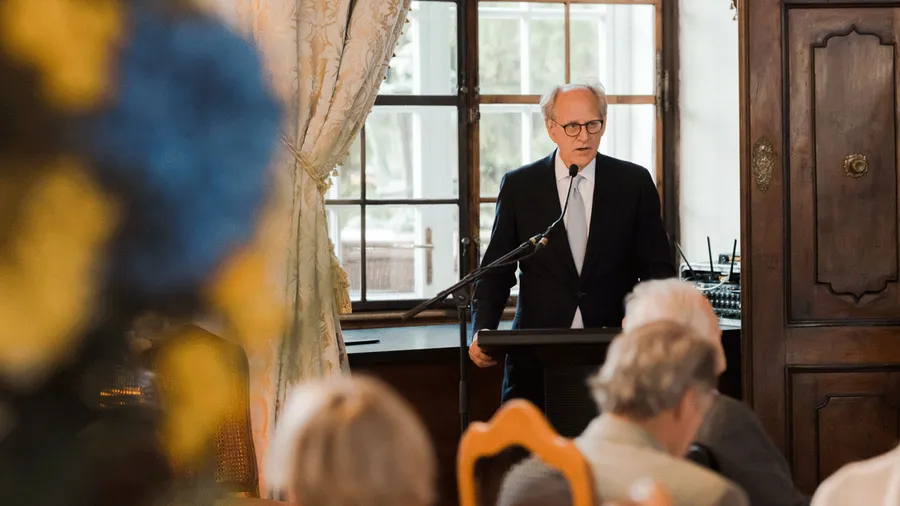
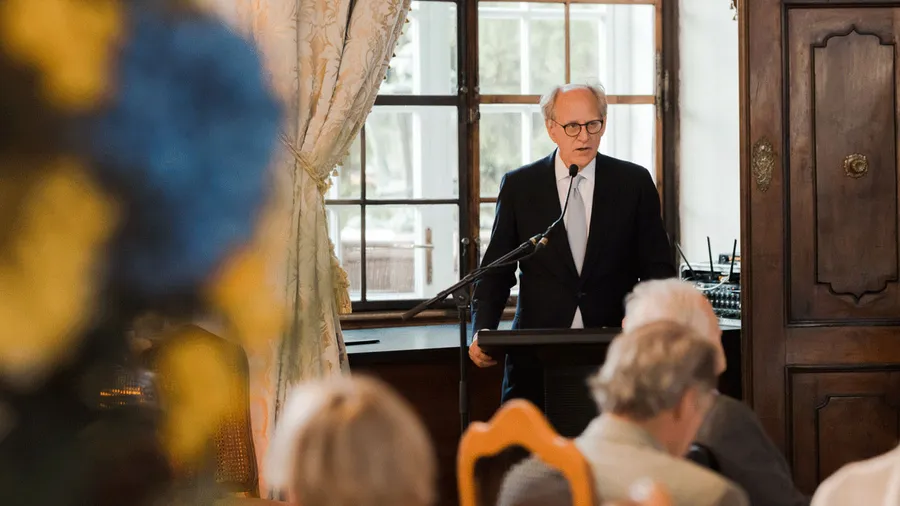
This speech was delivered during Salzburg Global's 75th Anniversary Weekend.
Good evening everyone, Salzburg Global Fellows from across the world, honored guests.
Please close your eyes for just a moment. Imagine the year is 1947. You and over 100 others have arrived in Salzburg from Europe and the United States for Salzburg Seminar number one. Seated among you are those who only recently were your enemies. Disease and malnutrition are rampant across the continent, making your journey and the organization of this gathering challenging at the extreme. The American student organizers have each brought with them a sack of flour as food supplies are scant; cots have been sourced from the Austrian army and food from care. Beds are arranged dormitory-style in the Schloss Gallery.
One of the three co-founders – Richard Campbell – has just heard an 11-minute speech by Secretary of State George C. Marshall given on June 5 at his Harvard University commencement, making the case for what came to be known as the Marshall Plan.
Just a month later, at Schloss Leopoldskron – in the library, next door – F.O. Matthiessen, a distinguished professor of literature and history and some would say the father of American studies – has just given the opening lecture.
“Our age has had no escape from an awareness of history,” Matthiessen said. “Much of that history has been hard and full of suffering. But now we have the luxury of an historical awareness of another sort, of an occasion not of anxiety but of promise.”
It was Matthiessen’s belief and that of the Seminar’s founders – Clemens Heller, Scott Elledge, and Richard Campbell – that Europe needed to be rebuilt not only physically and economically but intellectually and spiritually. It was incumbent on the young generation to re-establish dialogue to heal the wounds of war.
Now open your eyes. Seventy-five years have passed. Much has changed, and much remains the same.
More than 50,000 Salzburg Global Fellows have attended around 800 programs here. Salzburg Global Fellows are serving today as US Secretary of State, Managing Director of the International Monetary Fund, as members of central banks, high courts and legislatures around the world, and as leaders in business, education and civil society. Institutions and movements have been started here, and Salzburg Global Fellows attribute their Salzburg experience as contributing potently to who they have become. Yet we ask ourselves: “Is the optimism that a rules-based global order can enable economic competition to replace shooting wars any longer a view we can embrace?”
In March, we housed Ukrainian refugees here. Next month we gather a group to consider the role that civil society can play in the rebuilding of a European country once again devastated by war.
How does Salzburg Global contribute most in such a world?
A return to first principles may not be a bad place to start. Urged by our incoming president, Martin Weiss, we are emphasizing “peace and justice” as a central focus for our present and future work. As the Seminar’s founders understood well, without peace, little else is possible. Still, we recognize that security is not only geopolitical. Understanding that our planet is in peril and that collective action is essential to save it is as central a factor for peace and stability as resisting the use of armed force. In a crowded field of security conferences and think tanks, is this broader view of security where Salzburg Global might add the most?
Further, just as we helped develop and spread the concept of “one health” as a global strategy, our gatherings on “ending pandemics” and on nurturing effective health leaders remain of central importance for the future. Similarly, Salzburg Global has been active in the field of education since our founding.
In a world of artificial intelligence and revolutionary changes in the nature of work, we ask how can we prepare our children for lives of continuous learning, invention, and service? We also acknowledge and lead with conviction - especially post-COVID - the movement for social and emotional learning as a prerequisite for educational effectiveness. A priority of our Inspiring Leadership 75th-anniversary campaign is to endow an educational leadership center to anchor this work.
“Arts and Culture” also remains a central building block in our program. Creating a new program of residencies for artists, journalists, ethicists, and others will ensure that creativity thrives at the center of what we do here. What better way is there to celebrate the spirit of Max Reinhardt and of this creative community in which we reside?
With the forging of a new generation of leaders at the heart of our mission, we must take into account changing economic and political realities. Schloss Leopoldskron became in the Cold War a place where those on both sides of the Iron Curtain could meet and exchange ideas. As the world becomes more divided, we must be inclusive in our future approach if we aim to have influence.
This does not mean that we should sacrifice the aspirations of people everywhere to be free in matters of thought and access to information, nor to have a voice in determining one’s future. These aspirations have been bedrock at the Seminar since its founding, enshrined in the United Nations Charter, and should remain values we model and encourage across our work. Yet, Salzburg’s history of bringing ideological combatants together to seek common ground is every bit as important today as it was in 1947.
Salzburg Global Seminar brings much to addressing the enormous challenges that lie ahead. We have an approach and strengths complementary to, but very different from, academic centers, think tanks, and the watering holes of the rich and famous.
A key part of that difference is seeking out not just decision-makers and powerful figures but new voices to the policy table … those who have been historically under-represented and whose ideas are needed to shape a better future.
In the early years of the Seminar, our staff traveled regularly to spread the word about our work and to meet and interview potential Fellows. In the present world, we have other tools to showcase what we do, and during the pandemic, we got much better in engaging rising leaders online.
But just as nothing takes the place of meeting and exchanging ideas face-to-face, new strategies may be needed to find and recruit those who can benefit most from what we offer and to prepare them to achieve outsized impact.
Building coalitions with groups on every continent who share our search for solutions and commitment to ethical leadership is a strategy worth greater emphasis. While it is a big, diverse world, establishing Salzburg Global Seminar as a singular place for rising leaders who want to make a difference is well worth fresh attention.
As we began planning for this special anniversary, and as I anticipated the close of my presidency, I wanted to answer better the questions, “What is different about Salzburg Global Seminar?” And “How is its impact felt in the world?”
At a Paris café last summer, I met up with Tim Ryback, the Seminar’s former Resident Director and today Head of the Institute for Historical Justice and Reconciliation, which he founded here at Leopoldskron. We agreed that Tim would undertake a writing project that has evolved into “75 years in 12 vignettes” available for all of you in booklet form – a special issue of Clemens magazine, which we launched during our 70th anniversary year to honor our founder.
I would like to share some brief excerpts from four of these vignettes I find particularly powerful, but I encourage you to read them all. Each is tied to a room in the Schloss that figures prominently in the story.