

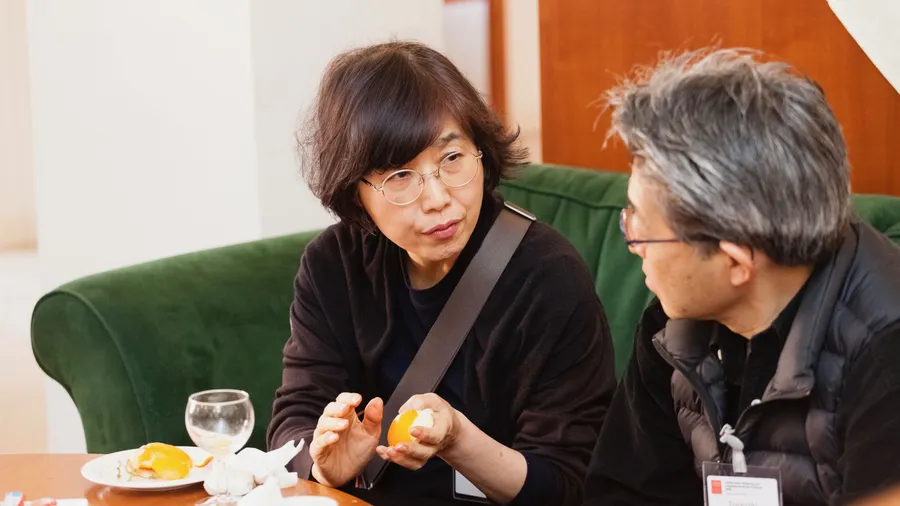
Fellows give their answers on the "hot topic" of Day 3 of Getting Smart: Measuring and Evaluating Social and Emotional Skills
“‘What is measured is treasured.’ That’s a very fine saying. It is treasured by policymakers and key stakeholders, and you have to assume that it has to be measured. It’s possible to measure using a combination of approaches: self-report, forced choice, and situational judgment test. If you use these three and triangulate across them, then you will be able to get rid of all the problems that would occur when you only use one of these approaches.”
Richard D. Roberts
Vice President and Chief Scientist, Professional Examination Service’s Center for Innovative Assessments, Australia
“The purpose of assessment needs to be clearly defined first. If it is simply to evaluate social and emotional skills of students, I don’t think it’s very meaningful. If we try to bring out educational effects through transforming evaluation methods, it could impede the original goal of furthering SEL development as students tend to focus on achieving a better score in the new evaluation system. We could learn much more if we discuss how we can develop more efficient ways to improve social and emotional learning through the assessment process.”
Chanpil Jung
Secretary General and Founder, Future Class Network, Republic of Korea
“To find more practical, relevant and simple ways of measurement – that is part of the reason why I came to this seminar. For our project in Bangladesh, we try to encompass both qualitative and quantitative measurement. Along with qualitative research methods such as class observation, focus group discussion, and in-depth interview, we use Ages & Stages Questionnaires that have been specially adapted for the Bangladeshi context. Though the method might differ from countries, I think we still need a global standard for the assessment.”
Sakila Yesmin
Research Associate, BRAC Institute of Educational Development, Bangladesh
“I think social and emotional learning should be measured to make sure that students are not only learning traditional competencies, such as math or literacy, but that they are educated more broadly to become a productive member of society and good citizens. I’m not sure if we should measure them in the high-stake assessments like other areas, as they are different, but we should definitely monitor if some specific programs are having an impact on their mission of developing these competencies.”
Elana Arias Ortiz
Education Senior Associate, Inter-American Development Bank, Costa Rica
Have an opinion? Tweet @SalzburgGlobal using the hashtag #SGSedu
-
Topics
TopicsOur programs create spaces where open-minded leaders can gather for breakthrough conversations on pressing global issues – each aligned to one of the following pillars:Get Involved
-
Events
EventsExplore the variety of events Salzburg Global hosts within Austria and in the rest of the world. Learn more about our programs and what else happens at Schloss Leopoldskron.
- Insights
-
Fellowship
FellowshipSince 1947, more than 40,000 people from over 170 countries have participated in Salzburg Global's sessions. Collectively, these alumni are known as Salzburg Global Fellows.
-
About Us
About UsSalzburg Global is an independent, non-profit organization committed to creating spaces that overcome barriers and open up a world of better possibilities.Our Approach
-
Support Us
Support UsYour generosity helps us gather open-minded leaders for breakthrough conversations, while creating space for dialogue that overcomes barriers and opens up a world of better possibilities.
- Donate
