Panel discusses past government initiatives to learn of the key factors influencing progress
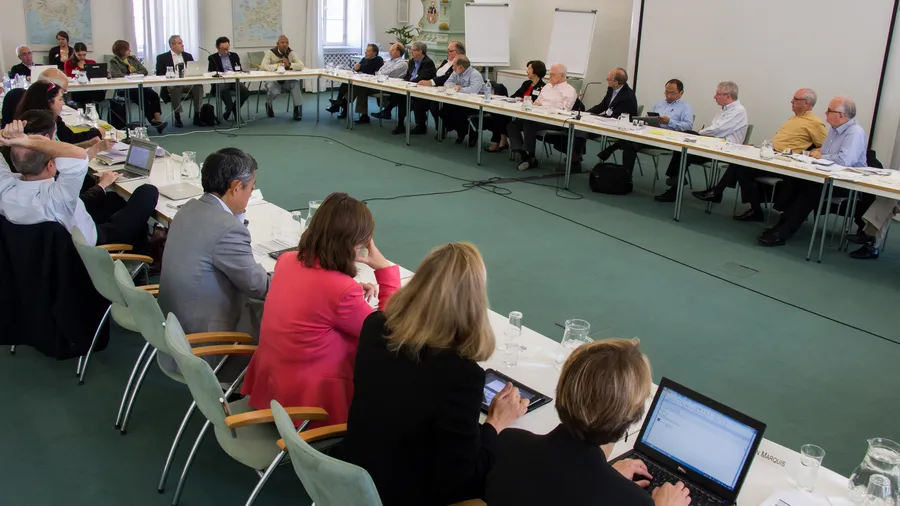
Participants of 'Restoring the Public's Trust: Delivering on Public Policy Goals' gathered on Monday to discuss what could be learned from past government endeavors.
A panel was convened in Parker Hall to discuss the state of the world, government, and governance.
The panel was moderated by Timothy Clark, Editor at Large of Atlantic Media Company's Government Executive Media Group.
Mr Clark was joined by: Juan José Daboub, Chairman and CEO of The Daboub Partnership; Richard Neu, Senior Economist at Frederick S. Pardee RAND Graduate School; and Sarah Wartell, President at The Urban Institute.
Before the panel started, Angel Gurría, Secretary-General at the Organisation for Economic Co-Operation and Development (OECD), gave a speech highlighting the "plummeting" levels of trust in government.
Mr Gurría said: "Quick fixes won't do. We need to think big. We need a true national strategy for trust - for each country."
Reaffirming his argument, he cited American essayist Ralph Waldo Emerson, who once said: "Our distrust is very expensive."
Mr Gurría suggested this expression served as a warning, with too much at stake in a crisis of trust.
"I'm sure this seminar can make a valuable contribution to rebuild trust in governments and public policies. We at the OECD stand ready to keep collaborating with the Volcker Alliance in this and other future endeavours."
Panelists identified a number of common themes contributing to a lack of trust in government and provided The Volcker Alliance with a number of ideas to pursue. They then opened the debate up to the floor.
To help restore trust, more attention is needed to inform citizens of the progress made by policymakers, alongside a more realistic set of targets.
A series of policy reforms however makes analysis and measurement very difficult.
It was suggested an opportunity exists for The Volcker Alliance to raise the standard of policy formulation at all levels.
Participants were separated into small working groups to identify management factors affecting government effectiveness and trust, which were later reported back to the rest of the group.
The Role of Research
After lunch, Donald Kettl, Dean at University of Maryland School of Public Policy, monitored a panel discussion on the significance of research in improving government effectiveness.
Mr Kettl was joined by: John Graham, Dean at School of Public and Environmental Affairs, Indiana University; Steven J. Kelman, Weatherhead Professor of Public Management, Harvard University's John F. Kennedy School of Government; Paul C. Light, Paulette Goddard Professor of Public Service, Robert F. Wagner Graduate School of Public Service, New York University; and Donald Moynihan, Professor of Public Affairs, Robert M. La Follette School of Public Affairs, University of Wisconsin-Madison.
Previous conversations had focused on leadership, structure, process and politics.
This panel reviewed public administration alongside policy implementation, with conversations centered on how research helped to make decisions.
Suggestions included increasing the quality of research and providing better databases for researchers to use.
Calls were made to focus on research to identify increasingly effective government practice and figure out how to translate and aggregate that research for a wider audience.
The Role of Education and Training
Before the start of the next plenary session, participants received a guided tour of the Schloss Leopoldskron's gardens from Salzburg Global President, and CEO, Stephen Salyer.
Returning refreshed, they sat down for another monitored panel discussion by Mr Kettl.
This topic, however, would focus on the relationship between education and policy execution.
This session's panel included: Thomas Kolditz, Professor in the Practice of Leadership and Management, Yale School of Management; Nathalie Loiseau, Director, École nationale d'administration; Kishore Mahbubani, Dean and Professor in the Practice of Public Policy, National University of Singapore Lee Kuan Yew School of Public Policy; Susan Marquis, Dean at Frederick S. Pardee RAND Graduate School; James Steinberg, Dean at Syracuse University Maxwell School of Citizenship and Public Affairs; and Joe Klein, Political Columnist, TIME Magazine.
The panel, and contributing participants, engaged in a lively discussion with a wide range of thoughts on the current standard of education and training.
A number of challenges were considered; including the aspect that there wasn't a typical public management program taught the world over.
Each course has its own variation and its own methods of teaching. A common theme in the panel's discussions centered on the skill of leadership and how it could be taught effectively.
It was suggested that leadership required experience, something that couldn't be found in a classroom.
A debate followed as to whether those with more practical and professional experience should be given a greater opportunity to teach students.
But the emphasis of the discussion did also look at the topic from a student's perspective.
Panellists and contributors questioned whether students were being provided with enough incentives, training and opportunities to pursue a career in public service.
Concern was raised that frustrations of those seeking to enter public service may leave future applicants discouraged.
It was agreed that a large number of students were interested in the subject of public service, but there was debate about how to translate that interest into courses on public management and also government careers.
Issues to Target for Change
Following a detailed discussion on education and training, Paul Volcker concluded the session by presenting a list of topics that The Volcker Alliance is considering to pursue in collaboration with other organizations.