
-
Topics
TopicsOur programs create spaces where open-minded leaders can gather for breakthrough conversations on pressing global issues – each aligned to one of the following pillars:Get Involved
-
Events
EventsExplore the variety of events Salzburg Global hosts within Austria and in the rest of the world. Learn more about our programs and what else happens at Schloss Leopoldskron.Upcoming EventsOct 19 - Oct 22, 2026Peace & JusticeThe Collective Action Problem: How Should Democratic Societies Respond to Increasing State Violence without Exacerbating Polarization and Political Violence?Violent Threats to Democratic SystemsOct 21 - Oct 25, 2026Peace & JusticeDemocracy Across the Frontlines: How Can Democracy Movements Collaborate To Build Resilience Across Borders?Democracy Resilience Forum
- Insights
-
Fellowship
FellowshipSince 1947, more than 40,000 people from over 170 countries have participated in Salzburg Global's sessions. Collectively, these alumni are known as Salzburg Global Fellows.
-
About Us
About UsSalzburg Global is an independent, non-profit organization committed to creating spaces that overcome barriers and open up a world of better possibilities.Our Approach
-
Support Us
Support UsYour generosity helps us gather open-minded leaders for breakthrough conversations, while creating space for dialogue that overcomes barriers and opens up a world of better possibilities.
- Donate

Education
Feature
Reimagining Education Access
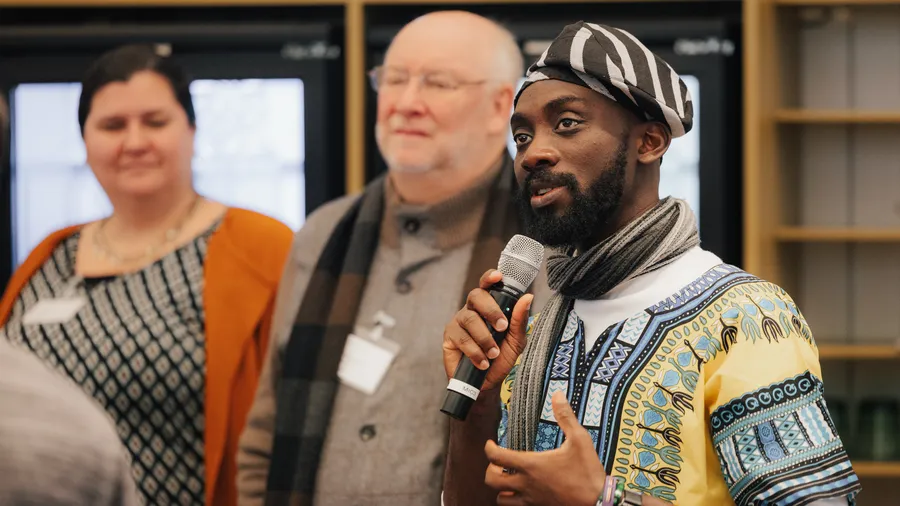
Hammed Kayode Alabi at the December 2024 session on "The Future of Teaching." Photo Credit: Katrin Kerschbaumer
When he was just 15 years old, Hammed Kayode Alabi began teaching at a local nursery school in Lagos, Nigeria. He had grown up in Makoko, one of Africa’s largest floating slums, and had seen firsthand the need for greater educational and professional opportunity. He felt that the classroom was a place where he could make a difference.
“I saw young people within my community who needed support and wanted resources. And I’d already graduated from high school at 15, so I was able to provide that kind of support, because I'd crossed that bridge already,” he says.
The experience marked the beginning of his love for education. After graduating from university, he went on to devote himself to the expansion of education access, founding the Kayode Alabi Leadership and Career Initiative (KLCI), a nonprofit career development and leadership enterprise, as well as its EdTech platform Skill2Rural Bootcamp, which makes KLCI’s resources even more widely available. More than anything, he believes in transforming education access through his work, and creating opportunities where there previously were not.
His most recent endeavor is Rafiki AI, a WhatsApp-based AI career pathway tool that allows students to design a career plan in under two minutes. Within the first three months of the tool’s launch, it served over 5,200 users across fifty countries and five continents, providing clear and encouraging career counseling for students who did not previously have access to such a service.
In 2024, at 30 years old, Alabi was a Fellow at the Salzburg Global program The Future of Teaching, where he helped run the AI workshop. At the session, he met Olanrewaju Oniyatan, founder of education enterprise SEED Care & Support Foundation, who helped him with the distribution of Rafiki AI. Rafiki is a tool that embraces AI’s capacity for good and is a part of Alabi’s optimistic vision for education’s future, where technology acts as a catalyst for opportunity instead of exacerbator of inequality.
At Salzburg Global, Alabi felt that the program’s egalitarian structure allowed him to really learn from his peers and fully contribute to the broader international dialogue on the future of the classroom — an opportunity that he relished and felt wasn’t as broadly available as it should be.
“I wanted to attend [Salzburg Global], to be a part of that conversation and discuss the future of teaching. Because whenever we discuss the future of teaching, or whenever we discuss AI, there are people like myself who do not get a voice, or who do not get to be in the room […] I think I bring a lot of local experience and context about what it means to influence local policies around the future of teaching and the future of AI,” he says.
Today, education is at a critical juncture, with new technologies, a changing global economy, and continued disparity all demanding rapid innovation grounded in compassion. And as difficult as it is, Alabi is up for the challenge.
“I love that Salzburg Global has created that space for young people like myself who are passionate, driven, and want to create something in the world,” he says. “Because for me, I want to keep building, even until my last breath.”
