

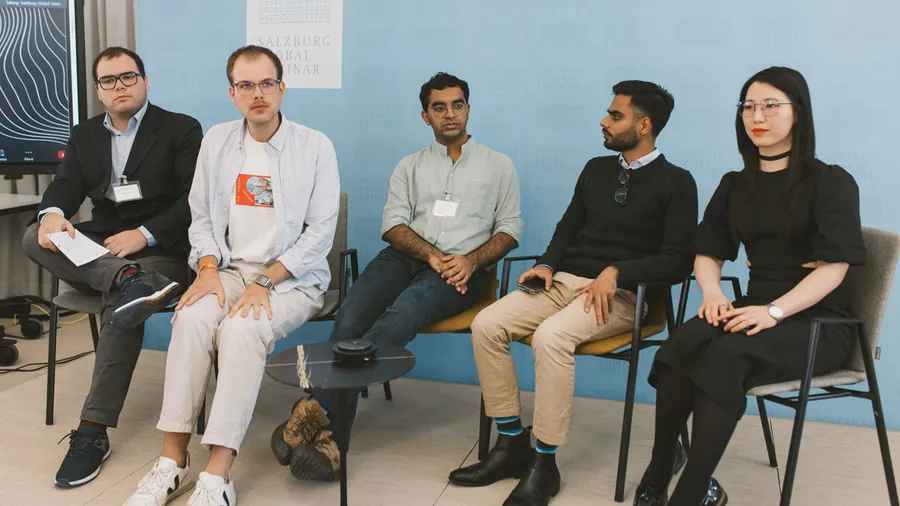
This op-ed piece is part of a series written by Fellows of the Salzburg Global Seminar program “Public Policy New Voices Europe”
This op-ed was written by Felix Dade, Ying Liu, Abdul Moiz, Adriano Rodari, Riccardo Sacca, and Neeraj Tom Savio.
Divisions along ideological lines complicate public policy spaces and everyday life in the collective West. In the US, public policy discussions on healthcare and immigration are polarizing with Democrats and Republicans taking extreme opposite positions. Polarization is not a new phenomenon in Europe. However, the rise of radical ideologies, anti-establishment elements and populist parties could disrupt democracy, the rule of law, the stability of state institutions and human rights safeguards. Political parties and movements contribute to this polarization, by perpetuating divisive stereotypes, and the media amplifies these divisions.
Political watchers, activists and community leaders working to combat political polarization and foster a more inclusive and open dialogue frequently encounter resistance from extreme “right" and “left" elements, fracturing the policymaking process. The results are limited spaces for sincere and critical conversations about the impact of policies on the most vulnerable, especially migrants and refugees in European spaces. Overcoming these complications requires pluralistic discussion spaces where everyone feels included, heard, and represented in the policy process.
Polarizing UK immigration policies for Muslim minorities
The treatment of Muslim migrants in the UK can be taken as a real-life example of modern high-stakes polarized discussion. Predominantly, the portrayal in mainstream media of Muslim refugees results in an increase of undue negative labelling and Islamophobic attacks. Victims of Islamophobic attacks in the UK recall being addressed as "terrorists" or "swamps".
Are the Muslim migrants extracting "resources" from Europe? Or are they in fact embracing multiculturalism and contributing to the public sector in Europe? According to MEND, over “21% of specialist occupations” in the NHS are held by Muslim migrants, yet the Muslim community is still marginalized in sectors of the public sphere. Due to polarization, there remains a clear disparity in assimilation efforts undertaken by the UK government when it comes to strictly Muslim communities. Unlike Ukrainian refugees who have been supported by local council initiatives in the UK, Muslim refugees have faced prejudiced media, driven by Islamophobic connotations in pursuing the narrative of "othering".
Discussions in public policy spaces should ideally engage all stakeholders, even those who may not hold formal positions within the decision-making process. Given the context of polarisation and "othering", how can all voices be heard and represented in the discussion about policies? How can public policy spaces ensure pluralistic discussion?
Pluralistic discussion in public policy spaces as a "remedy"
It is very unrealistic to think that it would be possible to prohibit the type of discourses (political and social) that usually become polarized. Where the possibility exists, its use could be unproductive. Addressing the issue of polarized discourses in public policy spaces requires a constructive approach rather than a disruptive one. Rather than limiting freedom of expression, policymakers should instead work towards the promotion of pluralistic discussion.
Pluralistic discussion can be defined as a space for non-violent and constructive exchanges on contested topics involving all invisible and non-political stakeholders, with the inclusion and consideration of different perspectives and ideologies in the public policy arena. Using this tool, it is possible to build a safe environment for people to share their views, encourage meaningful contact between opposing social and political groups and bridge the gap in communication, while dispelling the ignorance and fear that usually breed polarization. An important aspect of pluralism relates to meaningful representation, not just inclusion. It is relatively easy to bring a diverse population into a meeting, but the true challenge is to consider their arguments with genuine honesty, openness, and curiosity. Meaningful representation in pluralistic discussion arenas signals collaboration, listening, and cooperation in making policies work for all - despite differences.
Using pluralistic discussions in public policy spaces
Pluralistic discussions could be a Bottom-Up approach, by establishing an accessible platform for dialogue and communication from local residents to the national level. Organizations like Involve's Citizen Assembly and World Vision’s Advocacy's Citizen Voice and Action provide platforms for representatives from various social classes and populations, with demonstrated positive impacts. Simple tools like the traditional letterbox system in communities could strengthen how "ordinary people" interface with the public policy process. While the right to vote is largely conferred on citizens, citizens and ‘non-citizens’ could write down their concerns and place them in a letterbox to be collected and evaluated quarterly. This ensures that the different voices are heard at the local level and considered at the national level - often the focal policy making space. Additionally, regular multilingual leaflets could be sent to households informing residents about their rights, how to access public services and influence public decisions. Simple things like “letter boxes” collect real-time reflections of individuals and groups often marginalized in policy spaces.
Also, the lack of transparent communication regarding policies could be addressed through a "top-down approach". This approach is inspired by the discussions that preceded the release of the first-ever German National Security Strategy in 2023. It envisions a government outreach to discuss major policy initiatives with those most likely to be affected in the population, especially minorities and the youth. The "top-down approach" is anchored on the values of transparency and accountability. Transparency involves a clear and open exchange of ideas between all participants, with suggestions being debated and considered in a fair manner. Accountability ensures that the approach does not become a futile exercise. The policymakers, in this case the government, conduct a follow-up on the suggestions of the participants and engage in an honest and respectful dialogue with them.
Pluralistic discussions cement the personal and public
In a world where differing ideologies and divided public policy spaces have caused conflict, the situation faced by Muslim migrants in the UK, for example, serves as a reminder of the urgent need for open and inclusive conversations that can help mend our fractured societies. It is crucial to counter the polarizing narrative by engaging in dialogues that promote inclusivity, listening and representation of vulnerable groups. By embracing perspectives through discussions, we can create safe spaces where people from all walks of life can come together and foster empathy. Now is the time to move away from polarising discourses and embrace the power of pluralistic discussions to ensure that public policies are what they ought to be - benefiting everyone regardless of our differences.
