

How mutual respect for culture builds bridges from the past to the future
“Monuments are buildings of the past; they are also markers that represent the future.” This Cypriot notion of the monument as a physical manifestation of the past is powerful in many ways.
Sites of cultural heritage come out of a specific moment and specific social situation, thus immortalizing certain histories. In the slow destruction, and eventual reclamation, of these sites of historical interest, there is something telling about their importance in representing memory, conflict and, importantly, resolution across divides.
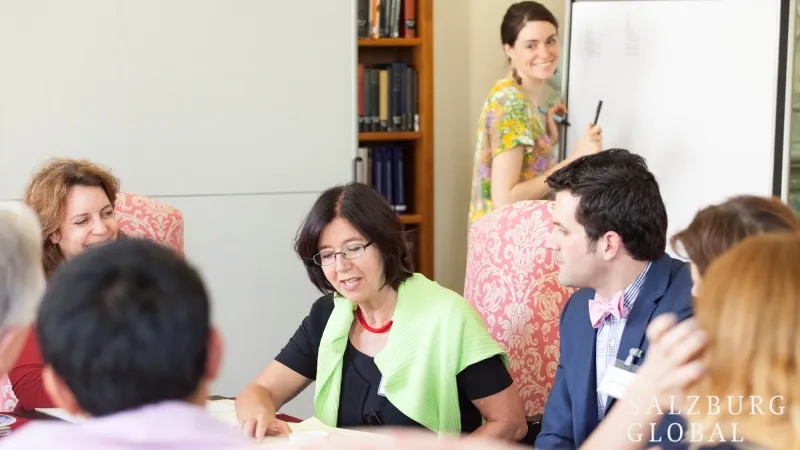
The representation of history and how we relate to these histories was something the participants of Salzburg Global Seminar session "Conflict Transformation through Culture: Peace-Building and the Arts" were invited to consider at length on the third day of the program, through a variety of projects, from monuments and film, to dance and social innovation. The different media all allowed for a greater expression of resolution and telling stories across the cracks of division.
For example, progress in Pakistan can be measured through how British Muslims engage in foreign issues related to their heritage. This isn’t just a post 7/7 perspective; the Pakistani diaspora has been a question of significance since the British drew borders dividing the region. There cannot be amnesia around these pivotal moments, particularly the aid the region gave to end the Cold War, which is largely ignored. In a conflux of interaction and rejection, support for cultural heritage in Pakistan allows many to question national and regional identity.
This identity crisis is not exclusive to such parts of the world. Ireland is still the site of a great number of tensions between religious divides. Loyalists and the British press largely controlled the state image of the conflicts in the 80s, which ensured that witnesses couldn’t tell their story: the lies told the more powerful story. Readdressing this has taken generations of work to tackle social and cultural divisions; film documentation has gained ground in presenting the facts, but tensions continue to oscillate on a weekly basis.
Yet, in their ability to talk to the audience, such art projects have considerably positive effects. One commentator noted that, “Despite all of our conflicts and division, it is surprising to find how friendly we feel when we meet one another.” This notion of an empathy and compassion that transcends conflict comes from a vision to introduce culture as a force for mutual respect and better knowledge. Through a process of learning and unlearning, history is continually reviewed. We might not agree on it, but we come closer to understanding it through collective work, and moving towards a dialogue by which we can address national trauma, internally and externally.
Culture is often a target in conflict; culture is therefore the remedy and a tool for peace-building too. Art represents all of the prospective materials for creating dialogue, putting the civic powers in the public space. Through social empowerment awakening in people their own passions and opinions, art provides a vector and a focusing lens by which to recover and reclaim the past, the present and the future.
