

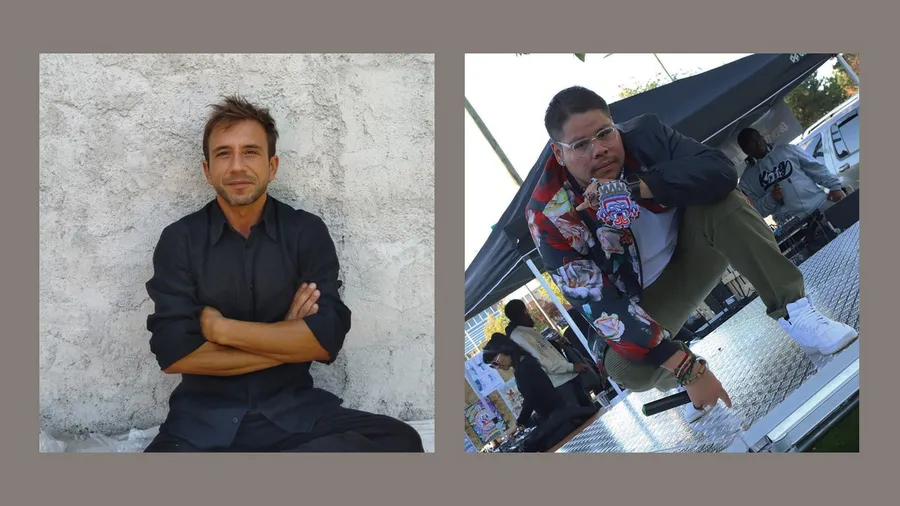
Athens-based Cultural Innovator Lazaros Damanis discusses his cross-hub collaboration with Detroit-based Sacramento Knoxx
Athens is a vivid city and one of the most historically influential Greek city-states. It carries values from the classical age that blend, bend and sometimes break with the modern era of social media, social capital, and social shifts. History speaks of philosophers on hills contemplating the meaning of life, the source of creativity, olive branches exchanged in moments of interrelatedness, and our ability to alter our worldviews once those connections are fully explored. Yet, so often, words like “democracy,” “compassion,” and “philosophy” are bandied about without much substance. Still, today, two Salzburg Global Fellows aim to ensure this trend doesn’t continue.
At the moment, cultural and societal turbulence is at the epicenter of an ongoing transformation in Greece. Musician, artist and activist Lazaros Damanis believes resilience and adaptation lead the way to stay flexible enough to change with the surrounding world. In 2014, he became a Fellow of the Cultural Innovators Forum. His time at Salzburg Global reassured him he needed to further embrace global shifts. This assurance was reaffirmed when he met Sacramento Knoxx, a Detroit-based music archivist participating in the program. Thus, a seed was planted during his time at Schloss Leopoldskron that is still bearing fruit today.
“We met for the first time around noon; this was during a workshop that allowed us to introduce ourselves and share some views, mainly from our musical background. Since Knoxx is a songwriter/musician and I am a sound engineer/festival organizer, the path was already there. Knoxx is like a gentle mountain, calm and decent until he starts playing music. From this point, he transforms into a very vivid persona.
“For me, his character and the way he writes his lyrics... the passion for change with music as a tool made me feel quite close to his mindset. We both speak the universal language of music that feeds the soul and ultimately changes the world.”
In 2020, Knoxx, also known as Christopher Yepez, produced a track called LVNDBVCK during heightened tensions worldwide in the wake of George Floyd’s murder by a police officer. The likelihood that two cultures so far removed from one another would be able to see eye to eye appeared to be small, but this was not true for the two creators.
Supported by the Cultural Innovators Forum and the Kresge Foundation, Knoxx and Damanis developed an idea for a joint project that emulated their connection. The project brought forth a combination of reverence for pre-colonial mother earth in the US, and the introspective nature of ancient Greek life, with the two finding common ground among the rubble 2020 had wrought.
The project was initially named “Waawiiyatanong,” a word that means “returning to the ways in which the people flourished here.” It is also the Indigenous name for what we understand today as Detroit. The pair were inspired by the idea of hearkening back to push their hopes for the future forward. Until the 1970s, it was illegal for Indigenous people to have any ceremonies in the US. Now they hope to host events that will break new ground for the people who know the land as it was before and can be going forth.
Athens is still, according to Damanis, “developing its transformational thought-culture.” Meanwhile, Detroit’s rich indigenous history, along with developing protest music in house and hip hop as havens for black and indigenous people, teach us more about cultivating a heritage of acceptance and respect, which can, in turn, translate to opportunities for reparations and growth in today’s cultural arenas.
“It is well known that music as a form of expression and furthermore as a universal language can involve different cultures and create connections amongst people. Our main goal is to preserve the cultural heritage of such a vivid area [in Detroit) using music as the main vehicle of our cultural exchange in order to create a multi-cultural cluster with an open-source philosophy.”
This idea involves three days of hybrid workshops, exhibitions, performances, and participation from both sides. Still, the pandemic has thus far prevented them from seeing the full extent of their dreams:
“Implementing the project as it was conceptualized is a bit difficult because we both believe that nothing can replace human contact,” says Damanis. “Having in mind that in Detroit, everyday living has a lot of unpredictable parameters, a purely online project may not have the same impact as it was planned.
"Living and working in Athens - and in other rural areas of Greece - under the scope of a country that works on resilience during tough socio-economic times, one of key factors that led us to a premature stability was the focus on our behavioral roots, bringing up values such as empathy, acceptance, courage and moreover to re-establish solidarity through participation and active citizenship.
“My aim is to apply in a different context methodologies and ideas that worked in my home, having the belief that it can be fruitful for the native arts and culture in Detroit, and of course for the people who are the real actors, acting as catalysts of change.“
As it stands, their project is still in production, but the two continue to think of ways to carve out a new path together, whether digitally or on the ground. In the meantime, Knoxx has released a new album called ‘Medicine Bag,’ which details his passion for Waawiiyatanong and the balance of mind, body, and spirit. Stream the deluxe version on Bandcamp.
