

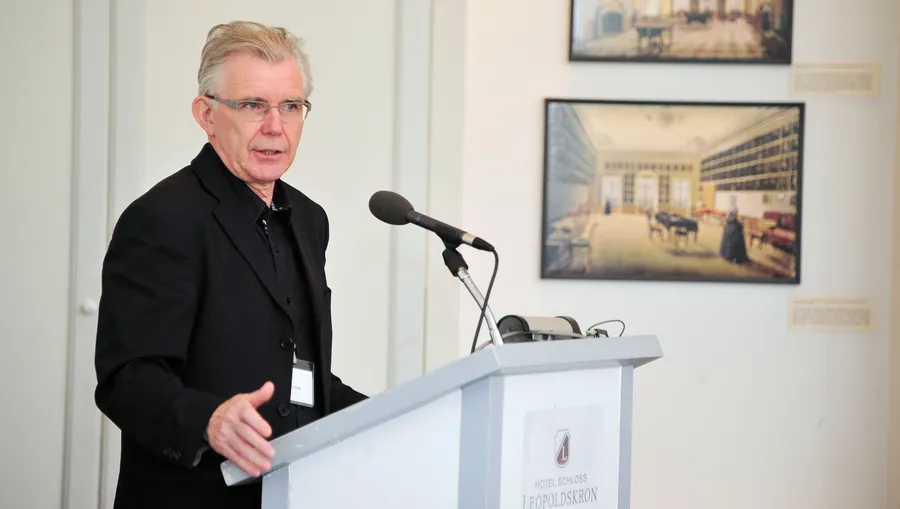
Opening session of main program looks at the many facets of EU Cohesion Policy
“EU cohesion policy matters more than any other policy the European Union has ever implemented – I am convinced of that!” exclaimed one Fellow on the second day of the Salzburg Global Seminar session ‘Mind the Gap! Innovating for Regional Cohesion and Smart Growth’ on Sunday, May 18.
Marking the opening of the full program, discussions focused on how one of the main objectives of the European Union is to promote economic, social and territorial cohesion between regions, and the reformed EU Cohesion Policy 2014-2020 comes at a pivotal moment. Recent years of austerity have seen rising unemployment and widening inequality, especially in peripheral regions, with youth, women and ethnic minorities worst affected.
Making near to €350 billion available to invest in Europe’s regions and cities, the reformed Cohesion Policy is the EU’s principal investment tool to deliver the Europe 2020 goals: creating growth and jobs, tackling climate change and energy dependence, reducing poverty and social exclusion.
At the introductory session for the Salzburg program, speakers represented the Directorate-General for Regional and Urban Policy (DG REGIO) – the European Commission body responsible for the Cohesion Policy, the Committee of the Regions – the EU body representing the interests of cities and regions which will be vital in the delivery of the Policy, and the Special EU Programs Body. Together, they examined the fundamentals and philosophy, founding and achievements of the Cohesion Policy, as well the refocusing of the Policy to maximize inclusive growth and jobs.
Whilst the reformed EU Cohesion Policy for 2014-2020 targets competitiveness, innovation and smart growth, the speakers were keen to point out that one of the original and continuing main objectives of the Policy is social and community capital, which is seen as a key lever for boosting economic dynamism and growth.
“Economic and territorial cohesion necessitates that you also focus on community cohesion,” said one of the panelists.
One initiative that clearly demonstrates the EU’s integrated approach to cohesion is the suite of PEACE programs for Northern Ireland and the border regions. Launched in 1994 following the first IRA ceasefire, these programs were envisioned as a “Marshall Plan” for Northern Ireland. Tackling community relations, reconciliation and peace-building, they had the added goal of overcoming the barriers to productivity, competitiveness and employment that had been erected – just like the “peace walls” between the warring Protestant and Catholic communities – during the long-running “Troubles”.
The initial PEACE program in 1994 gave the responsibility to local authorities to decide on where to place the investment funds. This not only empowered the local community to decide how best to use the money, but also forced both sides of the conflict divide to come together in a positive manner.
Since then, there have been three more PEACE programs, each with multiple objectives supporting an integrated approach to work towards social and economic cohesion. PEACE III, for example, had four pillars: to aid reconciliation between the two communities on a local level, deal with the past, create shared public spaces, and build capacity for a shared, rather than divided, future.
A concrete achievement for reconciliation and shared public spaces came in the form of a pedestrian and cycle bridge that was constructed over the River Foyle between the Catholic and Protestant communities in Northern Ireland’s second city, Derry-Londonderry. Once a heavily divided community (the city’s name is still contentious), the EU-funded bridge has become a symbol of civic pride in overcoming the conflict.
But, as was pointed out by one of the Fellows, the EU “cannot fix cohesion in one generation”. As Europe’s open borders expand and populations move within and into the EU, regions such as Northern Ireland are facing new challenges. Local communities might be slowly pulling down the mental and physical traces of the so-called “peace wall” , but they now face the challenge of adapting to immigration as migrant workers arrive in the country, primarily from Eastern Europe. The task of shifting societies – the foundation of Salzburg Global Seminar’s mission since 1947 - is far from over in Ireland.
In the EU as a whole, as we move into the new budget period of 2014-2020, the Cohesion Policy has been reformed to focus squarely on human capital and promoting the innovative economy. After more two years in the making, the Policy was approved by the European Parliament at the end of 2013 and is now in the implementation stage.
The EU is clearly “putting its money where its mouth is” when it comes to redressing inequalities between different parts of European territory. The reformed Cohesion Policy is the second biggest item in the EU’s budget (after the Common Agricultural Policy) and will see nearly €350 billion invested in the 28 member state’s 274 regions between now and 2020. Once Member States’ national contributions and the leverage effect of financial instruments are taken into account, the impact over this period is expected to be over €500 billion.
The EU has shifted its focus to encourage Member States to think not only about getting the resources they need, but also more strategically about what they do with these resources once allocated. Training and education remain high priorities, but without the innovation to create jobs, increased education will not reduce unemployment and improving infrastructure will not alone boost economic growth. Better infrastructure can help move goods more easily, but it doesn’t necessarily increase the productivity that is also needed to boost exports. As one speaker elaborated: “Innovation is the key to growth and prosperity... Cohesion policy is vital for smart, sustainable and inclusive growth.”
Despite the financial crash, declining industry and economic decline, “the old continent is still alive and innovating!” insisted one of the Fellows. In fact, 10 of the 28 EU member states still appear in the World Economic Forum’s global top 20 of global innovators and investors in research and development.
But this innovation is uneven across the EU – and this is where the Cohesion Policy steps in. Investment has to be stepped up in the regions that are failing to innovate in order to help bring them up to speed. This does not mean that the EU expects these regions to start from scratch. Regions have the choice and the EU Cohesion Policy aims to help them build strategically on the productive assets and capital they already possess.
Following the 2014-2020 reforms, it is not enough for applicant regions and cities to show they have a policy and program plan for innovation to qualify for EU funding. They must also show how they will attract private investment and measure their success to ensure return on investment for the EU. “It’s not about blank checks,” one Fellow explained, “it’s about transfers of investment with major strings.”
Forming policy at the supranational EU level to be concretized and implemented on a regional and local level obviously requires the buy in of the regions and cities themselves. These administrative and governance units are represented by the Committee of the Regions, which acts as an advisor to various EU bodies on how their policies can best be adopted and applied regionally in line with subsidiarity. In return, regional and local authorities need to demonstrate good governance and transparecy to ensure the funds are spent and the programs are managed effectively.
For some in the room, this raised questions of whether investment should first go into good governance programs instead of regional cohesion. Representatives from the European Commission were keen to point out that only a tiny percentage of past allocations to cohesion have been lost to fraud or corruption. Institutional capacity-building at decentralized level is now a recognized priority within the design, implementation and follow-through of the latest Cohesion Policy, which embeds cross-sector partnerships within the revitalized framework.
Another challenge facing the Cohesion Policy is the slow take up of funds. Whilst the reformed Policy has been in formation for the past two years, it was only passed by the European Parliament in late 2013. Many of the national, regional and local governments that will be implementing the Policy only started to formulate their own plans once it had been formally adopted, which now have to be submitted to the European Commission for approval. This means that at national and local level, much of the funding will not be allocated for programs until much later in the budget period, possibly as late as 2016, leaving only five instead of seven years for implementation. In previous policy periods, this has meant that Member States have allocated money to projects that are able to absorb the funding (which must be spent out by the end of the period) rather than invested into truly transformational projects, calling into question the real effectiveness of the Cohesion Policy.
As the program continues, the 65 Salzburg Global Fellows from 30 different countries on four continents will not only consider the metrics necessary to measure transformational – rather than incremental – change, but also look more closely at the drivers for innovation and smart growth, sustainable integrated urban development, and the role of cities as catalysts for change, especially with regards to energy transformation. Specialist small group work exercises will also look at issues including the importance of investing in human capital, the digital society and “third country” – non-EU members’ – success stories.
The session, 'Mind the Gap! Innovating for Regional Cohesion and Smart Growth', runs from Sunday 18 until Wednesday 21 May. Please regularly check the session page www.salzburgglobal.org/go/534 and our social media platforms using #SGSEuro for updates.
