Director of ETF and guest speakers review Policy Leaders’ Forum
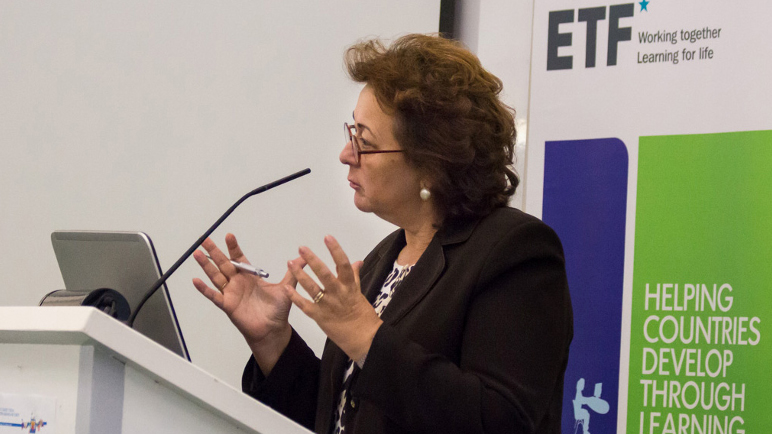
“Why here in Salzburg?” said Madlen Serban, director of the European Training Foundation (ETF), speaking on the morning of the first full day of the second Policy Leaders’ Forum.
“It’s my turn now to bring people [together] and give them back the chance of sharing with others at a regional level. But who knows, maybe at a global level in the future.”
The forum was designed to continue the dialogue on building a skills vision for 2020, involving countries of the Western Balkans and Turkey.
Describing the ETF's mission, Ms Serban said: “It’s a very complex agenda that for sure won’t be solved in one meeting.”
The ETF’s FRAME project supports the Western Balkan countries and Turkey with their human resources development strategies. It is built around four components: foresight, review of institutions, monitoring and regional cooperation.
High-level officials from ministries of education, labor and finance, gathered at this year's forum to focus on comprehensive, long-term policy making for human resources development with a view to Europe 2020 and South East Europe (SEE) 2020.
Discussions centred on how national efforts could contribute to skills that foster competitiveness, employment and social inclusion.
Europe 2020 is the European Union’s 10-year growth strategy, focusing on creating conditions for smarter and more sustainable types of growth. The SEE 2020 draft strategy was brought forward as a response from countries within South East Europe.
The forum included a number of guest speakers, including Goran Svilanovic, secretary-general of the Regional Cooperation Council.
Mr Svilanovic revealed the core of the Council’s engagement in the coming years will be related to the SEE 2020 strategy, which features 11 regional targets and 77 national targets.
“It cannot be successful unless directly linked to the reform processes needed in the education system in each and every country in the region.
“The strategy we’ve developed as the Regional Cooperation Council in close cooperation within the respective governments is how to reach these targets.”
The Council plans to work closely alongside each government to support them in developing national action plans, and remains hopeful that the SEE 2020 draft strategy will become fully adopted in November after reaching a final consensus.
Mr Svilanovic added: “Let me be honest, these goals are not a promise. We don’t know whether these goals are going to be achieved, but they are a driver. They’re the target.”
National priorities and EU objectives
Participants at the forum discussed how links could be fostered between national priorities and European Union objectives and targets.
Gerhard Schumann Hitzler, director for pre-accession assistance strategy and regional cooperation at the European Commission’s Directorate General for Enlargement, said countries are confronted with the same challenges worldwide.
“The Enlargement countries who aspire to join the European Union at one stage in their evolution are well-justified to try to anticipate and to align gradually on the objectives and targets of the European Union.
“The SEE 2020 strategy is a way of aligning the approach. Let’s be more strategic, forward-looking, more consistent and more coherent in this world.”
Mr Schumann Hitzler recognized how a number of the younger countries haven’t had the time to develop an experienced professional public administration.
“I think the forum here has confirmed how relevant it is to bring together all the relevant partners. We need to work together. We need to compare our views. We need to exchange information on best practices.
“We need to see who has come up with a good solution for a problem, which is roughly speaking the same for all of us around the table.”
Halil Etyemez, deputy minister at the Ministry of Labor and Social Security in Turkey, said one of the main benefits of the forum was the sharing of experiences among countries.
Speaking to Salzburg Global, Mr Etyemez said the main topics of discussion at the forum centred on the creation of new jobs and how to create and maintain economic growth.
“We agreed in the meeting that education and human resources development our key issues with regards to the development of our economies and our countries.
“We are sure that education and training brings development. We have allocated the largest share of the country’s budget for the Ministry of National Education.”
Mr Etyemez remarked how the countries represented at the forum each had their own unique geographies, economic resources, and social status.
Nevertheless, he added that employment was a cross-boundary issue that involved factors such as transportation, communication, multinational corporations, and the global economy.
“These issues are overarching in terms of economic cooperation and they turn out to be cross-boundary problems. So we need collective action.”
Future action
Jochen Fried, Salzburg Global Seminar’s Director of Education, sits on the advisory board of the FRAME project, providing expertise with respect to foresight methodology and the translation of foresight results into education and labor market policies.
Mr Fried said the relationship between the Seminar and the ETF was based on a level of close personal connections.
He remained hopeful for a longer-term institutional collaboration between the two organizations for mutual benefit in areas of common interest and concern.
“As a specialized agency in the European Union that supports policy making on human resources development in countries bordering the European Union, the ETF has a wealth of knowledge and experience in this field.
“Salzburg Global Seminar, on the other hand, has a reputation of bringing together smart minds from literally around the world who challenge the common wisdom and search for innovative approaches to challenges.
“Joining these two sides can unleash some very interesting and productive synergies.”
For an extended interview with ETF director, Madlen Serban, on the organization’s mission and her personal experiences with Salzburg Global, listen to our podcast below.