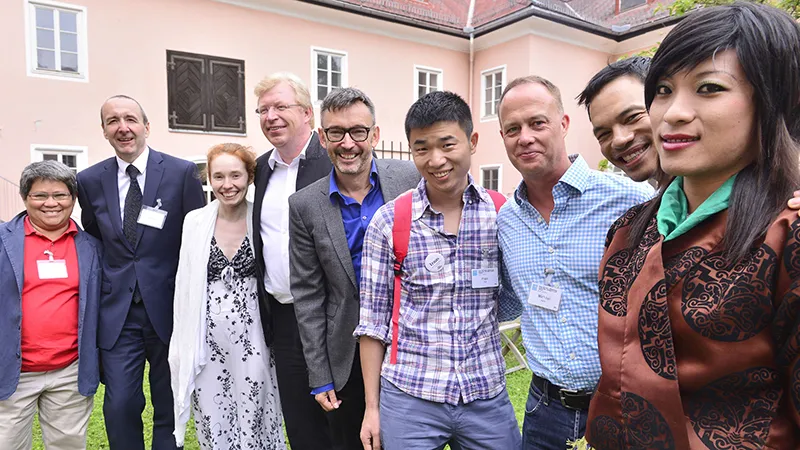
Fellows of the Global LGBT Forum consider what is family and how can we share our stories
Family is...?
Having a family is a fundamental right – whatever the constellation, State Secretary at the German Federal Ministry of Family Affairs Ralf Kleindiek told Fellows at the Salzburg Global LGBT Forum on day four of the program.
The German Federal Ministry for Family Affairs, Senior Citizens, Women and Youth is one of the many supporters of the Salzburg Global LGBT Forum, and this was the second time Kleindiek had addressed the Fellows, having met with a number of them at the Berlin meeting in 2014.
Families come in all sorts of “constellations,” Kleindiek said, including heterosexual couples, same-sex couples, and childless adults caring for older parents. The German Ministry is now committed to helping all these constellations, and hopes other countries will follow Germany’s lead.
Although Germany does not yet support equal marriage – something which is often cited by countries such as Russia as proof that not all Western countries support LGBT individuals and communities and thus they should not be expect to support these citizens either – the impact of the recent popular vote in favor for marriage equality in Ireland is being felt across Europe, with many in Germany hoping that their country will “keep up and follow” the example of other European countries.
Voices of Fellows
What is family?
“Family to me is often burdensome when it’s blood-lineage, though I dearly and desperately keep the lineage with my biological daughter and son, even though I don’t know if they think I am burdensome. But I love my current family (living together), which consists of my partner, her biological new born baby (who is also my child), and a cat; none of who have blood lineage with me!”
Kaoru Aoyanna
“To me, family is like ‘cats’ (of course I live with cats). My family is always around me, supporting me, watching me with some ‘curious’ eyes like cats. They are very cautious and considerate, so they do not ask me directly about my sexuality. They are waiting ‘quietly’ for me to come out to them. ”
Hyun Kyung Kim
“Family to me is a party: loud, obnoxious, and fun. It’s who we choose to be and who chooses to love us in return.”
Clifton Cortez
“Family to me is that which I can call my own. Family members are those which I can rely on and they can rely on me. Family back one up no matter what the physical and emotional circumstances. Above all, family loves genuinely. ”
Name withheld
“Family to me is to be together with someone you love. ”
Popo Fan
“My natal family – oppressive; my family of choice – warm, responsible, supportive; my family by marriage – wife and four step-children: terrific, exciting. ”
Saskia Wieringa
“Family to me is attachment and support, no matter who should be in family. It could be mom, dad, friends, supporters, colleagues, and parents. ”
Manisha Dhakal
“The definition of family should be changed. When we think of family we often think of love, respect, solidarity. Two people. One pair of lovers. Family may not just be based on the goal of reproducing. Three friends can also set up a family to support each other. Maybe we will have very diverse family format in the future. ”
Xin Ying
“Family to me is people who love and care for each other and plan to do that forever. ”
M.V. Lee Badgett
“Family to me is a community of love that we create by choice, as opposed to just one we are born in to. An institution that can be incredibly disempowering, but can also unleash power. ”
Danish Sheikh
“Family to me is individuals who have come together to form a unit that provides love, safety and security, either by birth or by love.”
Mary Audry Chard
“I have two families. The one I am born in to and loves me in the best way they can. The other is made up of people of my choosing, second mothers and fathers, friends that are like family and a partner.”
Angeline Jackson
“Family is my life. Doesn’t matter relative or not! Global brotherhood!”
Fumino Sugiyama
Telling our own stories: What do we tell and whom do we reach?
Film can be a powerful medium for sharing our stories and changing the mistaken impressions of others.
Filmmaker Popo Fan and social entrepreneur Laurindo Garcia shared their experiences of using the medium to tell stories and increase exposure of LGBT individuals, communities and issues.
Fan realized the power of film when a homophobic classmate became more LGBT friendly after Fan showed him a series of queer movies. Since then, Fan has focused his film-making on women as he felt them to be under-represented within queer film. Despite the positive reception his films have received from some audiences, Fan has faced problems with the authorities. His film Mama Rainbow, which focused on the mothers of queer children, was removed from an video hosting website for dealing with themes that were deemed to be “not following the values of Socialism.” He has repeatedly asked for explanations as to why he work was removed, but has yet to have an adequate response and he is now unsure if or when his work will be accessible in China again.
Financing such films can prove difficult, with some Chinese filmmakers turning to selling socks to fund their films. Fan has been fortunate with support coming from individuals and organizations such as PFLAG.
Garcia takes an alternative route to relying solely on donors to support his film sharing platform B-Change. As a social enterprise, his organization offers services including building apps and uses that money to support their websites such as be-app.me and plus-app.me.
These two websites host videos that offer advice on a variety of topics from how to come out to your parents to how to access healthcare services for those who are HIV+. All videos feature LGBT Asians as Garcia felt they were not represented in the media – not even LGBT media.
In addition to the social enterprise revenue, B-Change is also supported by multiple international donors, but as Garcia explained, this can often prove difficult. Many of his donors want to promote the human rights angle of the films on the platform, but audience research proved that viewers want to know how to come out, how to get jobs, how to deal with society, laws, health services, etc., and so he has had to push back on his donors’ expectations in favor of those of his audience.
The Salzburg Global program Strengthening Communities: LGBT Rights & Social Cohesion is part of multi-year series Global LGBT Forum. The list of our partners for Session 551 can be found here. For more information, please visit: www.salzburgglobal.org/go/551
You can follow all discussions online on Facebook, Twitter and Instagram via the hashtag #SGSlgbt
*LGBT: Lesbian, Gay, Bisexual and Transgender. We are using this term as it is currently widely used in human rights conversations on sexual orientation and gender identity in many parts of the world, but we would not wish it to be read as exclusive of other cultural concepts, contemporary or historical, to express sexuality and gender, intersex and gender-nonconforming identities.