

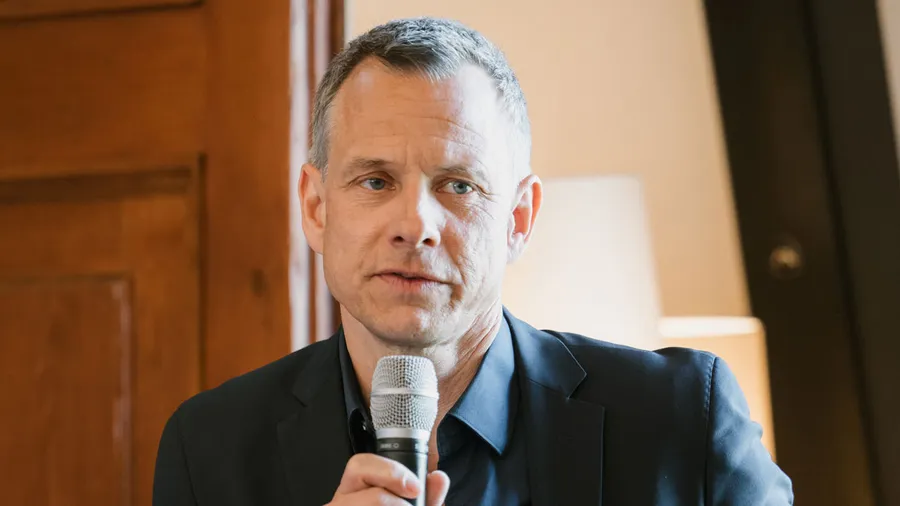
Christian Bason discusses the power of design in shaping society and driving systemic change
Christian Bason is CEO of the Danish Design Center, a nonprofit foundation that is working to advance the value and impact of design globally in four main areas: the green transition, digital ethics, social innovation, and the future of organizational design. He attended the 2023 Annual Strategic Foresight Retreat, which enables senior public sector leaders to speak openly among peers about major disruptive forces confronting governments.
The 2023 Annual Strategic Foresight Retreat, taking place on May 22-24, 2023, is part of the Public Sector Strategy Network. This program is supported by the Abu Dhabi Office of Strategic Affairs, in cooperation with apolitical.
This interview has been edited for length and clarity.
Audrey Plimpton, Salzburg Global Communications Associate: How can design be used to shape a society in meaningful and positive ways?
Christian Bason, CEO of the Danish Design Center: Once you get to know the field of design, you see the world through that lens [and realize that] everything around us is the result of human design. In this way, design is an expression of what we want to do with the world to meet our needs [and] to shape the world in ways that are meaningful to us. Then the question becomes: What is a good world? What is a good society? What do we need to design to make it better? Bringing the mindset, thinking, tools, approaches, [and] profession of design as a human, systematic, creative approach to our world is incredibly powerful. But without purpose, values, direction, [and] vision, design by itself is nothing. It's only something if we are purposeful about what we want to change.
AP: What inspired you to push the boundaries of the design field into the domains of policy innovation and governance?
CB: Those are domains that are incredibly relevant to design because policymaking is essentially a design activity. It's asking what shape society should take and what interventions we can make on behalf of a society or government to achieve our goals. There's a huge potential to bring design into policymaking, into public management, into how we deliver services, and so on. For me, the big challenge now is that as problems become more complex, turbulent, and wicked, we have an urgent need to drive the big transitions in the world: the green transition, the social transition, and the transition to meaningful human use of digital technology. In these big transitions, the question is: How do we position design there, and how do we design for long-term systemic change? The questions we ask are: How do you mobilize people around preferred futures? How do we see a shared image of the long-term future that is concrete, that comes alive, that is human, that embraces nature, and that tells us stories about where we want to go? After we have mobilized, understood the preferred future, painted those pictures, [and] told the stories, we can ask questions about the capacities we need in public service and public administration, but also the capacities we need in other sectors of society, [such as] business, civil society, and academia. The bottom line is to design the long-term impact that we want… The big questions around transition design are where I want to devote my professional life.
AP: What is "expansive thinking", as your book Expand: Stretching the Future By Design describes, and how can public sector leaders work towards this mindset?
CB: As problems accelerate, expand, and become more complex, we need to expand the way we think and explicitly bring our thinking into design thinking. For public managers and policymakers, the challenge is to ask: What timeframe are you designing policy for? What sectors are you engaging with? What is your sense of proximity and closeness to the people you are serving, and to nature [and] every living thing that you need to take into account as you decide policies? What value do you want to generate… are you aware of broader value [regarding] democratic, social, environmental, climate, [and] trust? The “Expand” framework becomes an inspirational source, but also a challenge for leaders to take a step back and ask new questions in the process of designing and decision-making.
AP: What did you gain from your exchanges with public sector leaders during this program?
CB: Being in this unique setting [that is] beautiful, historic, and embedded with stories and values, you feel like you are in a neutral space to be inspired, to learn, and to open your eyes to a diversity of perspectives. From the people that I've engaged with over the last few days, I think what really strikes me is the diversity of views that challenge my own assumptions. It's striking how generous people are with their knowledge and wisdom. Whenever someone says something, it's worth listening to… There’s a sense of being with people who are genuinely interested in sharing and who are also open and curious to learn, as I hope I am. That's a rare thing and it's worth investing time in.
AP: What is something that surprised you during this program?
CB: One takeaway from the last three days is a sense of confusion and not seeing clearly what the future holds, a sense of humility about that, [and] a sense that things are breaking or falling apart to some extent. At the same time, [there is] hope that good people in and out of the government can make a difference. Behind the confusion and frustration and despair, I see hope and a recognition of agency. I think the key, both at the individual level and at the collective level, is to find good ways to act collectively to drive the big transitions forward.
