

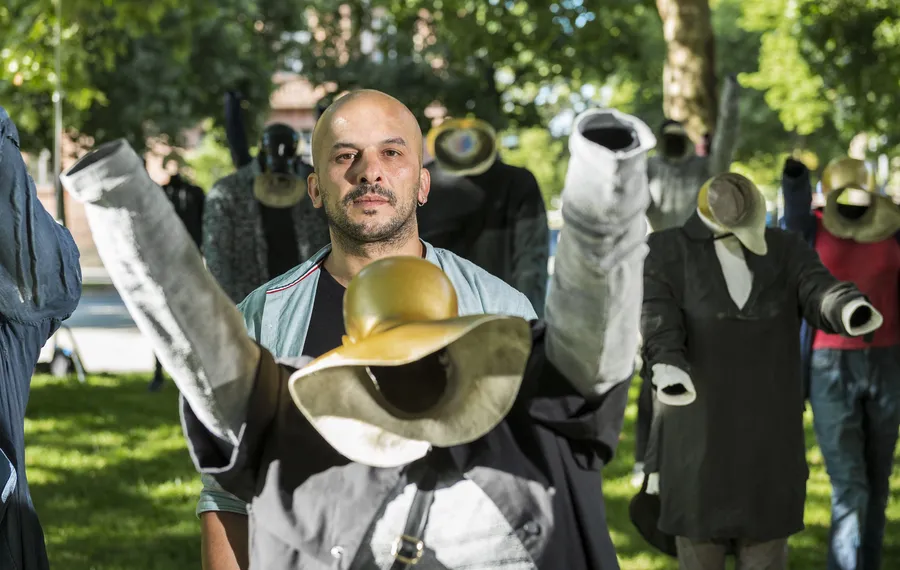
Salzburg Global Fellow Khaled Barakeh reflects on what "Democracy on the Front Lines" means to him and his work
This op-ed is part of a series, written by Fellows and speakers of the Salzburg Global Weekend, with the theme "Democracy on the Front Lines".
Democracy on the front lines is messy, complicated, and uncomfortable. In its ideal form, it is about inclusion, representation, and equality, but when one is on the front lines, these ideals often clash with the stark realities of power and injustice. This brings into question the very core of what we understand as democracy, which should push us to challenge the comfortable definitions of democracy we often cling to in “democratic countries”, especially since the establishment of United Nations organizations after the Second World War.
Perhaps the greatest challenge to this concept is the question of priorities. In some parts of the world where people are fighting for basic survival and human rights, can we truly talk about democracy in the same way? Can we prioritize voting and political participation when people are fighting against displacement, starvation, and violence? Can we blame them for not meeting the “Western standards” of democratic values? This doesn’t mean that democracy becomes irrelevant on the front lines. On the contrary, it becomes even more crucial. But it forces us to expand our understanding of democracy. It’s not just about political systems, but about human dignity, representation, and voice in all aspects of life.
“Democracy on the Front Lines” embodies the tension between the ideal and the real, between what we aspire to be and where we currently stand. It is about both participation and resistance—participation in structures that allow us to express our agency, and resistance against forces that seek to silence, marginalize, or oppress. These intangible front lines are where I engage in my work. I find myself constantly questioning and pushing against the boundaries of our societies, asking us to reconsider the status quo and inviting us to imagine new possibilities.
Art, for me, is more than just a tool for expression. It’s a lens, a megaphone, and a call to action, shaping and reshaping our understanding of society and our place within it. My front lines are the spaces where art, culture, and activism intersect with structures of power and marginalization. My front lines are not only in parliaments, local councils, and election booths. They are in galleries, studios, streets, refugee camps, and communities where people’s voices are often suppressed or ignored. Front lines should not be limited to physical spaces but extend into the realms of thought, perception, and dialogue.
Take my project “The Untitled Images,” for example. By removing the subjects from press photos of Syrian victims, I wanted to challenge the dehumanizing effects of media portrayal, to give back individuality to those reduced to mere statistics. This was my way of questioning the democratic principles of representation and voice: who gets to be seen and heard, and who doesn’t? Likewise, my “Syrian Biennale” initiative was a response to the lack of representation in the art world. I wanted to create a platform where artists outside the mainstream could be seen and heard. Here, the challenge was to the democratic principle of equality: why do some voices dominate while others are marginalized in art and elsewhere?
In essence, “Democracy on the Front Lines” to me is about active engagement, not passive acceptance. It is about questioning, challenging, and pushing back against the dominant narratives and structures that govern our societies. It’s about making space for marginalized voices, fostering inclusivity and dialogue, and building empathy. It is less about formal political structures and more about the daily fight for dignity, voice, and representation. It’s about challenging the mainstream narratives that often exclude the marginalized and voiceless.
Khaled Barakeh is a Berlin-based conceptual artist and cultural activist. Driven by his observations of longstanding social injustice, Khaled approaches creative practice as a tool for societal change; manipulating commonplace visual and cultural touchstones to expose and undermine stagnant power structures. In a recent major shift in his practice, Khaled developed coculture in 2017 - a non-for-profit umbrella organization with a suite of initiatives that leverage artistic thinking to directly address issues of contemporary mass migration. Among these projects is the SYRIA Cultural Index and the Syrian Biennale. Khaled has exhibited at Hamburger Kunsthalle, The 11th Shanghai Biennale, The Frankfurter Kunstverein, Salt Istanbul, The Busan Biennale, State Gallery of Lower Austria, Krems and MKG Hamburg, among many others. He graduated from the Faculty of Fine Arts in Damascus, Syria, in 2005, completed his MFA in 2010 at Funen Art Academy in Odense, Denmark, and a Meisterschuler study in 2013 at the Städelschule Art Academy in Frankfurt, Germany.
