

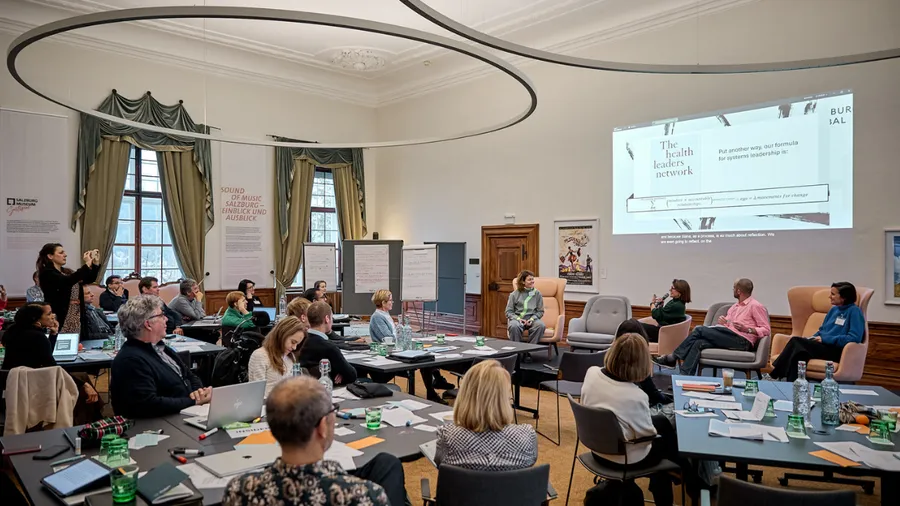
Cohorts 6 and 7 meet in Salzburg to exchange learning, strengthen bonds, and advance their Sciana Challenges
Toward the end of November, Sciana: The Health Leaders Network returned to Schloss Leopoldskron for Cohorts 6 and 7’s latest residential meetings.
Cohort 6’s final residential meeting brought Fellows together for an intensive three-day programme dedicated to consolidating their learning and strengthening their systems leadership for new forms of health, care, and well-being across Europe.
Cohort 7, meanwhile, built on the foundations of their first gathering. They strengthened their bonds within working groups, sharpened their problem framing, and continued to make progress toward their two-year Sciana Challenge.
The Exchange
Both cohorts had an overlap day during the week known as “The Exchange”. The purpose of this day was for Cohort 6 to present the culmination of their challenge work, key learnings, practical recommendations, and reflections on leading systemic change to Cohort 7.
The day began with an interactive session exploring population health innovations. Fellows became acquainted with new principles, hyperlocal approaches, and community partnership models.
Pedro Delgado, a vice president of the Institute for Healthcare Improvement, and Cohort 7 Fellows Bola Owolabi and Minal Bakhai shared perspectives from their experience. This session was followed by an activity exploring how to enhance leadership in public health emergencies.
Led by João Rangel de Almeida, global health emergency corps partnership officer at the World Health Organization, and Sciana Advisor Lothar H. Wieler, Fellows participated in an interactive, scenario-based exercise in which they played the roles of insiders and outsiders responding to a crisis.
The afternoon was spent with Cohort 6 sharing their challenge work, learnings, and experiences with Cohort 7. This included presenting outputs of their working groups on health prevention, childhood obesity, and end-of-life care.
In addition to these outputs, Cohort 6 shared themes and learnings that encapsulated their two-year programme. Fellows spoke about the benefit of having a rooted purpose, and ensuring inclusion remains a part of people's leadership. Additionally, Fellows discussed how powerful stories can motivate change and how having fun can help you go further.
Cohort 6 shared a core message linked to their Sciana Challenge: “As a group of purpose-driven leaders, we will tenaciously create space for accountable relationships and encounters and co-create powerful stories that move systems towards new forms of health and wellbeing.”
The day concluded with Lothar Wieler delivering a Sciana Lecture on "Leadership lessons in the response to COVID". Afterwards, Mirjam Lämmle offered a Fellow reflection, followed by Lothar joining Jennifer Dixon for a post-lecture conversation.
In the evening, both cohorts attended a reception, a celebratory dinner, and an exceptional concert performance by Songhaven, featuring mezzo-soprano Vivien Conacher and soprano Hazel McBain.
Systems leadership for new forms of health, care and wellbeing
Cohort 6 arrived in Salzburg ahead of Cohort 7 on November 23. As well as focusing on their Sciana Challenge, this meeting was a chance to revisit the personal and collective dimensions of leadership they’ve developed.
On their first full day, Fellows considered how their leadership had evolved during the programme, how they manage conflict and difference, and what they are proud of as leaders but rarely celebrate.
They also reviewed opinion pieces they had written ahead of the meeting, in which they were asked to share their thoughts on leadership. Navdeep Sidhu, marketing and communications manager at The Health Foundation, provided advice on how they can better craft their messages and reach the right audiences.
The day concluded with a post-dinner discussion where Fellows reflected on their personal experiences during the programme, their aha moments, and how to maintain their community moving forward.
On Tuesday, Fellows participated in an interactive session led by John Thomson, during which they explored a fictitious scenario in which a new technology is implemented across a hospital group.
Initially, they worked in small groups to consider micro, meso, and macro-level perspectives from different stakeholders. They then came together in a fishbowl discussion to explore tensions, synergies, and opportunities across the system.
The afternoon featured a session led by guest speaker Pedro Delgado, and Sciana Advisor Alwen Williams. They led a session on the relational foundations of systems leadership, exploring how leaders shape culture and create the conditions for collaboration.
Commenting on the cohort and his experience, Pedro said, “[It is] a great group of deeply committed individuals who’ll go back home to continue to build even better bridges for positive impact [...]”
Systems leadership for population health in times of scarcity
Following a lively overlap day, the second day of Cohort 7’s second residential meeting began with Fellows reflecting on their leadership style, systems change, and how to unlock new insights about their Sciana Challenge.
Having updated their shared values, Fellows were then asked to consider how they wish to improve their leadership and the disruptive trends they may face.
To aid them, programme co-lead David Behan led a session exploring a range of leadership styles and how to identify which style suits different leadership challenges.
In the afternoon, Fieke Oostvogel, a strategic adviser for change at GGD Amsterdam, delivered a presentation on system change approaches to health promotion, reflecting on experiences in Amsterdam. Commenting on the cohort and her experience, Fieke said it was a “pleasure” to join the meeting.
She added, “It was great to share our latest insights from Amsterdam’s health inequity and health transition work and to hear how others are working on similar challenges in their own contexts. I really appreciated the open conversations, the exchange of experiences on systems leadership and the chance to meet so many inspiring people.”
The day concluded with a problem-framing workshop relating to the group's Sciana Challenge. This was an opportunity to explore new perspectives on bottleneck issues and debunk assumptions. The workshop aimed to uncover and work through leverage points and new possibilities to foster wider change.
Across Cohort 7’s second residential meeting, each working group had several opportunities to present its progress and receive constructive feedback, including from Cohort 6.
This feedback led each working group to make changes to its approach or focus ahead of a final presentation on Friday afternoon. The three working groups are now working in the following areas:
- Building trust for wellbeing through narrative, focusing on people’s hesitancy in participating in clinical trials
- Enabling decision-makers to understand and use public-private partnerships successfully to address resource scarcity, rising demand, and complexity driven by increasing challenges of non-communicable diseases
- Identifying leadership development needs to help reduce health inequalities and improve population health by looking at different leaders’ areas of influence
Cohort 7 will continue to work on these topics ahead of their third residential meeting in May 2026 - a meeting which usually provides space for idea testing, prototyping, and the chance to gain support from communication experts.
“Innovation is not just about adopting tools”
Reflecting on both meetings, Louise Baker-Schuster, chief strategy and partnerships officer at the Sciana Network, said, “From the very first session, we asked [Cohort 6] to trust the process. And they did — showing up with dedication, curiosity, and a relentless focus on outcomes. They challenged and supported one another, building the kind of trust that allows for vulnerability — and that is where real leadership growth happens.
“Mid-week, Cohort 6 and Cohort 7 came together, a real highlight for everyone. Two cohorts at different stages, sharing questions, experience, and energy; Cohort 6 reflecting on how to move from insight to implementation; Cohort 7 beginning to explore what systems leadership for population health means in their own contexts and working groups.
“Across those conversations, one shared insight emerged clearly: innovation is not just about adopting tools — it’s about redesigning care pathways, building integrated community-based models, and creating population-level value to ensure real impact. “We were also reminded that meaningful innovation needs vision, relationships, and a deeply rooted sense of necessity. That we don’t need to boil the ocean. And that clarity often comes through conversation.”
