

Salzburg Global Fellow Shaireen Rasheed writes about engaging youth to create decolonial spaces of change
This op-ed article was written by Shaireen Rasheed, who attended the Salzburg Global Center for Education Transformation program "Civic and Civil Education: Identity, Belonging and Education in the 21st Century" from November 14 to 19, 2023. Shaireen's attendence was made possible thanks to the generous support of William J. Reckmeyer and Joan Reckmeyer through the Reckmeyer Family Fellowship.
“Democracy is a commitment, a conviction, a principle, a star to steer by in the unmapped sea. It is not what we have or what we are. Perhaps it is, at its best, what we long to be.” - Anne Norton
In her book, “Wild Democracy: Anarchy, Courage, and Ruling the Law”, Anne Norton perfectly reflects the state of democracy in our current time as a messy, non-linear concept and one that as Samuel McIlhagga states, "escapes narrow partisan concerns and geopolitical positioning.’’
Political Apathy Among Youth
November 5th, 2024 was election day in the U.S., a country I have called home for the last 40 years. This election sealed the fate and democratic future of the country, which is increasingly polarized in its political ideologies and partisan apathy.
The tenor of this apathy was reflected in the apolitical and often frustrated stance of many of my university students toward the upcoming elections. In the months preceding the election, I encouraged my students to vote in the most important election of our time.
According to the Center for Information and Research on Civic Learning and Engagement, only 42% of young voters cast ballots in the 2024 presidential election; this represents a lower youth turnout than in the 2020 election, while youth voter turnout in battleground states was higher.
Nevertheless, I remain hopeful that if political candidates can resonate with issues important to young people, then they will overcome their political apathy and exercise their right to vote.
The Puzzle of Youth Disengagement
This quest to increase youth's voices in political institutions across the globe and the role of youth involvement as a challenge facing democracy was a key area of focus of the Salzburg Global program on "Civic and Civil Education: Identity, Belonging and Education in the 21st Century" in November 2023.
One of the outputs from the program was a discussion during the Learning Planet Conference. Our panel reflected viewpoints of the panelists as diverse as the countries they represented: Pakistan, India, Austria, the United States, Africa, Germany, and more.
We brought up questions such as: Why are certain groups like the younger generation disassociating with politics and political processes, including the act of voting in democratic elections? Is there a link between representation and democracy? And if so, how can we create inclusive democratic spaces where marginalized stakeholders of democracy feel represented?
My current research is a continuation of the questions that were posed by our panelists. It explores the role of apathy and disengagement by youth in voting and participatory democracy.
Gerardo Berthin, the Vice President of International Programs at Freedom House, addressed the role of youth apathy in democratic elections. His research elucidates that “democratic backsliding” by youth has become a global trend. This suggests that young people are increasingly disengaged from political life: they are voting less, rejecting party membership, and perceiving that their country’s leaders are not serving their interests.
A Resurgence of Youth Activism
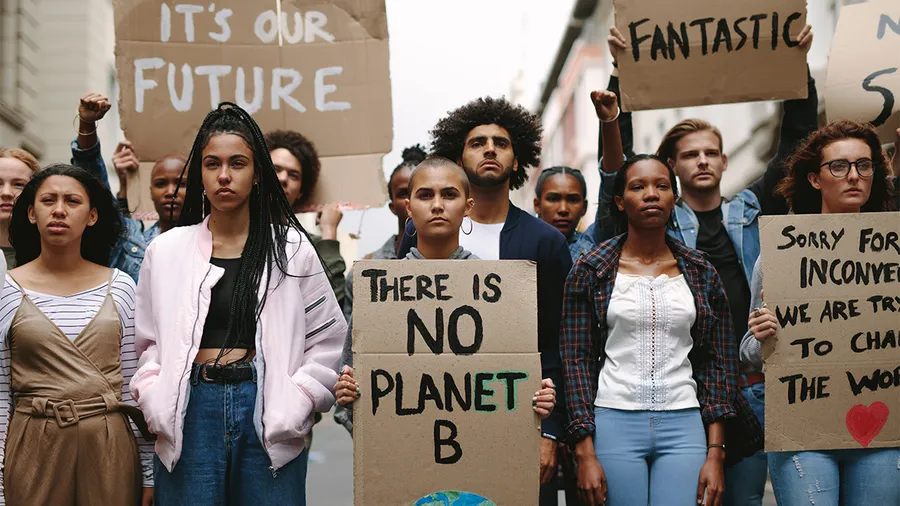
At the same time, we are seeing a resurgence of youth political activism outside the traditional political structures and institutions . These so-called “apathetic” students are fully and actively engaged in exercising their rights to protest. They attend demonstrations, use the internet to make their voices heard, and are actively engaged in businesses, schools, and religious communities.
The youth protests that started in the United State in 2020, part of the Black Lives Matter movement after George Floyd’s murder, ignited activism throughout the world against police brutality.
Another example was the high school "student walkout of class’” movement in the United States in 2016 and 2023, which demanded more restrictive gun laws. The Climate Students Movement is also an excellent example of how youth are mobilizing around the issue of climate change, which effects them directly.
The most recent “student encampment protests” across universities show that young students want to participate in civic life by speaking out against the genocide in Gaza. Bangladesh is another case where, in 2024, disfranchised students protested the nepotism of their Prime Minister Sheikh Hasina and successfully removed her from office.
Across the world, it is clear that Gen Z’s are increasingly using the language of participation and activism to stay engaged in issues that affect them and are close to their heart.
Creating Civic Spaces of Transformation
Perhaps the question we should be asking as educators is not why youth are apathetic and dissatisfied with democracy, but rather how we can create civic spaces of transformation in our educational, political, and social institutions that bring youth back into the political fold?
Drawing from Meghan Tinsley’s research on "Decolonizing the civic/ethnic binary", young people's experiences of belonging and exclusion across multiple and diverse national contexts offers them a critical perspective on national citizenship. This view rejects the binary thinking of either assimilated or alienated, or only belonging to one national identity.
My own research suggests that it is possible to rethink democracy outside the dichotomy of civic/ethnic nationalism discourse in favor of a more participatory, intersectional, non-western and decolonial framework. By doing this, we can work towards the goal of empowering disenchanted youth and include them in politics to achieve truly democratic systems.
Shaireen Rasheed is a professor of Philosophy, Education and Diversity/Social Justice at Long Island University in New York. She is also a a visiting professor at the University of Heidelberg of Education in Germany. She was a Fulbright visiting professor at the University of Salzburg and was a visiting scholar in the Department of Philosophy at Columbia University. She was also visiting fellow at the Harvard Divinity School, New York University, and the Columbia Law School.
