-
Topics
TopicsOur programs create spaces where open-minded leaders can gather for breakthrough conversations on pressing global issues – each aligned to one of the following pillars:Get Involved
-
Events
EventsExplore the variety of events Salzburg Global hosts within Austria and in the rest of the world. Learn more about our programs and what else happens at Schloss Leopoldskron.
- Insights
-
Fellowship
FellowshipSince 1947, more than 40,000 people from over 170 countries have participated in Salzburg Global's sessions. Collectively, these alumni are known as Salzburg Global Fellows.
-
About Us
About UsSalzburg Global is an independent, non-profit organization committed to creating spaces that overcome barriers and open up a world of better possibilities.Our Approach
-
Support Us
Support UsYour generosity helps us gather open-minded leaders for breakthrough conversations, while creating space for dialogue that overcomes barriers and opens up a world of better possibilities.
- Donate

- Published date
- Written by
Share
General
Update
Conversation Changers: Peace Through Power
Published date
Written by
Share
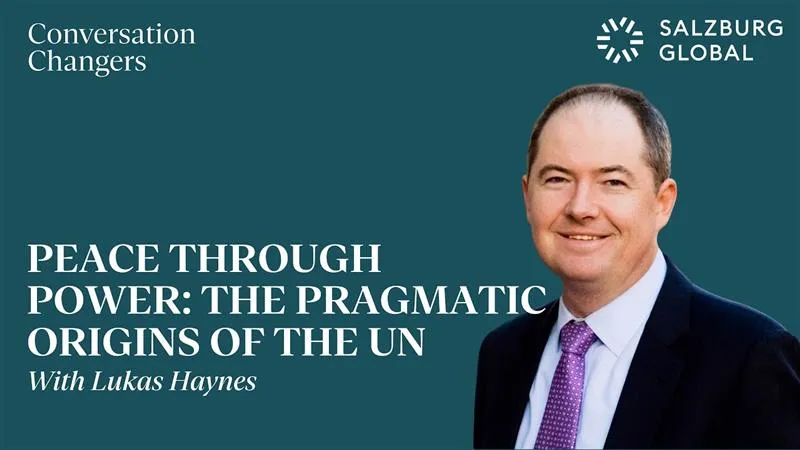
Conversation Changers, Salzburg Global's podcast, brings together thought leaders, artists, policymakers, and change-makers from around the globe to reframe dialogue, explore new ideas, and imagine better futures.
"Is the United Nations a failing experiment in idealism, or a misunderstood tool of global power?" — Lukas Haynes
In this episode of Conversation Changers, host Eric Olander is joined by Lukas Haynes, a Salzburg Global Fellow and author of the provocative new book "Peace Through Power: FDR’s Military Leaders and the Pragmatism of the UN Charter.”
As the UN faces what Secretary General Antonio Guterres calls a risk of imminent financial collapse and a deepening crisis of legitimacy, Lukas argues that we must look back to the organization’s founding to understand its future. Far from being a project of world government, Lukas reveals how the United Nations was meticulously designed by Franklin Roosevelt and his top military brass as a pragmatic framework to manage great power relations and prevent World War III in the atomic age. He challenges modern conservatives and internationalists alike to reconsider the UN not as a "woke" or bloated bureaucracy, but as an essential, cost-effective bargain for maintaining global stability.
Highlights From This Episode:
- The Myth of Idealism: Why the UN was built on Realpolitik and national security interests rather than pure international law.
- The Military Architects: The overlooked role of US generals and admirals in negotiating a charter that protected American sovereignty.
- The China Foresight: How Roosevelt and his team anticipated China’s rise as a global power 80 years ago.
- The Veto and Reform: Why the design flaws of the Security Council are so difficult to change, and whether the organization can survive without full US engagement.
- A New Global Map: The radical proposal to move UN agencies out of New York to better reflect a multipolar world.
Continue the Conversation
Click here to subscribe to Conversation Changers on your favorite podcast platform and join the conversation on social media using #ConversationChangers and tag @SalzburgGlobal.
Follow Lukas Haynes on LinkedIn and explore his book, "Peace Through Power: FDR’s Military Leaders and the Pragmatism of the UN Charter.”