-
Topics
TopicsOur programs create spaces where open-minded leaders can gather for breakthrough conversations on pressing global issues – each aligned to one of the following pillars:Get Involved
-
Events
EventsExplore the variety of events Salzburg Global hosts within Austria and in the rest of the world. Learn more about our programs and what else happens at Schloss Leopoldskron.Upcoming EventsOct 19 - Oct 22, 2026Peace & JusticeThe Collective Action Problem: How Should Democratic Societies Respond to Increasing State Violence without Exacerbating Polarization and Political Violence?Violent Threats to Democratic SystemsOct 21 - Oct 25, 2026Peace & JusticeDemocracy Across the Frontlines: How Can Democracy Movements Collaborate To Build Resilience Across Borders?Democracy Resilience Forum
- Insights
-
Fellowship
FellowshipSince 1947, more than 40,000 people from over 170 countries have participated in Salzburg Global's sessions. Collectively, these alumni are known as Salzburg Global Fellows.
-
About Us
About UsSalzburg Global is an independent, non-profit organization committed to creating spaces that overcome barriers and open up a world of better possibilities.Our Approach
-
Support Us
Support UsYour generosity helps us gather open-minded leaders for breakthrough conversations, while creating space for dialogue that overcomes barriers and opens up a world of better possibilities.
- Donate

- Published date
- Written by
Share
Peace & Justice
Opinion
Brazil's Democracy in the Age of Artificial Intelligence
Published date
Written by
Share

Key takeaways
- With Brazil's general elections approaching in October 2026, concerns over the spread of misinformation and disinformation are growing.
- Electoral courts have shared their concerns about artificial intelligence fueling fake news, but courts' interventions have drawn anti-censorship concerns from the public.
- AI-enabled misinformation and disinformation is likely to challenge the 2026 electoral cycle, as regulatory and monitoring authorities struggle to track and remove algorithmic influence.
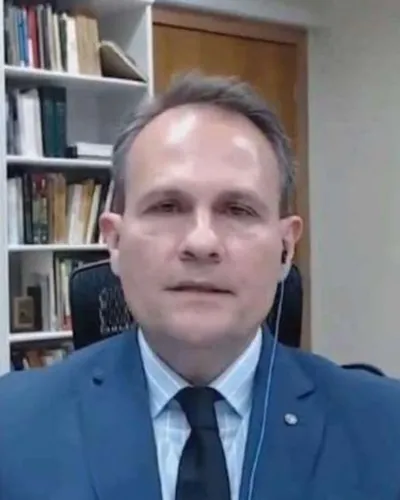
This article was written by Salzburg Global Fellow Marcio Schiefler Fontes, who attended the Pathways to Peace Initiative session on "Democracy on the Frontlines: How Can Democracies Defend Themselves?" in April 2026.
The views expressed here belong to this Fellow individually and should not be taken to represent those of any organizations to which they are affiliated.
From its last authoritarian regime (1964-1985) to the present day, Brazil has gone through a journey that evokes, as in many democratic nations, growing political divisions. On October 4, 2026, general elections will determine, for another four-year constitutional cycle, several consequential political positions: the president, vice president, members of the National Congress, the governors, vice governors, the legislative assemblies of all 27 States, and the district council of Fernando de Noronha in the Atlantic Ocean.
Mis- and disinformation, which is defined as false or misleading information deliberately created and shared to deceive, is not a contemporary invention, but rather a long-standing tool used to influence public opinion, cause harm, or achieve political goals. In recent years, however, the ease and almost universal use of social networks has fostered and generated a great deal of concern about the proliferation of false and misleading news on social media.
Even though universities, civil society, and governments at all levels reflect on these issues, starting with the basic question of “why people share such misinformation,” and seek solutions to reduce its spread, it seems beyond doubt that the veracity of headlines has little effect on sharing intentions, despite having a large effect on judgments of accuracy. This suggests that the act of sharing does not necessarily indicate personal belief.
As we know, we have reached a time when almost anyone can generate text, images, audio, or video in seconds using features already built into platforms such as search engines, social networks, mobile apps, and conversational assistants, since technical knowledge and infrastructure are no longer necessary: the barrier to entry has fallen dramatically, including for the production of misleading or manipulated content.
On the other hand, AI allows the use of even more ubiquitous tools, so that – to mention only the business field – it has been rapidly adopted by companies (and their employees), developers, and members of the public, creating a myriad of new attack surfaces for threat actors. Both sanctioned and unsanctioned AI agents are proliferating, and cyber security leaders and defenders are struggling to identify all of these new touchpoints and implement effective controls.
While AI content creators primarily create videos for social media, they also create content to simulate conversations using AI-generated text and video, as well as fake selfie videos attributing statements to celebrities or politicians. In Brazil, as well as in other countries where democracy has been challenged, electoral authorities deal with widespread mis- and disinformation at both national and regional levels.
The Brazilian Superior Electoral Court is the judicial body responsible for elections in Brazil which oversees electoral courts in all 27 states, including the one I belong to. It has repeatedly shared its concerns and continuously evaluates heavy fines for the use of AI in creating so-called fake news. Experts, however, are skeptical and say any measures to combat mis- and disinformation through official or educational communications must recognize that simply issuing a lengthy denial is unlikely to work.
In the Brazilian legal system, freedom of expression does not constitute an absolute shield for strategies such as flooding. Courts must balance it with other fundamental values, such as fairness of elections, and they may take measures against what they consider mis- and disinformation. Yet, courts’ interventions have elicited anti-censorship concerns from the public.
Indeed, both mis- and disinformation can flourish in such an environment, and it is unlikely that any regulatory or monitoring authority will be able to effectively and consistently track and remove all such algorithmic influence. Political polarization and increasing distrust of institutions in Brazil are also likely to contribute to a demanding information environment in the lead-up to the 2026 election.
In short, Brazil has implemented a regulatory framework around the use of synthetic media in electoral campaigns, including banning deepfakes, chatbots simulating candidates, and false content. Enforcing these prohibitions while holding free and fair elections in a democratic environment, however, is increasingly difficult, and AI-enabled mis- and disinformation is likely to challenge the 2026 electoral cycle.