

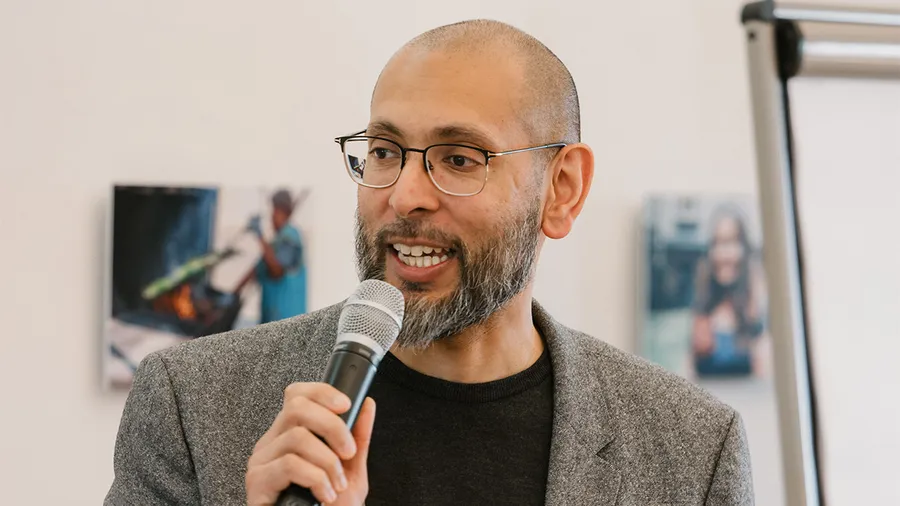
Faisal Naru delves into how observing human behavior can optimize policy and the significance of convening
Faisal Naru is a leader, implementor, and thinker with over twenty years of experience in organizational management, public policy, and international development. He is the founder of Think Test Do, which is a learning, discovery, and enhancement partner to organizations globally.
This interview has been edited for length and clarity.
Namrata Bhandari, Salzburg Global Communications Intern: How would you introduce yourself and describe your work?
Faisal Naru, Founder and Director of Think Test Do: I would introduce myself as somebody who is passionate about understanding why people do what they do and trying to find solutions to complex problems, and that's largely been the theme in my career.
NB: Can you reflect on any significant experiences that have affected how you lead?
FN: The most meaningful experiences that you have are those experiences that you have witnessed yourself. Unfortunately, we know through behavioral science that we remember harm more clearly than we remember good. I have learned more from witnessing bad leadership as compared to good leadership. That is a normal thing that happens among people. The other side of this, which is probably more positive, is that you can use this to focus on creating an environment for growth, a mindset of learning, enabling a good environment for your staff and trusting them. The significant experiences that I have had in trialing and testing those have been positive, and that has been very reaffirming about trusting people, empowering them, and letting them grow and develop.
NB: How would you explain behavioral insights to someone who is unfamiliar with the term?
FN: I would describe behavioral insights in two ways. A very simplistic way of describing it would be that it seeks to understand why people do things and behave in certain ways. But there is a more technical aspect to it, the way that it has spread across the world, particularly in public policy, and given rise to the behavioral public policy movement. Firstly, it leverages a wealth of knowledge, the wealth of the social sciences, cognitive sciences, decision-making, and design thinking. So, it has empirical foundations. Secondly, it introduces and tries to mainstream the notion of experimentation in public policy. Thirdly, it applies the inductive approach to problem-solving, which essentially starts with no assumptions, and no hypothesis and attempts to induce results and find out what's going on. Instead, you start with a blank slate.
NB: How would you use behavioral insights to affect policymaking and public policy?
FN: One of the most powerful uses of behavioral insights in public policy is in diagnosis and truly understanding what is going on. Why are people behaving in a certain way? Why aren't they doing what we want them to do? Why are they not recycling? Why are they speeding on the roads? Why? You keep asking the question "why" to try and find out the cause of the behavior. Behavioral insights can also be used for policy evaluation, which is closely linked to diagnosis.
NB: What do you hope to learn from the 2023 Annual Strategic Foresight Retreat and the Fellows attending it?
FN: I want to understand where people are at. We are all dealing with similar issues, but you rarely get the chance to sit and interact with peers from the field. It's compelling to sit down and brainstorm and share notes on what is working or what is not working, which direction we are going in, or what the most significant challenges are. There are those kinds of rich conversations that you can't have elsewhere but can certainly have in this type of environment. It's a luxury to be able to spend time with all these fantastic Fellows and to be able to try and come up with ideas so that when we all depart, we have a fresh impetus, which can be quite challenging when you're dealing with these complex problems. You form connections with people, which hopefully means that you can rely on them, and you reinvigorate your motivation to do what you love to do, which is helping people and improving governance.
Faisal attended the 2023 Annual Strategic Foresight Retreat, which enables senior public sector leaders to speak openly among peers about major disruptive forces confronting governments. We spoke to him during this program on May 22-24, 2023.
The 2023 Annual Strategic Foresight Retreat is part of the Public Policy Strategy Network.The Annual Strategic Foresight Retreat is supported by the Abu Dhabi Office of Strategic Affairs, in collaboration with apolitical.
