

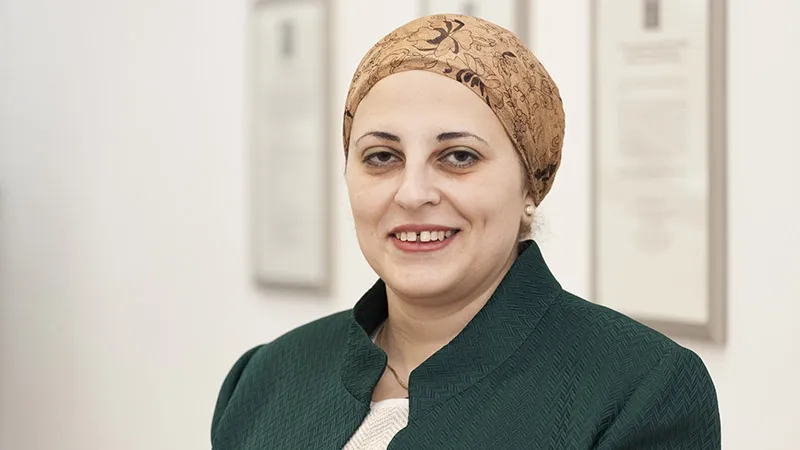
Egyptian Health Ministry consultant shares how contacts made at Schloss Leopoldskron have influenced her work
Amel Farrag is very happy to be back at Schloss Leopoldskron, just over a year after her first Health and Health Care in the 21st Century session.
While participating in Session 548 | The Promise of Data: Will this Bring a Revolution in Health Care?, she spoke to Salzburg Global about how her time in Austria has shaped her work as a quality consultant for the Ministry of Health and Population in Egypt.
She has fond memories of her first visit to Salzburg in December 2013 for Session 507 | The Drive for Universal Health Coverage: Health Care Delivery Science and the Right to High-Value Health Care.
“It was a very interesting experience,” she said. “I learned a lot from my colleagues about universal health coverage.
“I discovered the work the World Bank and Salzburg Global Seminar are doing to bring all countries together sharing information, knowledge and experience of how to develop universal health coverage, especially in Lower and Middle Income Countries.”
The contacts made at Salzburg Global laid the groundwork for the formation of Egypt’s first national task force for governance, where Farrag serves alongside the three other Egyptian Fellows who attended the session.
She said: “The idea started at Salzburg Global Seminar with the Egyptian team and the World Bank, and we talked to our minister who developed this task force. We have developed a patients’ bill of rights and discussed many other subjects.”
While Farrag credits Salzburg Global faculty member, World Bank Senior Operations Officer Marilou Bradley for mentoring her work since she returned home from Salzburg in December 2013, she has continued to build a valuable network among the participants of Salzburg Global’s Big Data session.
“This session is very, very interesting,” she said. “I’m so fascinated by the knowledge and experience I can learn and share with all these experts in data management and quality, in health care delivery. I have learned a lot and I thank Salzburg Global Seminar for giving me this chance to learn from these expert people.
“I work to develop quality in Egypt, and I have met many experts who can help me,” she said. “I have a design in my mind, and they are helping me to improve my design to create a new quality department. I hope to carry it out when I go back to Egypt.
“We collect data and analyze it to develop new protocols for health care delivery in Egypt. We analyze the results after implementing these protocols, and we can use these results for continuous improvement.”
Farrag says this improvement is necessary given the challenges surrounding health care in her country.
“In Egypt we are still some distance away from quality, from understanding how health care delivery science can be developed. We are facing many problems, like funding.
“We have many hospitals and primary care centers suffering from a shortage of doctors and nurses. We need to improve their skills and practices to improve health care outcomes in Egypt.”
Amel Farrag was a participant at the session The Promise of Data: Will This Bring a Revolution in Health Care? The session is part of the Salzburg Global series “Health and Health Care Innovation in the 21st Century” and was held in collaboration with the Mayo Clinic, Arizona State University, The Dartmouth Center for Health Care Delivery Science, and in association with the Karolinska Insititutet. More information on the session can be found here: www.salzburgglobalseminar.org/go/548
