

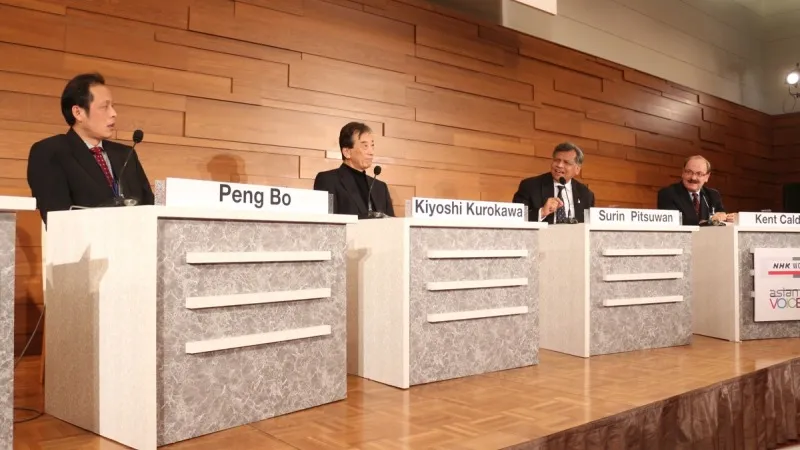
Expert panel offer their insights at Tokyo Public Forum
In November 2013, 28 specially selected Salzburg Global Fellows presented their visions for 2030 at an open public forum in Tokyo, Japan (read more here), which was the culmination of the joint Salzburg Global Seminar-Nippon Foundation session People, Peace and Planet in 2030: Shaping Inclusive and Sustainable Growth.
Also speaking at the open event were a panel of expert speakers, moderated by Salzburg Global Fellow and senior commentator for Japan’s national broadcaster NHK’s English-language channel NHK World, Aiko Doden. The panel was filmed as part of a special edition of NHK World’s flagship show “Asian Voices”, which was broadcast across the world on February 9.
Speakers at the public forum included Surin Pitsuwan (former Secretary General of ASEAN), and Peng Bo (Vice Dean, School of International and Public Affairs, Shanghai Jiao Tong University in China), who also led plenary sessions in Kyoto, as well as Kent Calder (Professor and Director of the Edwin O. Reischauer Center for East Asian Studies at the John Hopkins School of Advanced International Studies in Washington, DC, USA); and Kiyoshi Kurokawa (Chairman of the Fukushima Nuclear Accident Independent Commission), who delivered a keynote speech ahead of the debate.
In his keynote, Kurokawa highlighted some of the major changes the world has seen in the past few decades, thanks to technological innovations, political upheavals and shifts in social norms.
Two decades ago, the Internet didn’t exist. Seventeen years ago the founders of Google were still studying at Stanford and Apple was facing bankruptcy having fired Steve Jobs. What will we invent and change the world with in the next 17 years by 2030?
“The world has become flat – national barriers are becoming increasingly irrelevant,” said Kurokawa.
The world is currently in a major transition phase, he argued, and, thanks to the World Wide Web, much of the world’s population as well as its politicians are in near constant connection. But are we too “hyper-connected”?
A century ago, the population was 1.6 billion people, but today this figure stands at over 7 billion; can we really accommodate so many greedy people, asked Kurokawa. To sustain our increasing numbers, we will need to innovate and find new energy resources to replace our rapidly depleting and heavily polluting fossil fuels. “There must be an integral relationship between growth and energy,” he stressed.
Despite much discussion centering around potential conflicts in the region, particularly around the uninhabited but much disputed Senkaku/Diaoyu Islands, Kurokawa suggested that perhaps it was our rapidly growing population that was the “real weapon of mass destruction.”
Opening the panel debate, Doden asked the panelists what word or phrase or word best described their “ideal” (rather than likely) scenario for Asia in 2030.
For Calder, a leading academic and adviser in the area of Asian foreign relations, his answer was focused primarily on the geopolitical: “peaceful.” Former ASEAN Secretary General, Surin Pitsuwan hoped to see a “better sense of community,” with Bo adding that he wished to see the region be more “harmonious,” building mechanisms and relationships that not only bring about peace but also continue to maintain peace long into the future. Kurokawa echoed his own keynote, saying that his ideal scenario for Asia in 2030 would one that had embraced sustainability – and developed a broader sense of vision.
The world is now more interconnected technologically, but it has long since been connected environmentally – something that is often forgotten in the mix of competing national demands on energy supplies. The Fukushima-Daiichi disaster had been the first of its kind, especially given its proximity to the Pacific Ocean. Kurokawa called for greater international regulation of nuclear power stations and their operators to ensure that all power plants across the world met the same high standards necessary to ensure their safety.
“For some people growth is an ideology. If you don’t have growth, you don’t have legitimacy as a government,” said Pitsuwan. However, the energy resources needed to sustain this growth is an intensely geopolitical issue, pointed out Calder, bringing countries closer to disputes with each other as they chase after the same resources or face the fall-out from each others’ strive for progress, as with the numerous haze crises south-east Asia has seen in the past few years. Asia continues to face a “squeeze” between protecting the environment and continuing to grow economically.
“Our current balance of wealth is not sustainable,” added Pitsuwan, not only environmentally, but also politically and morally.
“A new concept of growth, wealth and prosperity needs to be established by the international community.”
2030 will be a third of the way into what was originally deemed “the Asian century”. Key to Asia’s success as a region in building sustainable and inclusive growth, and thus achieving all that was hoped for and expected of it, is to develop a greater network for more cooperation that goes beyond geopolitical and trade issues.
As one panelist pointed out, the “Three E’s of Asia” – environment, economic growth and energy security – are all mutually dependent.
