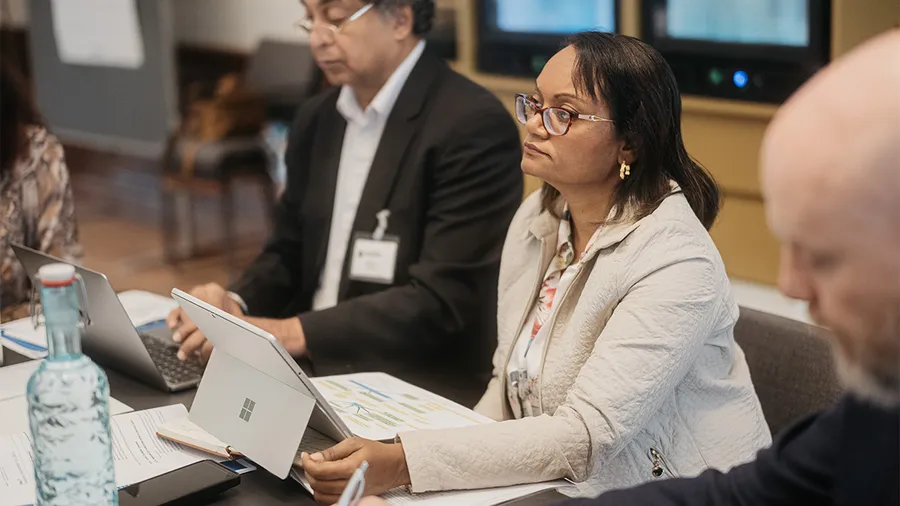
Omalisa Baldeo is the Acting Director of Research and Planning in the Ministry of Labour in Trinidad and Tobago. In her twenty-four-year career as a public policy professional, she has been actively involved in promoting national tripartite social dialogue, greater inclusion of persons with disabilities in the workplace, and providing inputs into discussions on Just Transitions in Trinidad and Tobago.
Audrey Plimpton, Salzburg Global Communications Associate: In one sentence, what does a just transition from oil, gas, and fossil fuels mean for Trinidad and Tobago?
Omalisa Baldeo, Acting Director of Research and Planning, Ministry of Labour, Trinidad and Tobago: A just transition from oil and gas means moving to an environmentally sustainable economy where decent jobs and sustainable livelihoods are created and protected and where we leave no one behind.
AP: What do you think are the most important factors that should be considered when planning and implementing just energy transitions?
OB: From my perspective, coming from the Ministry of Labor, I would say one of the first things we need to do is assess the labor market implications of a just transition. We know labor cuts across all spheres. We know that a just transition means there would be opportunities and there would be fallouts. We need to assess what skills might be required and what sectors might be in decline. We need to know what education and training opportunities need to be explored. We would also need to consider stakeholder engagement. Again, drawing from my experience in the labor sphere, social dialogue is the cornerstone of our policy, program, and project formulation. For any policy and any initiative to be developed, we need the input of governments, employers, and workers. Those are critical elements in planning. In the implementation phase, we need all actors on board as well. It is not just the government's responsibility to have just transition as a goal. We need all hands on deck.
AP: Is there anything needed specifically in Trinidad and Tobago to implement just energy transitions?
OB: Trinidad and Tobago is an oil- and gas-producing country. One of the major things that we need, and we have started, is to have a just transition policy. We have gone through a process of consultations with key stakeholders, including employers, trade unions, civil society, and academia, and we have developed a draft policy. Once approved, implementation of the policy will be critical to progress in promoting the just energy transition.
AP: What are the benefits of implementing just energy transitions, both in Trinidad and Tobago and worldwide?
OB: I believe implementing a just transition gives us an opportunity to right a number of wrongs. For one, it gives us an opportunity to have an inclusive approach to developing an environmentally sustainable economy where issues such as the gender dimensions of the just transition can be considered, where the impacts on workers, especially those in the informal economy, can also be considered. It gives us an opportunity to work together with a range of stakeholders as well as with multilateral institutions and with other countries to develop South-South cooperation initiatives as well as North-South and triangular cooperation initiatives. I think it's a very opportune time for us to engage in some of these initiatives.
AP: How can evidence-based research be better integrated into policymaking to ensure that just transitions are effectively implemented?
OB: First, through establishing communities of practice. I believe that this dialogue has given us a good base from which we have already started setting up our own small communities of practice to address it in specific areas. It can also be integrated through greater policy coherence. Given, for instance, [that] we have the labor research done in the labor sector, we have research on the environmental side and the energy side, it gives us that opportunity to bring together all the research. Just transition is like a converging, focused, multidisciplinary approach to climate change. It allows us to have that coherence among all the different sectors and bring great minds together.
AP: How can we better align international conversations and commitments with domestic policy planning and implementation?
OB: We are currently doing this in Trinidad and Tobago. As a member state of the International Labor Organization, we have participated in conversations in 2023 at the International Labour Conference on a just transition towards environmentally sustainable economies and societies for all. We also work closely with our colleagues in government ministries who participate actively in discussions at international energy conferences and climate conferences, such as the UN Climate Change Conference. Through this close collaboration, we have been able to understand that participation in international conversations should allow us to bring to the fore the multidisciplinary perspectives that shape actions related to just energy transitions, including those related to labor, employment, and social protection.
Omalisa Baldeo attended the “Policy Dialogue on Just Energy Transitions: Identifying Pathways to Prosperity Post Fossil Fuels” in September 2024.